
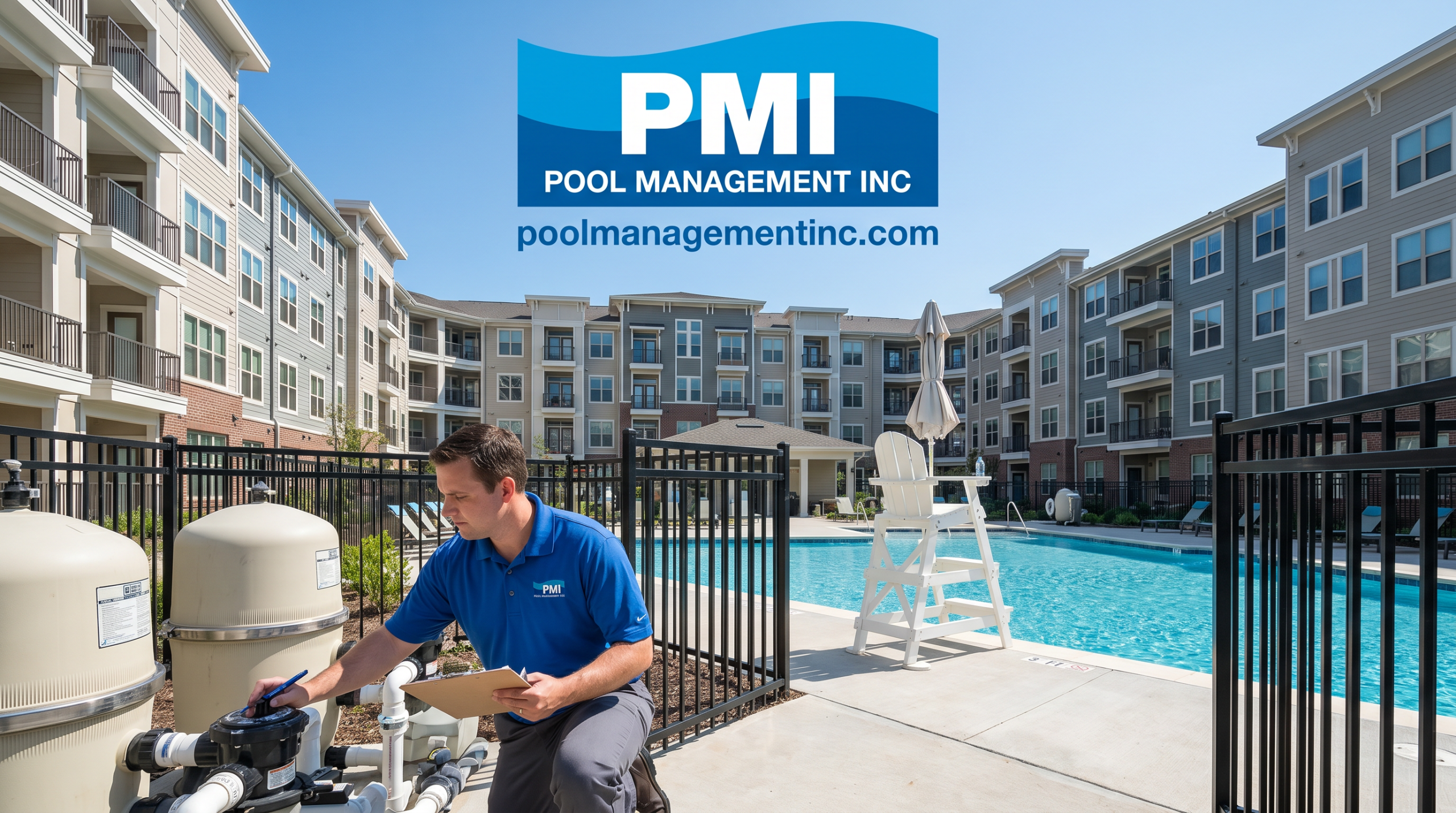
A property manager in Atlanta, Georgia opened her inbox on a Monday morning in June and found three messages waiting. The first was from a resident whose child had slipped on the pool deck Saturday afternoon. The second was from the Georgia Department of Public Health – a surprise inspection had flagged a chlorine reading 0.4 ppm below code. The third was from her “pool guy,” the one she hired to “take care of everything,” asking her to forward the inspection report because he wasn’t sure what the inspector wanted.
That’s the moment most facility owners realize something important: pool cleaning is not pool management. They are two completely different jobs, billed at two completely different rates, with two completely different outcomes when something goes wrong. If you’re weighing vendors right now, Pool Management Inc. runs full-scope commercial aquatic operations across eight states – and the contrast between management and maintenance is where every mid-season disaster begins.
Pool Management vs. Pool Cleaning: The Distinction That Costs People Money
A pool cleaning service skims, vacuums, tests chlorine, and leaves. A pool management company runs the facility as an operation. Here’s the real difference, side by side:
| Function | Pool Cleaning Service | Pool Management Company |
| Water chemistry | Basic chlorine/pH test | Full daily log with digital controller integration |
| Staffing | None | Certified lifeguards, CPO/AFO operators, supervisors |
| Compliance | Not their responsibility | Full state and county code compliance, documented |
| Inspections | You handle them | They prepare, host, and file the paperwork |
| Equipment | Visual check | Preventive maintenance schedule + failure alerts |
| Emergencies | Next business day | 24/7 on-call response with backup staffing |
| Documentation | Informal | Inspection-grade logs, incident reports, seasonal packages |
| Liability | On you | Shared, with commercial insurance and COI on file |
For the deeper comparison, the guide on commercial pool management best practices and pool management vs maintenance from a Charlotte perspective both break this down in operational detail.
The 8 Functions of a Modern Pool Management Company
Here’s the workflow a professional pool management company actually executes – every day, on every account:
| Step | Stage | Core Activities | Who Owns It | Output |
| 1 | Pre-Open | Safety check, chemistry test, equipment scan, deck inspection | Certified Pool Operator (CPO/AFO) | Pre-open log + green light to open |
| 2 | Staffing | Certified lifeguards on stand, operator on deck, supervisor check-in | Account Supervisor | Signed staff roster + certification verification |
| 3 | Operate | Bather-load monitoring, continuous chemistry, rule enforcement, rotations | Lifeguards + Operator | Live water-quality readings every 2 hours |
| 4 | Document | Digital chemistry logs, incident reports, inspection prep | Operator + Supervisor | Time-stamped digital records |
| 5 | Close | Equipment shutdown, deck sweep, chemical dosing, overnight log | Closing Operator | Closing checklist + overnight alarm set |
| 6 | Report | Client service summary, compliance filing, exception flagging | Account Manager | Weekly client report + filed compliance paperwork |
Certified Staffing and Lifeguard Services
A real pool management company sends a documented team – CPO or AFO credentialed operators, lifeguards certified by Red Cross, Ellis & Associates, or StarGuard, plus current CPR and AED. A dedicated account supervisor visits on-site, not just over email. Staffing depth is the single biggest operational failure point in this industry, so ask how many active, certified lifeguards are available in your region this week.
Water Chemistry and Chemical Management
Daily testing of chlorine, pH, alkalinity, cyanuric acid, and calcium hardness, plus automated controller calibration and corrective dosing. In 2026, the best operators log every reading digitally with time stamps and operator initials – those logs are what a health inspector asks for first.
Regulatory Compliance and Documentation
Federal law (the VGB Act) is the floor. State health departments and county codes are where citations actually happen. A real pool management company cites the specific regulation that governs your facility type and files the paperwork to match.
Equipment Operation and Preventive Maintenance
Pumps, filters, heaters, chemical controllers, VGB-compliant drain covers, and UV or ozone systems all run on scheduled service intervals, with flagged end-of-life components replaced before they fail mid-July. The piece on extending commercial pool equipment life covers the ROI side in depth.
Safety Audits and Risk Management
Deck inspections, signage and depth-marker audits, rescue equipment checks, EAP drills, and documented incident reports – all active, ongoing, and filed. Facilities in Virginia can see exactly what this looks like in the aquatic risk management strategies for Virginia pools guide, and the broader commercial pool safety standards article lays out the 2026 compliance baseline.
Seasonal Opening, Closing, and Off-Season Care
Opening a commercial pool is line pressurization, equipment commissioning, water balance from scratch, staff onboarding, and a signed pre-season compliance package. Closing is the mirror. The off-season is when the best companies do equipment overhauls – so you don’t pay emergency rates in peak season. The commercial pool maintenance checklist covers the full cadence.
Reporting and Stakeholder Communication
Weekly service reports, monthly compliance summaries, 24-hour incident reports, and board-meeting attendance when requested. You should never be the one discovering a problem first.
Emergency Response and Contingency Coverage
A real pool management company has a written response protocol, backup staffing depth, and 24/7 on-call operators. Everyone else has a phone tree and hope.
A Real-World Case: Denver HOA, Summer 2025
A 240-unit HOA in the Denver metro switched from a local pool-cleaning vendor to a full-scope management company in April 2025. Within six weeks, the new team caught a failing circulation pump before it seized, corrected an altitude-driven chlorine-loss issue their previous vendor had missed for two seasons, and passed a Tri-County Health inspection with zero citations. The board’s year-over-year comparison told the story:
- Citations: 3 (prior year) → 0
- Emergency repair calls: 7 → 1
- Resident complaints: 22 → 4
- Total annual cost: up 11%, with resident satisfaction up 58%
The difference wasn’t the water. It was the operation. Colorado operators face this kind of altitude-specific challenge routinely – covered in the Colorado resort pool management guide .
What a Pool Management Company Does, by Facility Type
| Facility Type | Primary Functions | Common Pitfalls | Learn More |
| HOA & Community Pools | Lifeguard staffing, state HOA code compliance, board reporting | Residential-grade service used on a shared amenity | Top HOA Pool Management Tips |
| Apartments & Multifamily | Pool attendants, key-card access, daily water balance | Under-staffed peak weekends | – |
| Resorts & Hotels | Guest-facing lifeguards, 7-day coverage, aesthetic clarity | Shoulder-season staffing gaps | Colorado Resort Pool Guide |
| Waterparks & Aquatic Centers | Multi-pool teams, ride audits, high-ratio lifeguarding | Underestimated holiday bather load | Maryland Waterpark Best Practices |
| Municipal & Public Pools | Public health code compliance, accessible staffing | Treating it as parks-and-rec overhead | – |
| Commercial / Mixed-Use | Full-scope management, COI, capital planning | Vague “full service” contracts | Commercial Pool Management Best Practices |
Service Area: Where This Work Happens Every Day
Pool Management Inc. actively operates across the eastern and central United States – Virginia, Maryland, Georgia, Texas, Colorado, Delaware, South Carolina, and the Charlotte, NC metro – with active commercial and HOA clients in each state this season. Scope of work shifts with the regulatory environment:
| State / Region | What the Job Involves | What Most Owners Underestimate |
| Virginia | VDH chemical logs, lifeguard ratios, incident reporting | How specific VDH enforcement has become |
| Maryland | County variation (Montgomery, Baltimore, Anne Arundel) | Compliance in one county ≠ the next |
| Georgia (Atlanta metro) | Annual DPH permit renewal, documented chemical logs | The permit process itself is part of scope |
| Texas (Houston, Dallas) | 25 TAC Ch. 265 – HOA pools = commercial | Residential service is not legally sufficient |
| Colorado (Denver metro) | Altitude-adjusted chemistry, faster chlorine loss | High-altitude water behaves differently |
| Delaware | DHSS oversight, limited in-state staffing | A license on paper ≠ boots on deck |
| South Carolina | DHEC water-quality reporting, detailed docs | Chemical testing ≠ DHEC compliance |
| Charlotte, NC | Mecklenburg County environmental health | County expertise matters as much as state |
The guide to keeping commercial pools compliant in South Carolina and the hiring lifeguards in Maryland breakdown both show how regional this work really is.
What It Doesn’t Do
A professional pool management company is not a general contractor, not a construction firm, and not an indefinite warranty on your equipment. Major renovations, structural repairs, equipment replacement beyond routine service, and guest-behavior enforcement sit outside the operational contract – though good managers coordinate the vendors who handle them. Clarity on scope is what separates a clean contract from a mid-season dispute, which is exactly what the long-term pool management contracts guide addresses.
How Much of This Is Automated in 2026?
More than five years ago – and less than the marketing suggests. Real automation today means digital chemical controllers with cloud logging, IoT-connected pumps reporting flow anomalies, scheduling software with certification tracking, and automated incident reporting.
What is not automated: judgment. The decision to close a pool in a thunderstorm, shock after a fecal incident, pull a lifeguard off stand for a suspected fracture, or push back on an inspector’s misread of the code – those are human calls, made by certified operators. Technology amplifies the work. It doesn’t replace the operator.
Frequently Asked Questions
What does a pool management company do day to day?
Certified operators test and balance water chemistry, lifeguards open the facility after a safety check, the supervisor reviews prior-shift logs, equipment is inspected, incidents are documented, and a service report is filed – with staffing, compliance, and client communication running in parallel.
Is a pool management company the same as a pool cleaning service?
No. Cleaning is a narrow maintenance task. Management is full operational, regulatory, and staffing responsibility. The full comparison is in the piece on what a pool management company does .
Do they provide the lifeguards, or do I hire them separately?
A full-scope pool management company provides, trains, certifies, and supervises lifeguards as part of the contract. Hiring them separately usually costs more and creates liability gaps.
What certifications should their team hold?
CPO or AFO for every pool operator, plus current Red Cross, Ellis & Associates, or StarGuard lifeguard certification with CPR and AED. Ask for documentation.
How much does a pool management company cost in 2026?
Small seasonal HOA pools run $15,000–$35,000 annually. Mid-size community facilities run $35,000–$75,000. Resort and multi-pool operations can exceed $100,000. Always compare on total scope, not base fee.
Can they handle compliance with my state’s health department?
Yes – a good one already is. They should cite the specific regulation governing your facility type and show sample documentation from a current client in your state.
What happens if a lifeguard calls in sick?
A written backup staffing protocol with defined response times – typically within hours. If the answer is “we’ll figure it out,” keep looking.
Get a Scoped Proposal for Your Facility – Not a Template
A pool management company in 2026 takes operational ownership of your aquatic facility so you don’t spend your summer reacting to problems you didn’t know you had. If you want to see what that looks like for your specific property – with a proposal that names the certifications on your account, the state code your facility falls under, the backup staffing depth in your ZIP code, and the exact scope line by line – submit a bid request with Pool Management Inc.
It takes under five minutes, there’s no obligation, and you’ll get a response scoped to your facility within two business days – covering Virginia, Maryland, Georgia, Texas, Colorado, Delaware, South Carolina, and Charlotte, NC .