
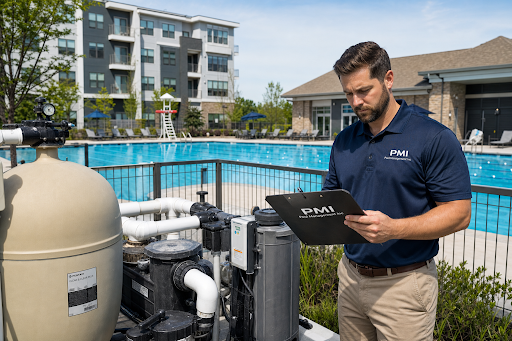
Commercial pool equipment rarely fails out of nowhere.
Most equipment problems build slowly. A pump runs under strain. A filter goes too long without service. Water chemistry drifts. A heater works harder than it should. A small leak gets ignored. Logs are incomplete, so no one sees the pattern until the facility is dealing with an emergency repair, a closed pool, and an expensive invoice.
That is why pool equipment lifespan management is not just a maintenance issue. It is an ownership issue.
Pool Management Inc. works with commercial aquatic facilities where equipment life is tied directly to pool cleaning, chemical management, inspections, documentation, repairs, staffing coordination, and seasonal planning. Clean water matters, but the real goal is bigger than appearance. The goal is to keep the facility safe, open, efficient, documented, and protected from preventable equipment failure.
For owners evaluating the larger role of a management partner, the Commercial Pool Management: A Complete Buyer’s Guide explains how full-scope support connects operations, safety, staffing, maintenance, and long-term planning.
Quick Answer
Professional pool management extends commercial pool equipment life by keeping water chemistry stable, maintaining proper circulation, cleaning filters on schedule, inspecting pumps and heaters, documenting equipment trends, and correcting early warning signs before they disrupt pool operations.
This creates a system where equipment issues are noticed earlier, assigned clearly, and handled with less guesswork.
For facility owners, CFOs, HOA boards, resort operators, and property managers, that means better repair planning, fewer emergency decisions, stronger documentation, and a clearer view of when equipment should be serviced, upgraded, or replaced.
Why Equipment Life Matters in Commercial Pools
Commercial pool equipment works harder than residential equipment.
Apartment pools, HOA pools, resort pools, aquatic centers, hotels, clubs, and community facilities often deal with longer operating hours, heavier bather loads, seasonal pressure, safety requirements, and higher expectations from residents, guests, and boards.
When equipment fails, the cost is not only the part.
| Equipment Failure | Direct Cost | Operational Cost |
| Pump failure | Repair or replacement | Weak circulation, cloudy water, possible closure |
| Filter failure | Cleaning, media, cartridge, grid, or replacement | Poor water clarity and chemical instability |
| Heater failure | Service call, parts, or replacement | Guest complaints and reduced pool usability |
| Chemical feeder issue | Repair, calibration, or replacement | Unsafe readings and water-quality risk |
| Controller issue | Diagnostics or replacement | Poor automation and inconsistent chemistry |
| Valve or fitting leak | Plumbing repair | Water loss, equipment strain, and downtime |
| Poor winterization | Equipment repair or replacement | Delayed opening and budget shock |
The larger problem is usually not one repair.
It is repeated unplanned spending.
If ownership does not have clean equipment records, repair history, and preventive maintenance documentation, it becomes difficult to know whether the current service model is protecting the facility or quietly increasing long-term costs.
Equipment Lifespan Depends on Management Quality
Pool equipment does not operate in isolation.
A pump depends on proper water level, clean baskets, healthy plumbing, correct valve positions, filter condition, and regular inspection. A heater depends on water flow, chemistry, scale control, and timely service. Filters depend on cleaning frequency, pressure monitoring, bather load, and chemical stability.
That is why basic cleaning is not the same as full pool management.
For facilities still deciding whether they need routine service or broader operational oversight, Pool Management vs. Pool Maintenance is the right comparison point before assigning responsibility.
| Service Level | What It Usually Covers | Equipment Life Impact |
| Basic pool cleaning | Skimming, vacuuming, surface cleaning | Helps appearance but may not protect major equipment |
| Routine maintenance | Cleaning, chemical testing, basket cleaning, filter checks | Better protection if documented consistently |
| Commercial pool management | Maintenance, staffing coordination, safety, inspections, reporting, planning | Stronger equipment lifespan management |
| Long-term pool management | Multi-season planning, repairs, documentation, vendor accountability | Better budget control and fewer surprise failures |
If equipment protection matters, the scope must go beyond “keep the pool clean.”
Someone needs to own the system: water chemistry, circulation, equipment checks, records, repairs, seasonal planning, and reporting.
Water Chemistry Protects Equipment
Water chemistry is one of the biggest drivers of equipment life.
Poor chemistry can damage heaters, metal components, surfaces, sensors, rails, ladders, fittings, and plumbing. It can also make filtration harder and increase chemical demand.
| Chemical Factor | What to Watch | Equipment Risk |
| Sanitizer | Chlorine or bromine level | Unsafe water, higher corrective demand, possible closures |
| pH | Acid and alkaline balance | Corrosion at low pH, scale risk at high pH |
| Total alkalinity | pH stability | Repeated chemical swings and harder control |
| Calcium hardness | Water hardness | Scale buildup or surface and equipment damage |
| Cyanuric acid | Stabilizer level for outdoor pools | Poor sanitizer efficiency if mismanaged |
| Combined chlorine | Chloramine buildup | Water-quality complaints and corrective treatment needs |
| Water temperature | Operating condition | Affects chemical behavior and heater demand |
| Chemical inventory | Availability and storage | Delayed correction and unsafe operation risk |
Chemical testing should be logged, not guessed.
Each record should include:
- Date
- Time
- Reading
- Corrective action
- Retest result if needed
- Staff initials or technician name
- Notes on recurring problems
A number without corrective action is weak documentation.
If the reading is outside range, the log should show what was done and when the condition was corrected. For a practical schedule of daily, weekly, monthly, and seasonal maintenance tasks, facility teams can use the Commercial Pool Maintenance Checklis as a working reference.
Pool Pump Maintenance Protects Circulation
The pump is the heart of the commercial pool system.
If the pump is not performing correctly, circulation suffers. If circulation suffers, filtration and chemical distribution become less reliable. That puts the entire facility under pressure.
| Pump Check | What to Look For | Why It Matters |
| Pump basket | Debris, cracks, improper seating | Protects flow and reduces strain |
| Prime | Pump staying properly primed | Prevents dry running and circulation problems |
| Noise | Grinding, whining, rattling | Early warning of mechanical issues |
| Vibration | Excessive movement | Possible alignment, bearing, or mounting issue |
| Leaks | Around seals, fittings, unions | Prevents water loss and equipment damage |
| Motor heat | Excessive temperature | Can indicate strain or electrical concerns |
| Flow | Weak returns or poor circulation | Signals restriction or system imbalance |
| Schedule | Run time and operating pattern | Supports filtration and energy control |
Professional pool pump maintenance is not just “check the pump.”
It means watching how the pump behaves over time. A pump that repeatedly loses prime, runs loudly, overheats, or creates flow problems needs deeper review.
Possible causes include:
- Clogged baskets
- Dirty filters
- Air leaks
- Valve restrictions
- Plumbing problems
- Aging seals
- Improper operating schedule
- Poor water level
- Deferred repairs
If these issues keep repeating, the facility needs better documentation and a clearer service scope.
Filter Longevity Depends on Pressure and Cleaning
Filters often fail because they are ignored until water clarity drops.
That is too late.
By the time swimmers notice cloudy water, the filtration system may have already been under strain for days or weeks.
| Filter Type | Maintenance Need | Failure Warning |
| Sand filter | Backwashing, pressure tracking, media condition | Poor clarity, channeling, high pressure |
| Cartridge filter | Cartridge cleaning and replacement timing | Restricted flow, cloudy water, pressure increase |
| DE filter | Grid condition, DE level, backwashing | Poor filtration, leaks, pressure problems |
| All filters | Pressure logs, flow checks, leak checks | Repeated instability or weak circulation |
Filter cleaning should be based on pressure, flow, facility use, bather load, and service history.
It should not be based only on whether the pool “looks fine.”
A strong maintenance program treats filter monitoring as a required operating task, not an occasional reaction.
Pool Heater Care Prevents Expensive Shutdowns
Commercial pool heaters are expensive to repair and disruptive to lose.
Heater failure can create immediate complaints in hotels, resorts, apartments, clubs, and seasonal facilities. In some cases, heater issues also reveal larger system problems such as poor flow, scale buildup, chemical imbalance, or neglected maintenance.
| Heater Check | What to Review | Why It Matters |
| Temperature performance | Pool reaching target temperature | Shows whether heater is operating effectively |
| Error codes | Recurring faults or shutdowns | Early warning before failure |
| Flow | Proper circulation through heater | Protects internal components |
| Leaks | Around heater and connections | Prevents water damage and system strain |
| Scale risk | Chemistry and hardness trends | Reduces efficiency and component damage |
| Cycling | Short cycling or inconsistent firing | May signal control or flow issues |
| Ventilation | Airflow and safe operation where applicable | Supports safe heater performance |
| Service history | Repairs and recurring issues | Helps plan replacement or deeper diagnosis |
A heater that still runs can still be in trouble.
Slow heating, repeated error codes, unusual noises, leaks, or inconsistent performance should be documented and escalated before peak season.
Preventive Maintenance Reduces Capital Surprises
Preventive maintenance is boring when it works.
That is the point.
Weak maintenance focuses on the next service visit. Strong maintenance looks at the full operating season.
| Maintenance Style | What It Looks Like | Financial Result |
| Reactive | Fix equipment after failure | Emergency repairs, closures, budget surprises |
| Routine | Perform basic recurring service | Better stability but limited planning |
| Preventive | Inspect, document, trend, correct early | Fewer surprises and better cost control |
| Managed | Maintenance, inspections, repairs, seasonal planning, reporting | Strongest equipment lifecycle protection |
Preventive maintenance should include:
- Chemical trend review
- Filter pressure tracking
- Pump inspection
- Heater inspection
- Leak checks
- Controller review
- Valve and fitting inspection
- Chemical feeder review
- Seasonal startup inspection
- Seasonal closing documentation
- Repair prioritization
- Ownership reporting
If no one is reviewing trends, the facility is not doing preventive maintenance.
It is doing recurring tasks without analysis.
Variable-Speed Pumps Need Management Too
Variable-speed pumps can support better efficiency and equipment ROI.
But they are not magic.
A variable-speed pump only performs well when it is properly selected, programmed, monitored, and maintained. If the system has dirty filters, incorrect valve positions, poor chemistry, or weak documentation, better equipment will not fix the underlying management problem.
| Variable-Speed Pump Factor | Why It Matters |
| Correct sizing | Prevents underperformance or unnecessary strain |
| Programming | Controls runtime, speed, and operating efficiency |
| Flow requirements | Ensures filtration and turnover needs are still met |
| Filter condition | Dirty filters reduce efficiency and performance |
| Staff knowledge | Prevents improper adjustments |
| Monitoring | Confirms expected savings and system behavior |
| Service history | Shows whether performance changes over time |
Technology helps good operations.
It does not rescue bad operations.
For facilities evaluating equipment upgrades, Professional Pool Management Services can help connect equipment decisions to maintenance, reporting, inspections, staffing, and seasonal planning.
Documentation Turns Repairs Into Asset Planning
If equipment history is not documented, ownership is guessing.
That is a serious problem for CFOs, boards, and facility owners.
Without documentation, owners lose the context needed to make repair, replacement, and budgeting decisions.
| Documentation Item | What It Shows | Why Ownership Needs It |
| Equipment age | How old each system is | Helps forecast replacement timing |
| Repair history | What has failed before | Identifies recurring problems |
| Chemical logs | Water condition trends | Shows whether chemistry contributed to wear |
| Filter pressure logs | Circulation and filter health | Helps catch restrictions early |
| Pump notes | Noise, leaks, prime, flow | Tracks developing problems |
| Heater notes | Errors, leaks, performance | Supports repair or replacement decisions |
| Seasonal reports | Opening and closing condition | Protects next-season planning |
| Vendor recommendations | Suggested repairs or upgrades | Creates accountability |
Good documentation helps answer:
- Is this equipment failing early?
- Are we spending too much on repeat repairs?
- Should this be repaired or replaced?
- Is maintenance quality contributing to the issue?
- What needs to be budgeted next season?
- Is the current vendor protecting the facility?
This is where Facility Inspections become useful.
Inspections should not be treated as a separate event. They should support operating records, repair planning, and risk reduction.
Seasonal Opening and Closing Affect Equipment Life
Equipment problems often start during seasonal transitions.
A rushed opening can stress pumps, heaters, filters, valves, plumbing, and chemical systems. A weak closing can create damage that does not show up until the next season.
| Seasonal Phase | Equipment Tasks | Risk if Missed |
| Pre-opening | Inspect pumps, filters, heaters, valves, controllers | Startup problems and delayed opening |
| Opening | Start circulation, balance water, check leaks | Chemical instability and equipment strain |
| Mid-season | Monitor performance and repair trends | Repeated issues become urgent failures |
| Pre-closing | Document equipment condition | Missed repair planning |
| Closing | Clean filters, winterize equipment, protect lines | Freeze damage, corrosion, delayed reopening |
| Post-season | Review repair list and budget needs | Surprise expenses next season |
A good closing creates a better opening.
If the closing report identifies repairs but no one reviews them until the next season, the facility has already lost valuable planning time.
That is one reason Long-Term Pool Management Contracts can make sense for commercial facilities. Multi-season planning helps owners avoid treating repairs, inspections, opening, and closing as disconnected tasks.
Copy-Ready Equipment Life Checklist
Use this checklist to evaluate whether your facility is protecting commercial pool equipment.
Daily
- Test sanitizer
- Test pH
- Record readings
- Correct unsafe readings
- Retest when needed
- Check water clarity
- Check water level
- Empty skimmer baskets
- Empty pump baskets
- Look for visible leaks
- Listen for unusual pump noise
- Confirm circulation appears normal
- Record visible equipment concerns
Weekly
- Review chemical trends
- Check filter pressure
- Clean or backwash filters as needed
- Inspect pump operation
- Inspect heater performance
- Check chemical feeders
- Review controller readings
- Inspect valves and fittings
- Look for air in the system
- Document recurring issues
- Escalate repeat warnings
Monthly
- Audit equipment logs
- Review repair history
- Inspect visible corrosion
- Review filter performance trends
- Check equipment room condition
- Review chemical storage
- Confirm staff procedures
- Prioritize small repairs
- Prepare ownership update
- Review upcoming seasonal needs
Seasonal
- Inspect equipment before opening
- Confirm startup performance
- Balance water before heavy use
- Schedule preventive repairs early
- Review equipment age
- Prepare replacement-risk list
- Complete closing documentation
- Protect equipment during off-season
- Prepare next-season budget notes
When In-House Maintenance Is Not Enough
Some facilities can manage routine maintenance internally.
Many cannot manage equipment lifespan properly.
In-house maintenance becomes risky when:
- Chemical logs are incomplete
- Filter pressure is not tracked
- Pump issues are noticed but not documented
- Heater problems are ignored until failure
- Staff do not understand warning signs
- Repairs are always reactive
- Seasonal openings are rushed
- Closing reports are missing
- No one owns preventive maintenance
- Ownership receives repair surprises instead of planned updates
At that point, the problem is no longer basic maintenance.
It is operational and financial risk.
If the facility needs staffing, maintenance, safety oversight, inspections, documentation, and vendor coordination, Aquatic Management Services may be the better fit than a basic service arrangement.
Questions Facility Owners and CFOs Should Ask
Before approving another repair or renewing a pool service agreement, ask these questions.
| Question | Why It Matters |
| What equipment is most likely to fail in the next 12 months? | Supports capital planning |
| Are pump, filter, and heater issues documented? | Shows whether problems are tracked |
| Are chemical readings stable? | Identifies hidden equipment stress |
| How often are filters cleaned or backwashed? | Confirms filtration discipline |
| Are emergency repairs increasing? | Signals weak preventive maintenance |
| Are repeated repairs happening on the same system? | Helps decide repair vs. replacement |
| Are seasonal reports complete? | Protects opening and closing planning |
| Does the current scope include equipment inspections? | Clarifies vendor responsibility |
| Who reviews repair recommendations? | Creates accountability |
| What should be budgeted before next season? | Prevents surprise spending |
These questions separate a maintenance vendor from an operating partner.
Where Professional Pool Management Fits
Professional pool management connects the work that protects equipment.
Pool Management Inc. supports commercial aquatic facilities through pool maintenance, water chemistry, routine service, aquatic facility maintenance, staffing, inspections, and planning. Equipment life is affected by all of these areas, not just by one technician visit.
| PMI Service Area | Equipment Life Connection |
| Pool cleaning and maintenance | Reduces debris, circulation strain, and water-quality issues |
| Chemical management | Protects heaters, fittings, sensors, surfaces, and system components |
| Facility inspections | Identifies small equipment, safety, and documentation issues earlier |
| Aquatic facility maintenance | Keeps daily maintenance tied to routine schedules and facility needs |
| Facility upgrades and repairs | Addresses equipment problems before they become larger failures |
| Consultation and compliance | Helps facilities follow safer, more consistent operating practices |
| Lifeguard staffing | Supports daily observation, reporting, and facility readiness |
For owners still evaluating the full scope of support, start with the Commercial Pool Management Buyer’s Guide and then compare whether your facility needs a maintenance-only vendor or a broader operating partner.
Frequently Asked Questions
How does professional pool management extend equipment life?
Professional pool management extends equipment life by controlling water chemistry, maintaining circulation, cleaning filters, inspecting pumps and heaters, documenting trends, and correcting small problems before they become expensive failures.
Why is water chemistry important for pool equipment lifespan?
Poor water chemistry can contribute to corrosion, scale buildup, cloudy water, chemical inefficiency, and added strain on heaters, pumps, filters, fittings, sensors, and surfaces.
How often should commercial pool equipment be inspected?
Commercial pool equipment should be checked regularly during the operating season, with daily visual checks, weekly system reviews, monthly audits, and seasonal opening and closing inspections.
What equipment needs the most attention?
Pumps, filters, heaters, chemical feeders, controllers, valves, fittings, drains, and circulation components need consistent attention because they directly affect water quality, safety, and reliability.
Do variable-speed pumps improve pool equipment ROI?
Variable-speed pumps can improve ROI when they are properly selected, programmed, monitored, and maintained. They should be part of a larger equipment management plan, not treated as a standalone fix.
What is the biggest equipment management mistake?
The biggest mistake is treating equipment care as a repair-only function. Commercial pools need routine inspection, clean documentation, and seasonal planning to protect major systems.
Can poor pool maintenance damage heaters?
Yes. Poor chemistry, scale, weak flow, and delayed inspections can contribute to heater damage and reduced performance.
When should a facility hire professional pool management support?
A facility should consider professional support when internal teams cannot consistently manage chemical logs, equipment checks, filter maintenance, inspections, seasonal planning, repairs, and documentation.
Keep Equipment Problems Predictable
Strong equipment management gives owners fewer surprises.
Pumps are monitored. Filters are cleaned on schedule. Heaters are inspected before peak demand. Chemical readings are documented. Small repairs are prioritized before they affect the operating season. Owners know what needs attention before budget season, not after a surprise breakdown.
Weak equipment management shows up as emergency calls, unclear service history, avoidable closures, frustrated residents or guests, and capital expenses that should have been forecast earlier.
If your facility needs help protecting pumps, filters, heaters, chemical systems, controllers, and other commercial pool equipment, contact Pool Management Inc. before small issues become capital problems.
If you are ready to compare support options, submit a bid request and ask for a scope that clearly separates routine maintenance, equipment inspections, chemical management, seasonal opening, seasonal closing, repair reporting, and preventive maintenance planning.