
A property manager gets two proposals for the same commercial pool.
One vendor quotes weekly cleaning, chemical balancing, and basic equipment checks. The other quotes lifeguard staffing, daily logs, inspection prep, emergency response, board reporting, and preventive maintenance.
On paper, both vendors say they provide “pool service.”
In reality, they are selling two completely different outcomes.
That is where most bad contracts start. Pool management vs pool maintenance is not just a wording difference. It is the difference between paying someone to care for the water and hiring a team to run the aquatic facility as an operation.
If you manage an HOA pool, apartment amenity, hotel pool, resort pool, waterpark, fitness center, or municipal facility, choosing the wrong service tier can turn a cheap contract into an expensive season.
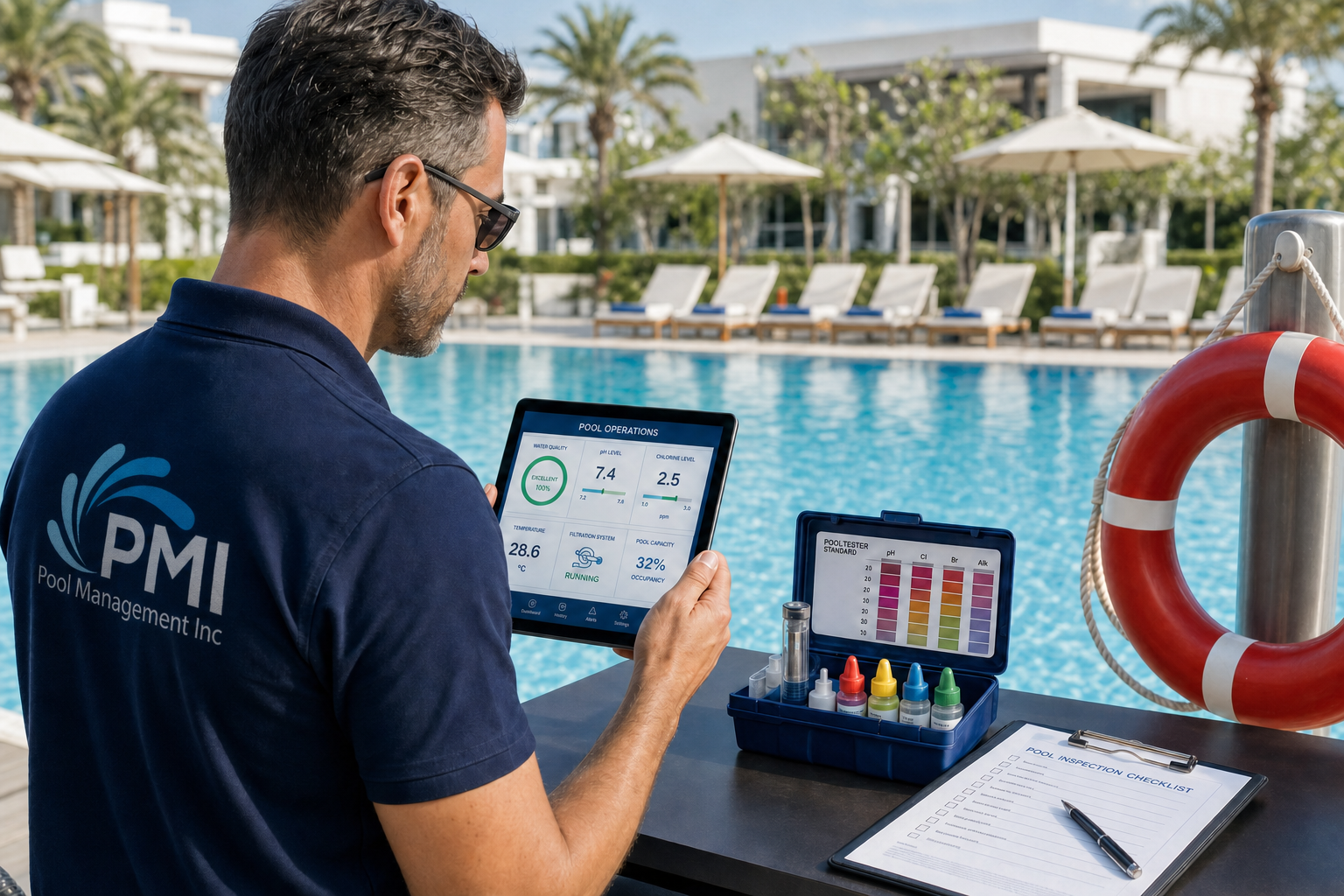
Pool Management Inc. works with commercial aquatic facilities where the real issue is rarely just “dirty water.” The bigger problem is unclear responsibility: Who owns staffing? Who owns compliance? Who handles inspections? Who responds when the pool cannot open on a Saturday morning?
This article breaks that down clearly.
Quick Answer
Pool maintenance keeps the pool clean, chemically balanced, and mechanically functional.
Pool management includes maintenance, but adds operational control: staffing, lifeguard scheduling, compliance documentation, inspections, incident reporting, emergency response, board communication, and full facility oversight.
| If You Need This | You Need |
| Cleaning, chemical balancing, filter care, and basic equipment checks | Pool maintenance |
| Staffing, compliance, inspections, safety documentation, reporting, emergency response, and operational accountability | Pool management |
If you are still unclear about the broader role, read this guide on what a pool management company actually does.
The Core Difference
A pool maintenance company maintains the pool.
A pool management company manages the facility.
That sounds simple, but it changes everything inside the contract.
| Function | Pool Maintenance Company | Pool Management Company | Why It Matters |
| Water chemistry | Tests and balances chlorine, pH, alkalinity, and related readings | Maintains documented testing cadence, corrective action logs, chemical inventory, and operator accountability | Inspectors and owners need records, not verbal reassurance |
| Cleaning | Skimming, vacuuming, brushing, tile-line cleaning, trash removal, and debris control | Includes cleaning as part of an operating schedule tied to opening, closing, staffing, and bather load | A clean-looking pool can still be poorly operated |
| Equipment | Basic visual checks, filter cleaning, backwashing, and minor service | Preventive maintenance schedule, failure alerts, repair escalation, and warranty documentation | Peak-season failure is usually a planning failure |
| Staffing | Usually not included | Lifeguards, attendants, operators, supervisors, backup staff, and scheduling | Commercial facilities often fail because people coverage breaks |
| Compliance | May support water-quality basics | Tracks state/county requirements, logs, certifications, signage, inspection prep, and incident files | The owner gets cited when responsibility is vague |
| Inspections | May help after an issue is found | Prepares for inspections, supports inspector communication, files documentation, and closes corrective actions | Reactive compliance is expensive |
| Emergency response | Usually next available service window | Written escalation path, emergency contact, backup staffing, and after-hours protocol | Saturday failures need a plan, not a Monday callback |
| Reporting | Informal notes or service slips | Weekly reports, exception logs, seasonal summaries, and board-ready documentation | Decision-makers need visibility before complaints arrive |
The blunt version: maintenance protects the asset. Management protects the operation.
What Pool Maintenance Covers
Pool maintenance is legitimate when the buyer only needs technical upkeep.
A pool maintenance company usually handles:
- Skimming, brushing, vacuuming, and tile-line cleaning
- Trash removal and basic deck appearance
- Chlorine, pH, alkalinity, stabilizer, and calcium hardness testing
- Chemical dosing and water balancing
- Filter cleaning and backwashing
- Pump, basket, heater, and controller observation
- Seasonal opening and closing
- Basic troubleshooting
- Minor repair identification
This scope makes sense for facilities that already have someone internally managing safety, compliance, staffing, inspections, and guest or resident communication.
For example, a small private facility with limited use may only need aquatic facility maintenance
if an internal manager already owns the operational side.
But here is the trap: maintenance does not automatically include management.
If the contract only says cleaning, chemicals, and equipment checks, then staffing, documentation, inspections, emergency response, and safety oversight are probably still your responsibility.
For task-level planning, pair this article with the commercial pool maintenance checklist. That checklist should cover daily, weekly, monthly, and seasonal maintenance tasks. This article is about choosing the correct service tier.
What Pool Management Covers
Pool management includes maintenance, but it goes much further.
A pool management company can own the full operating system around the facility.
That may include:
- Routine cleaning and chemical balancing
- Preventive equipment maintenance
- Lifeguard recruitment, scheduling, and supervision
- Pool attendant staffing
- Certified operator oversight
- Staff credential tracking
- Backup staffing plans
- Inspection preparation
- Health department documentation
- Incident reports
- Safety audits
- Emergency action procedures
- Rule enforcement
- Resident or guest communication
- Weekly reporting
- Seasonal opening and closing
- Repair coordination
- Vendor communication
- Budget and capital planning recommendations
This is why professional pool management services are not the same thing as hiring a weekly cleaning vendor.
For larger facilities, the better frame is aquatic management services, because the vendor is helping manage the aquatic operation, not just the swimming pool.
That distinction matters most when the facility has public access, residents, guests, children, programming, high bather load, inspection exposure, or lifeguard requirements.
Facility Decision Matrix
Use this table before requesting proposals.
| Facility Type | Maintenance May Be Enough When | Management Is Needed When | Recommended Scope |
| Small private club pool | Use is limited and internal staff owns compliance | Members, guests, events, or seasonal staffing create operational risk | Preventive maintenance or partial management |
| HOA / community pool | Rarely, unless the board has strong internal oversight | Residents, guests, lifeguards, complaints, inspections, and board reporting are involved | Full-scope management |
| Apartment / multifamily pool | Very small property with internal staff handling rules and compliance | Weekend traffic, tenant complaints, inspections, or access-control issues exist | Management or managed maintenance |
| Hotel / resort pool | Almost never for guest-facing pools | Guest experience, seven-day coverage, staff behavior, and incident prevention matter | Full management |
| Waterpark / aquatic center | No serious case for maintenance-only | Multiple attractions, high bather load, lifeguard rotations, ride checks, and public safety are involved | Full aquatic management |
| Municipal / public pool | Only if parks staff already run operations | Public access, health oversight, programming, staffing, and incident reporting are required | Full or hybrid management |
| Fitness center / school pool | Internal aquatics director owns programming and compliance | Classes, swim teams, children, lifeguards, or inspection documentation are involved | Hybrid management |
| Commercial mixed-use property | Small, controlled-use amenity | Tenants, guests, shared ownership, or liability exposure are present | Management with clear exclusions |
If your facility has guests, residents, inspectors, lifeguards, public access, board oversight, or insurance exposure, maintenance-only is usually too thin.
When Maintenance Is Enough
Maintenance can be enough when the pool is simple, controlled, and low-risk.
Choose pool maintenance when:
- The pool has low traffic
- There is no lifeguard requirement
- The facility is not guest-facing or public-facing
- Internal staff already manages compliance
- Internal staff handles inspections and documentation
- You only need cleaning, chemicals, and equipment care
- Emergency response expectations are limited
- The contract clearly defines exclusions
This is the right fit for buyers who already have operational control.
It is not the right fit for buyers who want to “not think about the pool.”
That expectation requires management, not maintenance.
When Management Is Required
Pool management becomes necessary when the facility has operational exposure.
Choose pool management when:
- The pool serves residents, guests, members, students, campers, or the public
- Lifeguards or attendants are required
- Someone must manage staff schedules
- The facility needs inspection-ready records
- There are health department requirements
- The owner needs incident reports
- The board or ownership group expects regular updates
- The pool has had past citations, closures, complaints, or emergency repairs
- The facility has multiple pools, spas, splash pads, slides, or high weekend traffic
This is not just about convenience.
It is about risk.
A maintenance vendor may keep the water clear. But if no one owns pool safety, documentation, staffing, and inspection readiness, the facility is still exposed.
That is why commercial buyers should also look closely at facility inspections
before deciding whether maintenance-only is enough.
The Cost Trap
The cheapest quote often looks attractive because the expensive work has been removed from the base scope.
Then those missing items come back later as:
- Emergency service calls
- Chemical surcharges
- Repair change orders
- Staffing problems
- Inspection corrections
- Board complaints
- Resident or guest refunds
- Insurance documentation issues
- Mid-season vendor disputes
Here is where buyers get burned.
| Low Quote Exclusion | How It Shows Up Later | Better Contract Language |
| No staffing coverage | Owner scrambles when attendance spikes or a guard calls out | Define staffing schedule, certification requirements, substitute coverage, and supervisor escalation |
| No inspection ownership | Vendor says paperwork is not their responsibility | Assign inspection prep, documentation, and corrective-action follow-up |
| No emergency SLA | Pump failure waits until the next business day | Name emergency response window, approval threshold, and after-hours contact |
| No labor allowance | Every minor fix becomes a separate invoice | Include monthly minor-repair labor allowance or clear rate schedule |
| No documentation package | Owner cannot prove water quality, staffing, or incident response | Require weekly logs, chemical readings, incident reports, and seasonal summaries |
| No preventive maintenance | Equipment runs until failure | Tie service intervals to manufacturer guidance and warranty preservation |
This is where the commercial pool management buyer’s guide becomes the next logical read. Once you know you need management, you need to evaluate the contract properly.
Do not compare vendors only by monthly price.
Compare them by what responsibility they are actually accepting.
Equipment Is a Good Test
Equipment exposes the difference quickly.
A maintenance vendor may notice that a pump is noisy, a heater is underperforming, or a filter is struggling.
A management company should go further.
It should track equipment condition, document recurring problems, schedule preventive service, recommend replacement timing, coordinate repairs, and help protect warranty documentation.
That is why this topic naturally connects to equipment life and preventive care.
If a vendor only reacts when something breaks, you are not buying management. You are buying delayed repair coordination.
Contract Scope Checklist
Before signing, ask who owns each responsibility.
| Question | Maintenance Contract Answer | Management Contract Answer |
| Who owns chemical logs? | Technician logs readings during visits | Operator maintains inspection-grade logs at defined intervals |
| Who handles lifeguards? | Usually not included | Vendor recruits, schedules, certifies, supervises, and backs up staff |
| Who prepares for inspection? | Owner unless added | Vendor prepares records and supports inspection process |
| Who responds after hours? | Often excluded or billed separately | Emergency path and SLA are written into the contract |
| Who communicates with the board or owner? | Informal notes | Weekly/monthly reports, issue tracking, and seasonal recommendations |
| Who manages repairs? | Technician flags issues | Vendor diagnoses, escalates, coordinates, and documents repair completion |
| Who owns safety documentation? | Usually owner | Vendor maintains incident reports, staff credentials, and safety checks |
| Who is accountable if the pool cannot open? | Often unclear | Opening criteria, backup plans, and closure authority are defined |
If a vendor cannot answer these questions clearly, the proposal is not mature enough.
Vendor Questions Before You Sign
Ask these before you compare prices.
- Are you maintaining the pool or managing the facility operation?
- Which tasks are included in the base monthly fee?
- Which tasks are billable extras?
- Do you provide lifeguards or attendants?
- Who owns chemical logs and inspection files?
- Who tracks staff certifications?
- What happens if a lifeguard calls out before opening?
- What is your emergency response time?
- Do you prepare for health department inspections?
- Do you provide weekly service reports?
- Do you provide seasonal closeout documentation?
- What does your proposal exclude that buyers often assume is included?
- Can you show sample documentation from a current commercial facility?
The strongest vendors answer directly.
Weak vendors hide behind phrases like “full service” without defining the work.
Red Flags
Do not ignore these.
- The proposal says “full service” but does not define staffing, documentation, inspections, emergency response, or exclusions
- The vendor talks only about clean water
- The contract says nothing about compliance responsibility
- No one can explain who signs logs
- No one can explain who talks to inspectors
- There is no written response time for unsafe water
- There is no backup plan for staffing gaps
- Chemicals, openings, closings, emergency visits, or labor are excluded from the low quote
- The company cannot provide sample reports
- The vendor avoids direct questions about liability, insurance, and accountability
A cheap contract with vague responsibility is not a good deal.
It is deferred risk.
Practical Scenario
An HOA board has one pool, seasonal use, heavy weekend traffic, and residents who expect the amenity to stay open every day from Memorial Day through Labor Day.
A pool maintenance company can keep the water clean.
But that does not automatically solve:
- Lifeguard scheduling
- Resident rule enforcement
- Incident reports
- Inspection readiness
- Emergency closures
- Guest policy enforcement
- Board communication
- Weekend escalation
- Staff callouts
That board does not have a maintenance problem.
It has an operations problem.
The right contract is either full pool management or a hybrid agreement where maintenance, staffing, compliance, reporting, and emergency response are explicitly assigned.
If those responsibilities are not written down, they will land back on the board when something goes wrong.
Which One Do You Need?
Use this final decision table.
| If This Describes Your Facility | Choose This |
| You only need cleaning, chemical balancing, filter care, and basic equipment checks | Pool maintenance |
| You already have an internal aquatics director handling compliance and staffing | Maintenance or hybrid support |
| You need lifeguards, attendants, staff scheduling, or backup coverage | Pool management |
| You answer to an HOA board, hotel GM, municipality, school, or ownership group | Pool management |
| You need inspection logs, incident reports, and compliance documentation | Pool management |
| You had citations, closures, complaints, or emergency repairs last season | Pool management |
| You operate a resort, waterpark, municipal pool, or multi-pool facility | Full aquatic management |
Here is the practical rule:
If the pool is just an asset, maintenance may be enough.
If the pool is an amenity, operation, guest experience, resident service, or public-facing facility, you need management.
Frequently Asked Questions
Is pool management the same as pool maintenance?
No. Pool maintenance focuses on water, cleaning, and equipment upkeep. Pool management includes maintenance but also covers staffing, compliance, safety documentation, inspections, emergency response, reporting, and facility operations.
Is pool maintenance cheaper than pool management?
Usually, yes at the line-item level. But for commercial or shared facilities, a cheaper maintenance-only contract can become more expensive if it excludes staffing, inspections, emergency response, documentation, and preventive planning.
Can a pool maintenance company handle commercial pools?
Some can handle the technical maintenance of commercial pools. That does not mean they are equipped to manage lifeguards, inspections, compliance files, incident reporting, or full facility operations.
When should an HOA choose pool management instead of maintenance?
An HOA should choose pool management when the pool is a resident amenity with inspections, lifeguards, access rules, board reporting, complaints, weekend traffic, or meaningful liability exposure.
Do resorts and hotels need pool management?
Most guest-facing resort and hotel pools need management, not just maintenance. Guest experience, staffing, safety response, water clarity, documentation, and seven-day reliability matter.
What should be included in a pool management contract?
A pool management contract should define cleaning, chemical management, equipment care, staffing, inspection support, compliance documentation, emergency response, reporting cadence, repair escalation, insurance, and exclusions.
What is the biggest mistake buyers make?
They buy maintenance while expecting management. If the contract does not assign staffing, compliance, inspections, emergency response, and reporting, those responsibilities remain with the owner.
Get the Right Scope Before the Season Starts
If you are comparing pool maintenance companies and pool management companies, do not ask for “a pool quote.”
Ask for a scoped proposal that shows exactly who owns:
- Water quality
- Staffing
- Compliance
- Documentation
- Inspections
- Safety
- Emergency response
- Repairs
- Reporting
If you are unsure which level your facility needs, contact Pool Management Inc. and ask for a scope review before signing another contract.
If you are already collecting vendor proposals, submit a bid reques and request a line-item scope that separates maintenance, management, staffing, compliance, and emergency response.
The wrong contract will look cheaper in January.
It will not feel cheaper in July.