
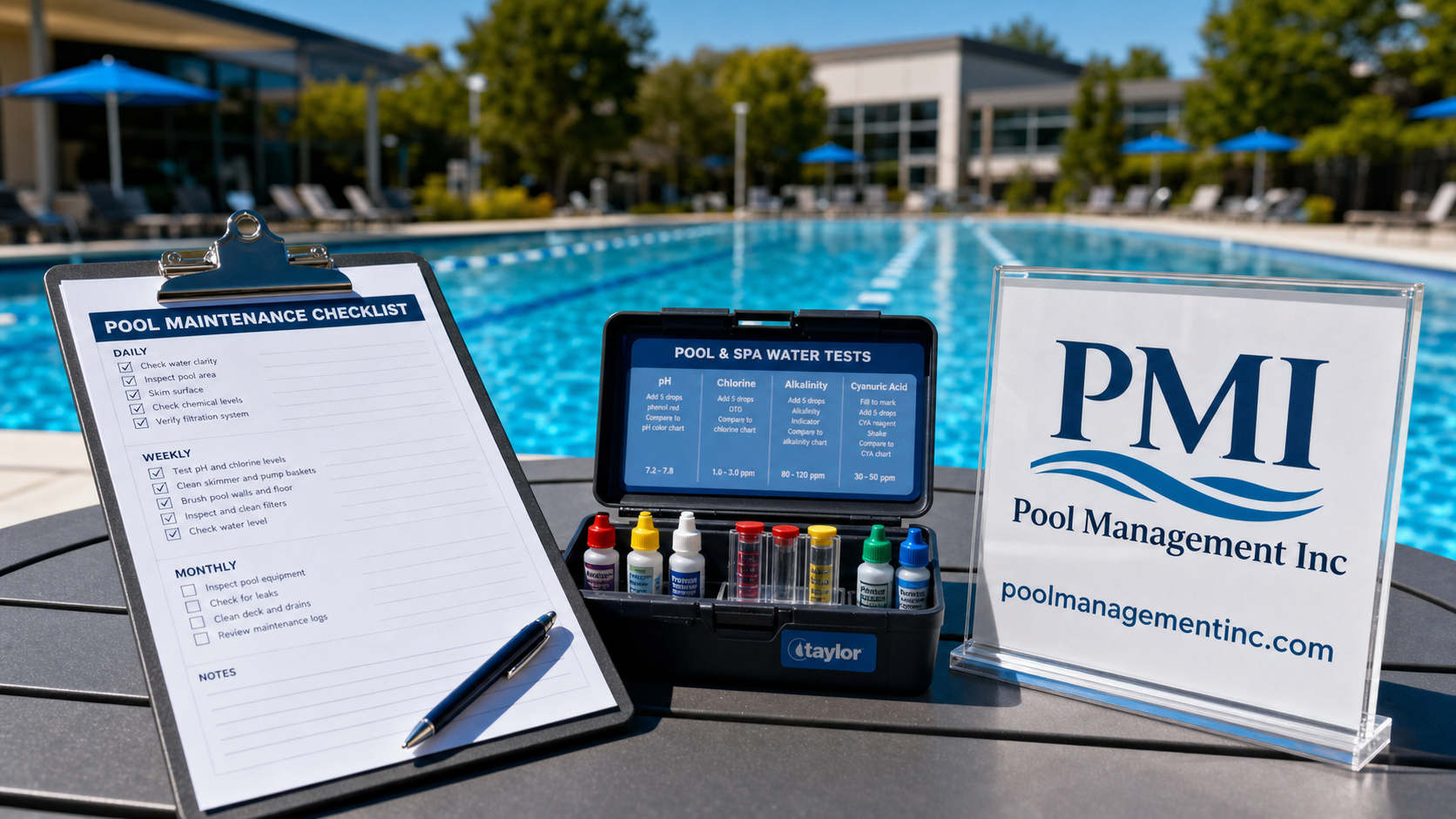
Commercial pool maintenance is not just about keeping the water clear.
It is about keeping the facility safe, open, documented, and ready for residents, guests, members, students, or the public every day the pool is in use.
A missed chemical reading can become a water-quality problem. A neglected filter can become a circulation issue. A loose handrail can become a liability claim. A weak opening checklist can turn the first week of the season into a complaint cycle.
That is why every commercial pool needs a written maintenance schedule.
Pool Management Inc. works with commercial aquatic facilities where maintenance is only one part of the operation. Cleaning, chemical testing, equipment checks, safety inspections, documentation, staffing coordination, and seasonal planning all need to work together.
This checklist gives property managers, on-site teams, and facility operators a practical way to organize daily, weekly, monthly, and seasonal commercial pool maintenance tasks.
Quick Answer
A commercial pool maintenance checklist should cover:
- Daily water testing
- Chemical balancing
- Pool cleaning
- Deck and safety checks
- Skimmer and pump basket cleaning
- Filter monitoring
- Equipment inspections
- Weekly deep cleaning
- Monthly log reviews
- Preventive maintenance
- Seasonal opening
- Seasonal closing
- Documentation and reporting
If your team is only cleaning the pool but not documenting chemical readings, checking safety equipment, inspecting filtration, or preparing for seasonal operations, the maintenance program is incomplete.
Why a Checklist Matters
Commercial pools fail slowly, then suddenly.
Most problems start small:
- Chlorine drifts out of range
- pH stays high for too long
- Filter pressure rises
- Pump baskets are ignored
- Deck hazards go unnoticed
- Safety equipment is missing
- Logs are incomplete
- Opening tasks are rushed
- Closing tasks are skipped
A checklist prevents small misses from becoming expensive problems.
It also creates accountability.
When maintenance is handled by multiple people, a written process keeps everyone aligned. When the work is outsourced, a checklist helps property owners verify whether the vendor is actually performing the right tasks.
For facilities still deciding whether they need basic upkeep or full operational support, review pool management vs pool maintenance before assigning responsibilities.
Daily Commercial Pool Maintenance Checklist
Daily tasks protect water quality, swimmer safety, and operational readiness.
These tasks should be completed before opening and monitored throughout the operating day when the pool is in use.
| Daily Task | What to Check | Why It Matters |
| Test sanitizer | Chlorine or bromine level | Prevents unsafe water and contamination risk |
| Test pH | Confirm pH is within acceptable operating range | Protects swimmers, surfaces, and equipment |
| Check water clarity | Main drain should be clearly visible | Cloudy water is a serious safety issue |
| Inspect pool surface | Debris, leaves, insects, oil, foam, or discoloration | Keeps water clean and identifies early problems |
| Empty baskets | Skimmer baskets and pump baskets | Protects circulation and pump performance |
| Check water level | Too low or too high | Supports proper skimming and circulation |
| Inspect deck | Trip hazards, loose furniture, broken glass, standing water | Reduces accident risk |
| Check safety equipment | Life rings, rescue hooks, first aid access, emergency phone | Safety equipment must be ready before opening |
| Review gates and barriers | Latches, locks, fencing, access points | Prevents unauthorized access |
| Record readings | Chemical log, corrective action, initials, time | Creates proof of maintenance and accountability |
Daily maintenance is not optional.
If water is cloudy, chemical readings are unsafe, or safety equipment is missing, the pool should not open until the issue is corrected.
Daily Pool Cleaning Routine
A basic daily pool cleaning routine should include:
- Skimming floating debris
- Brushing steps, benches, corners, and shallow areas
- Vacuuming visible dirt or sediment
- Removing trash from the deck area
- Straightening furniture if included in scope
- Checking tile line buildup
- Looking for stains, algae, foam, or unusual water appearance
- Removing debris near drains and returns
- Confirming the pool area is clean before opening
The goal is not just appearance.
Debris affects circulation, chemical demand, swimmer experience, and equipment performance.
If daily cleaning is becoming inconsistent, the issue is usually not effort. It is process ownership.
That is where aquatic facility maintenance should be structured around a routine schedule rather than reactive visits.
Chemical Testing Checklist
Chemical testing should be logged, not guessed.
Commercial pools need consistent testing because bather load, weather, sunlight, rain, debris, and equipment performance can change water chemistry quickly.
| Chemical Item | Recommended Check |
| Sanitizer | Chlorine or bromine reading |
| pH | Acidity/alkalinity balance |
| Total alkalinity | Water stability |
| Calcium hardness | Surface and equipment protection |
| Cyanuric acid | Stabilizer level for outdoor pools |
| Combined chlorine | Indicator of chloramine buildup |
| Water temperature | Affects chemical behavior and swimmer comfort |
| Chemical inventory | Confirm supplies are available and stored properly |
Each chemical test should include:
- Date
- Time
- Reading
- Corrective action
- Retest result if needed
- Staff initials or technician name
A number without a corrective action is not enough.
If a reading is outside range, the log should show what was done and when the water was safe again.
Weekly Commercial Pool Maintenance Checklist
Weekly maintenance goes deeper than daily cleaning.
It focuses on system stability, equipment condition, and early problem detection.
| Weekly Task | What to Check |
| Brush full pool surface | Walls, floor, steps, benches, corners |
| Vacuum thoroughly | Dirt, sediment, and debris not removed by skimming |
| Test extended chemistry | Alkalinity, calcium hardness, stabilizer, combined chlorine |
| Inspect filters | Pressure readings, cleaning needs, backwash schedule |
| Inspect pumps | Noise, vibration, leaks, basket condition, priming |
| Check heaters | Error codes, leaks, temperature performance |
| Inspect chemical feeders | Feed rate, tubing, injectors, chemical supply |
| Check controllers | Readings, calibration needs, alarms |
| Inspect ladders and rails | Loose hardware, corrosion, movement |
| Review logs | Missing readings, repeated swings, unresolved issues |
Weekly work catches patterns.
If the same chemical reading keeps drifting or the same equipment warning keeps appearing, that is not a one-time issue. It is a maintenance trend.
This is where preventive maintenance starts.
Filter Cleaning and Circulation Checks
Filters are one of the most important systems in a commercial pool.
If filtration is weak, water quality becomes harder to control.
Weekly or scheduled filter checks should include:
- Filter pressure reading
- Backwash needs
- Cartridge condition
- Sand or media performance
- DE filter condition where applicable
- Flow rate concerns
- Air in the system
- Leaks around valves or fittings
- Pump basket condition
- Unusual noise or vibration
Do not wait for cloudy water to inspect filtration.
By the time swimmers notice the problem, the system has usually been struggling for a while.
A strong preventive plan can also support longer equipment life. See how professional pool management extends equipment life for the broader connection between maintenance discipline, service history, and replacement planning.
Monthly Commercial Pool Maintenance Checklist
Monthly tasks are about audits, prevention, and documentation.
These are the items that often get skipped when teams are busy.
| Monthly Task | Why It Matters |
| Audit chemical logs | Confirms readings are complete and corrective actions are documented |
| Inspect drain covers | Helps identify damage, age, or compliance concerns |
| Check depth markers | Ensures markings are visible and accurate |
| Inspect signage | Rules, warnings, emergency instructions, and required notices |
| Review safety equipment | Confirms equipment is present, visible, and usable |
| Inspect ladders and rails | Prevents loose fixtures from becoming injury risks |
| Check deck condition | Cracks, uneven surfaces, slippery areas, drainage issues |
| Review staff procedures | Confirms operators and attendants follow the same process |
| Review repair list | Prioritizes small fixes before they become urgent |
| Inspect storage areas | Chemical storage, labeling, ventilation, and organization |
Monthly work should not be treated as extra.
It is what keeps the facility from drifting into reactive maintenance.
Safety and Compliance Checklist
Pool safety checks should be built into routine maintenance.
They should not wait for an incident or inspection.
Check the following regularly:
- Rescue hook present and accessible
- Life ring present and accessible
- First aid supplies available
- Emergency phone or communication method working
- Pool rules posted
- Depth markers visible
- No diving signs posted where required
- Gates and latches functioning
- Fencing secure
- Deck free of trip hazards
- ADA equipment maintained where applicable
- Chemical storage secured
- Staff know closure procedures
- Incident forms available
Strong pool safety depends on repetition. The same checks should happen before problems appear, not after someone complains.
Facility Inspection Preparation
A commercial pool should always be close to inspection-ready.
Waiting until an inspection is scheduled creates rushed work and missed details.
Before inspections, review:
- Chemical logs
- Staff certification records
- Incident reports
- Safety equipment
- Signage
- Drain covers
- Water clarity
- Chemical storage
- Equipment room condition
- Pump and filtration function
- Corrective-action records
- Opening and closing procedures
Inspection preparation is easier when the daily and weekly checklists are already being followed.
That is why facility inspections should not be seen as a separate event. They are the result of consistent maintenance and documentation.
Seasonal Pool Opening Checklist
Pool opening should start before the first planned swim day.
Rushed openings create chemical instability, equipment surprises, and avoidable complaints.
Use this checklist before opening:
- Remove and clean pool cover
- Inspect pool shell and surfaces
- Check tiles, coping, ladders, rails, and steps
- Inspect deck and furniture
- Reinstall equipment removed for winter
- Inspect pumps, filters, heaters, and controllers
- Check valves, fittings, drains, and returns
- Fill pool to proper operating level
- Start circulation system
- Clean and vacuum pool
- Balance water chemistry
- Shock or treat water if needed
- Confirm water clarity
- Check safety equipment
- Confirm signage is posted
- Review chemical storage
- Confirm staff procedures
- Complete opening documentation
Opening is not just a cleaning task.
It is the first operational test of the season.
If the facility has recurring opening problems, the issue may be contract planning. Long-term planning and clearer scope are covered in long-term pool management contracts.
In-Season Preventive Maintenance
Preventive maintenance happens during the season, not after the pool fails.
In-season preventive tasks include:
- Tracking chemical trends
- Watching filter pressure
- Monitoring pump performance
- Checking heater function
- Reviewing controller accuracy
- Inspecting visible leaks
- Tightening loose hardware
- Scheduling small repairs quickly
- Reviewing repeated service issues
- Communicating upcoming repair needs
- Updating ownership before problems become closures
The goal is to reduce surprise.
Surprise is expensive in commercial pool operations.
A pool that is maintained only when something looks wrong is already behind.
Seasonal Pool Closing Checklist
Closing protects the pool, equipment, and next season’s budget.
A poor closing can cause freeze damage, staining, algae growth, equipment problems, and delayed reopening.
Use this seasonal closing checklist:
- Complete final cleaning
- Balance water chemistry
- Remove debris from pool and deck
- Lower water level if required
- Clean filters
- Backwash where applicable
- Drain or protect lines as needed
- Winterize pumps, heaters, filters, and chemical systems
- Remove ladders, rails, or accessories if required
- Store furniture and removable equipment
- Secure chemical storage
- Install and secure pool cover
- Document equipment condition
- Note repairs needed before next season
- Prepare seasonal closeout report
A good closing creates a better opening.
If the closing report lists needed repairs, those should be reviewed before the next season’s budget is finalized.
Copy-Ready Maintenance Checklist
Use this as a simple operational checklist.
Daily
- Test sanitizer
- Test pH
- Record chemical readings
- Correct unsafe readings
- Check water clarity
- Confirm main drain visibility
- Skim surface debris
- Brush high-use areas
- Empty skimmer baskets
- Empty pump baskets
- Check water level
- Inspect deck hazards
- Check safety equipment
- Inspect gates and latches
- Record issues and corrective actions
Weekly
- Vacuum pool thoroughly
- Brush walls, floor, steps, and corners
- Test alkalinity
- Test calcium hardness
- Test stabilizer if applicable
- Check filter pressure
- Backwash or clean filters as needed
- Inspect pumps and heaters
- Inspect chemical feeders
- Check ladders, rails, and fittings
- Review weekly chemical trends
- Document maintenance completed
Monthly
- Audit chemical logs
- Inspect drain covers
- Review signage
- Check emergency equipment
- Inspect deck condition
- Review staff procedures
- Inspect chemical storage
- Review repair list
- Schedule preventive maintenance
- Prepare ownership update if needed
Seasonal Opening
- Remove cover
- Inspect pool and deck
- Reinstall seasonal equipment
- Start circulation
- Clean and vacuum pool
- Balance water
- Confirm safety equipment
- Confirm signage
- Review staff procedures
- Complete opening report
Seasonal Closing
- Final clean
- Balance water
- Clean filters
- Winterize equipment
- Secure chemicals
- Store furniture
- Install cover
- Document repair needs
- Prepare closing report
When In-House Maintenance Is Not Enough
Some facilities can manage routine maintenance internally.
Many cannot.
In-house maintenance becomes risky when:
- Logs are incomplete
- Chemical readings swing often
- Staff are not trained
- Filters are neglected
- Equipment problems repeat
- Inspections feel stressful
- Safety checks are inconsistent
- Opening and closing are rushed
- No one owns documentation
- Repairs are always reactive
That is when the issue is no longer just maintenance.
It becomes operational management.
For owners comparing vendors, how to choose a commercial pool management company is the next step after the maintenance scope is clear.
If the facility needs staffing, compliance, reporting, safety oversight, and emergency response in addition to maintenance, professional pool management services may be the better fit.
Frequently Asked Questions
How often should a commercial pool be maintained?
A commercial pool should be checked daily when open, with deeper weekly maintenance, monthly audits, and seasonal opening and closing procedures.
What should be included in daily commercial pool maintenance?
Daily maintenance should include sanitizer testing, pH testing, water clarity checks, skimming, basket cleaning, deck inspection, safety equipment checks, and written documentation.
How often should commercial pool chemicals be tested?
Commercial pool chemicals should be tested and recorded regularly during operation. The exact frequency depends on facility type, bather load, local requirements, and operating conditions.
What weekly pool maintenance tasks are most important?
Weekly tasks should include deeper cleaning, extended chemical testing, filter checks, equipment inspection, brushing, vacuuming, and log review.
Why is filter cleaning important?
Filter cleaning protects circulation, water clarity, and equipment performance. Dirty or restricted filters can lead to cloudy water, chemical instability, and equipment strain.
What is included in seasonal pool opening?
Seasonal opening usually includes cover removal, cleaning, equipment startup, water balancing, safety checks, signage review, and opening documentation.
What is included in seasonal pool closing?
Seasonal closing usually includes final cleaning, chemical balancing, filter cleaning, winterization, equipment protection, cover installation, and repair documentation for the next season.
When should a facility hire professional pool maintenance?
A facility should hire professional support when internal staff cannot consistently manage chemical testing, documentation, equipment checks, safety inspections, seasonal work, or compliance preparation.
Keep Maintenance Boring
Good commercial pool maintenance should feel boring.
The water is clear. Logs are complete. Equipment is monitored. Safety checks happen on schedule. Small repairs are documented before they become closures.
Bad maintenance is the opposite.
It is loud, stressful, reactive, and expensive.
If your facility needs help building a stronger maintenance routine, contact Pool Management Inc. before the season becomes difficult to control.
If you are ready to compare maintenance or management support, submit a bid request and ask for a scope that clearly separates daily maintenance, chemical testing, equipment care, inspections, opening, closing, and preventive maintenance.
The best pool maintenance program is not the one that reacts fastest.
It is the one that prevents the same problems from happening every season.