
Most bad pool management contracts do not fail because the vendor forgot how to test chlorine.
They fail because the buyer hired the wrong type of company for the facility.
A residential pool service provider may be fine for a backyard pool. A basic maintenance contractor may be enough for a small, low-risk private facility. But if you manage an HOA pool, resort pool, apartment community, waterpark, municipal pool, school pool, or commercial aquatic facility, you are not just buying cleaning and chemicals.
You are buying operational accountability.
That means staffing, compliance, safety documentation, emergency response, inspections, reporting, insurance, equipment care, and clear responsibility when something goes wrong.
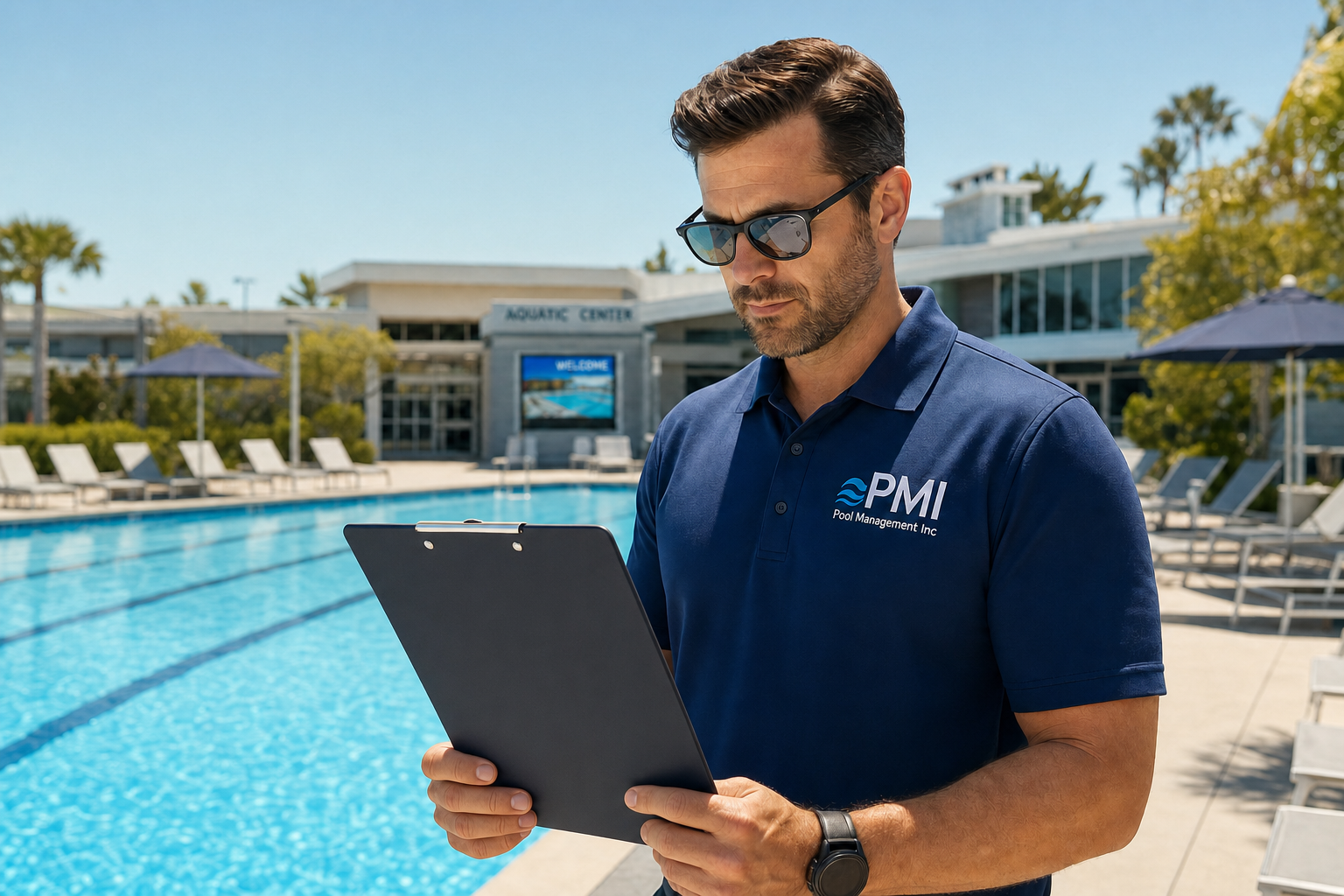
Pool Management Inc. works with commercial aquatic facilities where the real question is not “Who can clean the pool?” The better question is: “Which vendor can keep this facility safe, staffed, compliant, documented, and open when people are depending on it?”
This checklist will help you choose a commercial pool management company without getting trapped by vague proposals, low bids, or “full-service” language that does not actually define the work.
Quick Answer
To choose the right commercial pool management company, evaluate the vendor across eight areas:
- Commercial pool experience
- Licensing, certifications, insurance, and bonding
- Lifeguard staffing and backup coverage
- Compliance and inspection support
- Maintenance and chemical-management scope
- Emergency response and repair escalation
- Reporting, documentation, and communication
- Total delivered cost, not just monthly price
If a vendor cannot clearly explain how they handle these eight areas, they are not ready to manage a commercial aquatic facility.
They may still be a pool maintenance company.
That is not the same thing.
Why Vendor Selection Matters
A commercial pool is not just an amenity.
It is a public-facing risk point, a resident or guest experience, an inspection target, a staffing challenge, an insurance exposure, and a mechanical system that can fail at the worst possible time.
That is why choosing a pool management company should not be treated like hiring a basic cleaning vendor.
A weak vendor creates problems that show up as:
- Delayed openings
- Failed inspections
- Lifeguard callouts
- Missing documentation
- Unsafe chemical readings
- Resident complaints
- Guest refunds
- Emergency repair bills
- Board frustration
- Mid-season vendor disputes
If your team is still comparing basic maintenance against full operational support, review pool management vs pool maintenance before shortlisting vendors.
Once everyone understands the service level required, use the checklist below to compare companies properly.
1.Verify Commercial Pool Experience
The first filter is simple: has the company managed facilities like yours before?
Not serviced.
Managed.
There is a major difference between cleaning pools and running commercial aquatic operations. A backyard pool technician may understand water chemistry, but that does not mean they can handle lifeguard staffing, inspection files, incident reports, bather load, access rules, health department requirements, and board communication.
Ask vendors directly:
- How many commercial pools do you currently manage?
- What facility types do you serve?
- Do you work with HOAs, apartments, resorts, municipalities, schools, or waterparks?
- Can you provide examples similar to our facility?
- Who supervises the account after the contract is signed?
- Do you have commercial references from current clients?
A serious commercial pool management company should be able to explain its experience by facility type.
| Facility Type | What the Vendor Should Understand |
| HOA/ community pools | Board reporting, resident complaints, lifeguard coverage, seasonal openings, guest policies |
| Apartment pools | Weekend traffic, access control, tenant expectations, amenity standards |
| Resort and hotel pools | Guest experience, seven-day reliability, visual standards, staff presentation |
| Municipal pools | Public access, inspection standards, programming, incident documentation |
| Waterparks | High bather load, multiple attractions, guard rotations, rescue readiness |
| School or fitness pools | Programming schedules, child safety, lane use, staff coordination |
If the vendor speaks only in terms of cleaning and chemicals, they may not be the right fit for a commercial facility.
For larger or multi-use aquatic facilities, aquatic management services may be a better fit than a basic pool cleaning arrangement.
2.Check Licensing, Certifications, Insurance, and Bonding
Credentials do not guarantee quality.
But missing credentials should immediately concern you.
A commercial pool management company should be able to provide documentation before the contract is signed, not after the first problem.
Ask for:
- Certificate of insurance
- General liability coverage
- Workers’ compensation coverage
- Bonding details, if applicable
- Certified Pool Operator or Aquatic Facility Operator documentation
- Lifeguard certification process
- Supervisor qualifications
- State or local licensing where required
- Safety training documentation
- Written emergency procedures
Do not accept vague answers like “we are fully covered” or “our staff is trained.”
Ask for proof.
The company should also understand how insurance, staffing, maintenance scope, and documentation connect. If a vendor cannot explain who is covered, when coverage applies, and what documentation protects the facility, the risk is being pushed back onto the owner.
Insurance and bonding matter because commercial aquatic facilities involve real exposure: staff injuries, guest injuries, water-quality events, equipment failure, inspection issues, and emergency response decisions.
A company that cannot produce clean documentation during procurement will not magically become organized during peak season.
3.Review Lifeguard Staffing and Backup Coverage
If your facility needs lifeguards, staffing is not a side issue.
It is the operating model.
Many pool vendors say they provide lifeguards. The real question is how they recruit, train, schedule, supervise, replace, and document those guards.
Ask these questions before signing:
- Do you directly provide lifeguards?
- Are lifeguards employees, subcontractors, or seasonal hires?
- Who verifies certifications?
- Who creates the weekly schedule?
- Who handles callouts?
- What is the backup staffing process?
- How quickly can a replacement guard be sent?
- Who supervises lifeguards on site?
- How are rotations managed?
- How are incidents documented?
A weak staffing plan can shut down an otherwise clean pool.
That is why lifeguard coverage should never be buried inside a vague “staffing included” line.
It needs its own scope.
| Staffing Area | What to Confirm |
| Hiring | Who recruits and screens candidates |
| Certification | Which certifications are required and how they are verified |
| Scheduling | Who owns weekly coverage and shift planning |
| Supervision | Who checks performance and rule enforcement |
| Backup coverage | What happens when someone calls out |
| Documentation | Where rosters, credentials, and incident reports are stored |
For facilities where staffing is the primary concern, professional pool management services should include more than a body on deck. The scope should define scheduling, supervision, replacement coverage, certification tracking, and reporting.
If lifeguard staffing is weak, the entire operation is weak.
4.Ask How They Handle Compliance and Inspections
Compliance is where vague contracts become expensive.
A vendor may say they “follow local codes,” but that phrase is useless unless the contract defines who owns logs, documentation, inspections, corrective actions, and communication with the facility owner.
Ask:
- Who maintains water-quality logs?
- How often are readings recorded?
- Are logs digital, paper-based, or both?
- Who prepares inspection documents?
- Who meets or communicates with inspectors?
- Who tracks corrective actions?
- Who keeps staff certifications on file?
- Who maintains incident reports?
- Who alerts ownership if a compliance issue appears?
A commercial pool management company should not treat inspections as a surprise event.
Inspection readiness should be part of normal operations.
Strong facility inspections depend on organized logs, staff credentials, safety checks, and corrective-action tracking before an inspector arrives.
The same applies to pool safety. Safety is not only rescue equipment or posted rules. It includes staff behavior, chemical logs, incident response, documentation, signage, supervision, and escalation procedures.
A competent vendor should be able to explain how safety and compliance are managed together.
5.Demand a Clear Maintenance and Chemical-Management Scope
Every pool vendor says they handle maintenance.
That is not enough.
You need to know exactly what maintenance means inside the proposal.
A proper scope should define:
- Cleaning frequency
- Chemical testing frequency
- Chemical supply responsibility
- Filter cleaning
- Backwashing
- Pump and basket checks
- Heater checks
- Controller monitoring
- Deck and furniture checks
- Opening and closing tasks
- Minor repair handling
- Parts approval process
- Documentation requirements
Do not accept “routine maintenance” as a complete scope.
It is too vague.
A strong maintenance scope should answer three questions:
- What is done?
- How often is it done?
- How is it documented?
Use this table during vendor review.
| Maintenance Area | Weak Proposal Language | Strong Proposal Language |
| Cleaning | Pool cleaning included | Skimming, brushing, vacuuming, tile-line cleaning, and debris removal performed on defined schedule |
| Chemicals | Chemicals included | Specific testing cadence, chemical responsibility, corrective action process, and documentation method |
| Equipment | Equipment checked | Pump, filter, heater, controller, baskets, drains, and visible leaks checked on defined schedule |
| Repairs | Repairs extra | Approval thresholds, labor rates, response times, and escalation process defined |
| Opening / closing | Seasonal service included | Exact opening, closing, winterization, startup, and turnover tasks listed |
A commercial pool maintenance checklist can help owners verify whether routine work is being clearly defined instead of buried under vague service language.
6.Review Emergency Response and Repair Escalation
A pool can look fine during the sales meeting and still fail on a Saturday morning.
That is why emergency response needs to be written into the contract.
Not promised verbally.
Written.
Ask vendors:
- What counts as an emergency?
- What is your response time?
- Is after-hours support included?
- Who receives the first call?
- Who has authority to close the pool?
- What repair cost can be approved without owner signoff?
- What requires written approval?
- Who communicates with residents, guests, or management?
- How are emergency actions documented?
A good vendor will have a clear answer.
A weak vendor will say, “Just call us.”
That is not a plan.
| Scenario | What the Contract Should Define |
| Pump failure | Response time, repair authority, vendor escalation, closure decision |
| Unsafe chemical reading | Immediate corrective action, retesting process, reopening criteria |
| Lifeguard callout | Backup staffing process and expected replacement window |
| Contamination event | Closure procedure, treatment protocol, documentation, reopening standard |
| Storm or weather closure | Decision authority, communication process, reopening checklist |
| Guest or resident incident | Incident report, supervisor notification, documentation timeline |
A qualified vendor should also understand how preventive pool management extends equipment life through documented service intervals, early issue detection, repair planning, and warranty-conscious maintenance.
If repair escalation is unclear before signing, it will become a dispute during the season.
7.Ask for Reporting, Documentation, and Communication Standards
Poor communication is one of the easiest ways to spot a weak vendor.
If a company cannot explain how it reports work, tracks issues, and communicates with decision-makers, the owner will be left chasing updates.
That is not management.
It is vendor babysitting.
A commercial pool management company should provide a clear reporting structure.
Ask for:
- Sample weekly service report
- Sample chemical log
- Sample incident report
- Sample inspection checklist
- Sample staffing roster
- Seasonal opening checklist
- Seasonal closing report
- Repair recommendation format
- Account manager communication process
- Escalation contact list
Documentation matters because it gives facility owners visibility.
It also protects the facility when there is a complaint, citation, equipment issue, incident, or insurance question.
| Document | Why It Matters |
| Chemical logs | Proves water-quality monitoring and corrective action |
| Staffing rosters | Shows coverage, certifications, and accountability |
| Incident reports | Creates a formal record when something happens |
| Inspection checklists | Keeps compliance preparation organized |
| Weekly reports | Gives owners visibility before problems escalate |
| Seasonal reports | Helps with budgeting, planning, and board communication |
Do not hire a company that treats documentation as optional.
If they cannot show sample reports during vendor selection, expect weak reporting after contract signing.
8.Compare Total Delivered Cost, Not Just Monthly Price
The lowest monthly price is often the most expensive contract.
That happens when the base quote excludes the work your facility actually needs.
Common exclusions include:
- Chemicals
- Lifeguard coverage
- Backup staffing
- Opening and closing
- Emergency visits
- Minor repairs
- Inspection preparation
- Incident documentation
- After-hours response
- Reporting
- Supervisor visits
- Compliance support
A cheap quote may be cheaper only because it leaves responsibility with you.
That is not savings.
It is scope transfer.
Use this table when comparing proposals.
| Cost Area | Vendor A | Vendor B | Vendor C |
| Monthly management fee | Included / excluded | Included / excluded | Included / excluded |
| Chemicals | Included / excluded | Included / excluded | Included / excluded |
| Lifeguard staffing | Included / excluded | Included / excluded | Included / excluded |
| Backup staffing | Included / excluded | Included / excluded | Included / excluded |
| Emergency response | Included / excluded | Included / excluded | Included / excluded |
| Opening and closing | Included / excluded | Included / excluded | Included / excluded |
| Inspection support | Included / excluded | Included / excluded | Included / excluded |
| Reporting | Included / excluded | Included / excluded | Included / excluded |
| Minor repair labor | Included / excluded | Included / excluded | Included / excluded |
| Supervisor visits | Included / excluded | Included / excluded | Included / excluded |
For formal RFPs, vendor scoring, contract mechanics, and pricing evaluation, use the commercial pool management buyer’s guide after your shortlist is built.
This checklist helps decide which vendors deserve to stay in the conversation.
The buyer’s guide helps evaluate the final proposal.
The 8-Point Vendor Scorecard
Use this scorecard before selecting a pool management company.
| Evaluation Area | Max Points | What to Look For |
| Commercial facility experience | 15 | Similar facility types, current commercial clients, relevant references |
| Certifications and insurance | 15 | COI, workers’ comp, operator credentials, lifeguard certification process |
| Staffing depth | 15 | Recruiting, scheduling, supervision, backup coverage, callout process |
| Compliance and inspections | 15 | Logs, inspection prep, corrective actions, safety documentation |
| Maintenance scope | 10 | Clear cleaning, chemicals, equipment, opening, closing, and repair terms |
| Emergency response | 10 | Written response windows, escalation process, closure authority |
| Reporting and communication | 10 | Weekly reports, account manager, sample documentation |
| Pricing transparency | 10 | Clear inclusions, exclusions, labor rates, emergency fees, add-ons |
A vendor scoring below 75 out of 100 should not be treated as a serious finalist.
A vendor below 65 should be removed from consideration unless the facility is low-risk and only needs basic maintenance.
Red Flags That Should Slow the Deal Down
Some vendors sound good in a sales call but fall apart when asked for specifics.
Watch for these red flags:
- They say “full service” but cannot define the scope
- They focus only on cleaning and chemicals
- They have little commercial pool experience
- They cannot provide relevant references
- They avoid insurance or bonding questions
- They do not explain lifeguard backup coverage
- They have no written emergency response process
- They do not provide sample reports
- They treat inspections as the owner’s problem
- They cannot explain who owns chemical logs
- They are vague about exclusions
- They push for signature before answering scope questions
- Their price is much lower because key services are missing
A professional vendor does not fear detailed questions.
A weak vendor does.
Questions to Ask Before Signing
Use these in the final vendor interview.
- How many commercial aquatic facilities do you currently manage?
- Which facility types do you specialize in?
- Who will supervise our account?
- Can we see your certificate of insurance?
- Do you carry workers’ compensation?
- Are your operators certified?
- How do you verify lifeguard certifications?
- What happens when a scheduled guard calls out?
- Who owns water-quality logs?
- Who prepares for inspections?
- Do you provide weekly reports?
- What is your emergency response time?
- What is excluded from the base price?
- Are chemicals included?
- Are opening and closing included?
- How are repairs approved?
- What documentation do we receive at the end of the season?
- Can we speak with a current commercial client?
- What would cause you to recommend a different service scope?
- What risks do you see at our facility before the season starts?
That last question matters.
A good vendor will identify risk before the contract starts.
A weak vendor will avoid saying anything that could complicate the sale.
Facility-Specific Buying Advice
Different facilities should weigh vendor criteria differently.
| Facility Type | Highest-Priority Vendor Criteria |
| HOA pool | Lifeguard coverage, resident communication, board reporting, inspection support |
| Apartment pool | Weekend reliability, access control awareness, cleaning consistency, emergency response |
| Resort pool | Guest experience, staff presentation, seven-day coverage, water clarity, incident prevention |
| Waterpark | Staffing depth, rescue readiness, attraction checks, documentation, high bather-load planning |
| Municipal pool | Compliance, public safety, reporting, programming support, incident documentation |
| School pool | Child safety, certification tracking, supervision, scheduling, communication |
| Fitness center pool | Water quality, programming coordination, member experience, preventive maintenance |
This is why the right vendor is not always the cheapest vendor.
It is the vendor whose strengths match the facility’s actual risk profile.
A Practical Scenario
An HOA board receives three pool management proposals for the summer season.
Vendor A is the cheapest. The proposal includes cleaning, chemicals, and two weekly visits. Lifeguards are not included. Inspection support is not mentioned. Emergency response is “as available.”
Vendor B is mid-priced. The proposal includes cleaning, chemicals, opening, closing, basic reporting, and emergency response, but staffing is still separate.
Vendor C is the most expensive. The proposal includes maintenance, lifeguard scheduling, backup coverage, inspection prep, weekly board reports, chemical logs, incident documentation, emergency response, and repair escalation.
If the HOA only needed water care, Vendor A might be enough.
But if the community expects the pool to open daily, remain staffed, pass inspections, handle complaints, and stay documented, Vendor A is not cheaper.
Vendor A is incomplete.
That is the procurement mistake buyers need to avoid.
Which Vendor Should You Choose?
Choose the commercial pool management company that can prove five things:
- They have managed facilities like yours before
- They can document credentials, insurance, staffing, and compliance processes
- They define the scope clearly before signing
- They communicate in writing, not vague promises
- They can explain how they respond when something goes wrong
Do not choose based only on price.
Do not choose based only on a polished sales call.
Do not choose a vendor that makes the contract look simple by leaving important responsibilities undefined.
The right vendor should make ownership feel more informed, not more confused.
Frequently Asked Questions?
How do I choose a pool management company?
Choose a pool management company by evaluating commercial experience, insurance, certifications, staffing depth, compliance support, maintenance scope, emergency response, reporting, and pricing transparency.
What should I ask a commercial pool management company?
Ask about current commercial clients, facility experience, insurance, lifeguard staffing, backup coverage, chemical logs, inspection support, emergency response, reporting, exclusions, and repair escalation.
Is a pool maintenance company the same as a pool management company?
No. A pool maintenance company usually focuses on cleaning, chemicals, and equipment care. A pool management company may also handle staffing, compliance, inspections, safety documentation, reporting, and full facility operations.
Should I choose the cheapest pool management proposal?
Not automatically. The cheapest proposal often excludes staffing, emergency response, inspection support, chemicals, opening, closing, or documentation. Compare total delivered scope, not just monthly price.
Do commercial pool management companies provide lifeguards?
Some do, but not all. If lifeguard staffing matters, confirm whether guards are included, who verifies certifications, who handles scheduling, and what happens when a guard calls out.
What documents should a pool management vendor provide?
A serious vendor should provide insurance documentation, operator credentials, lifeguard certification process, sample service reports, chemical log examples, inspection checklists, emergency procedures, and references.
When should I contact a pool management company?
Contact vendors before the season starts, ideally early enough to evaluate staffing, scope, inspections, opening requirements, and contract terms. Waiting until peak season limits your options.
Get the Right Vendor Before the Season Starts
If you are comparing pool service providers, do not ask only for a price.
Ask for a complete operating scope.
The proposal should clearly show who owns:
- Cleaning
- Chemical management
- Staffing
- Compliance
- Inspections
- Documentation
- Emergency response
- Repairs
- Reporting
- Communication
If you are unsure what level of support your facility needs, contact Pool Management Inc. and ask for a scope review before choosing a vendor.
If you are already comparing proposals, submit a bid request and request a line-item proposal that separates maintenance, management, staffing, compliance, emergency response, and reporting.
The wrong vendor will look affordable before the season starts.
The right vendor will still look competent when the pool is full, the weather is bad, a guard calls out, and the board wants answers.