
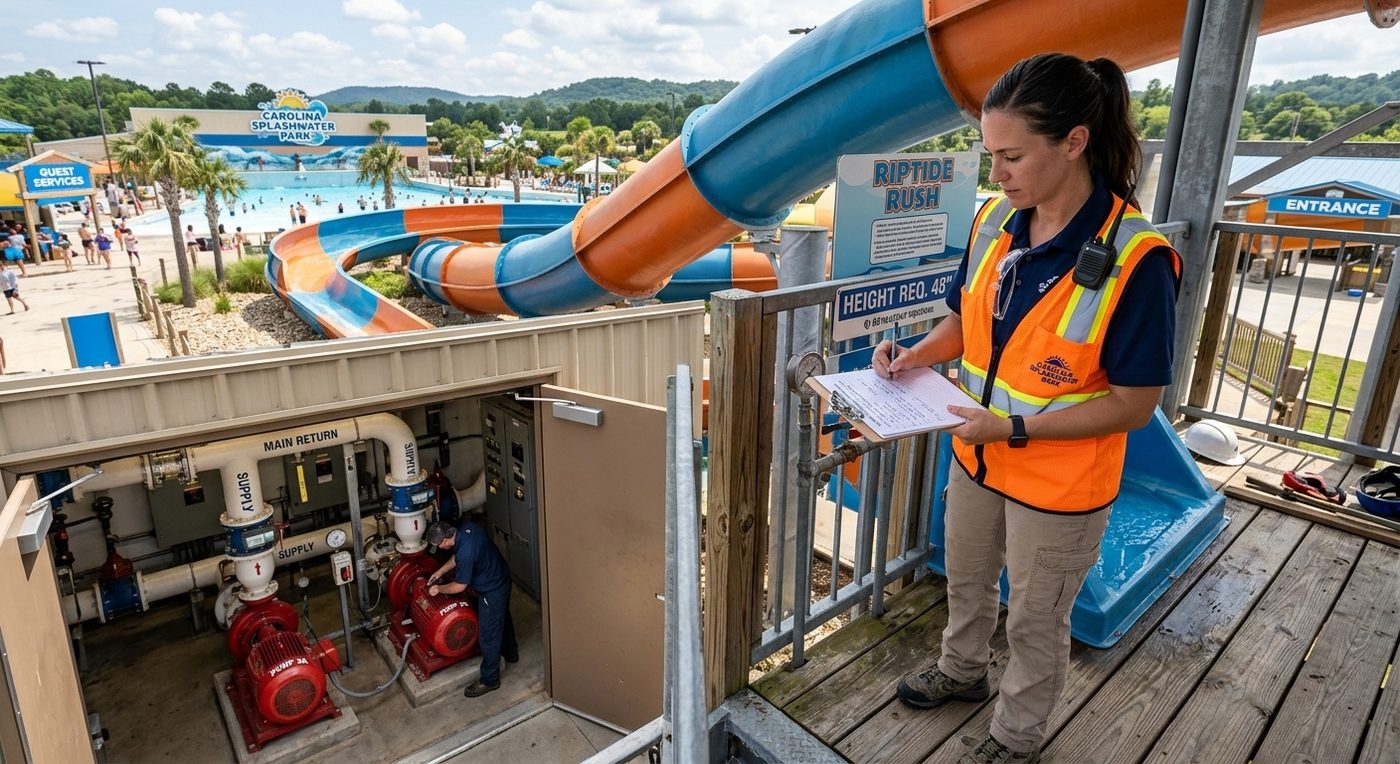
Operating a commercial waterpark involves far more than starting pump motors and admitting guests through entry turnstiles. Every operating day requires mechanical monitoring, strict chemical balancing, proactive crowd control, ride safety checks and coordinated aquatic rescue coverage across diverse attractions.
In high-volume facilities, facility owners and municipal authorities often partner with specialized commercial pool management operators to execute these complex workflows. A professional management company oversees the entire operational ecosystem, ensuring every attraction complies with public health sanitation rules and ride safety statutes from dawn until after closing.
This operational guide details the daily responsibilities managed by a waterpark operating firm, using the regulatory, environmental and statutory framework governing aquatic facilities in North Carolina.
| Quick Answer A waterpark management company handles pre-opening ride inspections, water chemistry testing, lifeguard rotation scheduling, slide dispatch pacing, mechanical maintenance and facility turnover every day. In North Carolina, daily operations must satisfy 15A NCAC 18A .2500 public swimming pool sanitation rules, documented drain cover checks, and mandatory daily pre-opening inspection logs under North Carolina Department of Labor (NCDOL) waterslide safety rules. |
Morning Pre-Opening Protocols
The operational day begins hours before guests arrive at the ticket windows. Management teams perform systematic mechanical, chemical and physical inspections across all catch basins, slide towers, spray grounds and lazy rivers.
Pre-opening checklists protect patron health and establish verified compliance documentation for state and county environmental health specialists.
Water chemistry testing and logging
Technicians perform comprehensive manual water testing before filtration systems adjust to daytime bather loads.
Under North Carolina administrative code 15A NCAC 18A .2535, public pools and interactive water attractions must maintain continuous disinfectant residuals and proper pH balance. Operators test free chlorine, total chlorine, pH, total alkalinity, calcium hardness and cyanuric acid across each isolated circulation system.files.
State regulations also require daily documentation of pool disinfectant levels, water pH, water clarity, chemical additions, and main drain cover integrity in the facility log.
Mechanical filtration and pump checks
Operators inspect commercial pump rooms to verify flow rates, turnover times and secondary disinfection systems.
Technicians examine commercial sand, cartridge or regenerative media filters to determine if backwashing is required prior to gate opening. They inspect chemical injection feed lines, clear pump strainers, check automated sensors, and verify secondary ultraviolet (UV) or ozone disinfection systems on high-turnover splash areas and wading attractions.
Surge tanks, balancing valves and variable frequency drives are inspected to confirm circulation velocities comply with state hydraulic standards.
Physical ride inspections and clear-runs
Every flume, speed slide, mat racer and wave generator undergoes physical inspection and testing before dispatching guests.
Under North Carolina General Statutes Chapter 95 Article 14B and 13 NCAC 15 .0410, commercial waterslides are regulated as amusement devices by the North Carolina Department of Labor (NCDOL). State rules mandate that an experienced operator must inspect control devices, water flows, structural joints, and safety equipment each day prior to opening, recording findings in a log retained for at least 12 months.
Technicians climb tower stairs, inspect fiberglass joints for cracks or rough seams, check water lubricating flow rates, clear foreign debris, and test ride dynamics using weighted test runs.
Deck safety and emergency hardware
Deck supervisors inspect walking perimeters, transition bridges, zero-depth entry points and queue lanes for surface hazards or standing water.
Personnel test emergency shut-off switches on wave generators, intake pumps and slide lift conveyors. They confirm that automated external defibrillators (AEDs), spine boards with head immobilizers and straps, bag-valve masks, rescue tubes, and first-aid supplies are stocked and positioned at marked response stations.
Staff also verify safety signage, depth markings, rules placards and patron height-measurement fixtures at every attraction entrance.
Daily Pre-Opening Audit Framework
| Inspection area | Key verification items | Primary operational goal |
| Mechanical plant | Turnover rate, filter differential, VFD frequency, pump strainers | Maintain hydraulic circulation and prevent equipment failures |
| Water quality | Free chlorine, total chlorine, pH, alkalinity, secondary UV output | Meet state health codes and eliminate waterborne pathogens |
| Slide towers & flumes | Seams, water flow, runouts, stair handrails, emergency stops | Prevent patron friction burns, joint impacts and structural failures |
| Wave pools & rivers | Grates, vacuum release systems, pneumatic blowers, wave gates | Ensure bather containment and anti-entrapment safety |
| Deck & safety staging | AEDs, spine boards, rescue tubes, depth signage, height posts | Prepare facility for rapid, coordinated emergency response |
Staffing and Surveillance
Managing waterpark surveillance requires continuous observation over shifting depths, water currents, visual obstructions and high bather densities.
An operating company builds, schedules and audits the aquatic team to eliminate supervision blind spots and lifeguard fatigue.
Zone coverage and staffing plans
Waterpark surveillance requires specialized positioning plans due to turbulent water features, blind turns, moving currents and splashdown basins.
Management teams design designated surveillance zones so lifeguards can scan their entire assigned water area within 10 seconds and reach a patron in distress within 20 seconds. Deep wave pools and multi-lane runouts require multiple overlapping lifeguard stations to maintain clear sightlines during heavy swimming cycles.
Supervisors place guards on elevated stands, roving perimeter posts, and shallow transition areas based on bather density and attraction layout.
Lifeguard rotations and fatigue management
Stationary guarding under summer heat causes cognitive and physical fatigue without structured rotations and relief schedules.
Operators implement rotation cycles, shifting lifeguards between elevated chairs, ground-level roaming posts, slide dispatch stations and indoor rest areas every 20 to 30 minutes. Regular off-stand intervals and hydration breaks keep surveillance personnel alert throughout their shifts.
Organizations operating regional commercial facilities can evaluate specialized lifeguard services in Charlotte to supply certified personnel trained specifically for high-capacity multi-attraction environments.
Dispatcher qualifications and supervision
Slide towers require dedicated operational oversight to manage loading zones and ride spacing.
North Carolina law explicitly defines waterslide dispatchers as employees stationed at the top of a waterslide to manage the queue and dispatch riders, requiring dispatchers to be at least 16 years of age. Management firms train dispatchers on height verification, approved riding postures, rider separation spacing, and emergency shutdown procedures.
Supervisors monitor tower decks to ensure dispatchers maintain clear visual or electronic communication with landing-pool guards before releasing riders.
Daily in-service training and audits
Daily operations include ongoing drills to maintain response readiness throughout the operating calendar.
Supervisors conduct quick-response drills, simulated submerged-victim drops, emergency action plan (EAP) walkthroughs, and spinal extrication training before opening or during scheduled mid-day breaks. Unannounced surveillance audits evaluate scanning discipline, posture and reaction times across all active water zones.
Daily training logs track drill participation, response times and rescue technique adjustments.
Guest Flow and Attraction Safety
High guest volume creates operational friction if queues, dispatches and transitions are not systematically managed.
Operating firms implement crowd controls that balance guest throughput with strict attraction safety guidelines.
Dispatch intervals and queue pacing
The timing between rider dispatches directly impacts attraction safety.
Attendants at slide launch platforms enforce height requirements, approved swimwear and riding posture restrictions. Dispatchers utilize line-of-sight visual checks, automated traffic-light sensors, or two-way radios with runout guards to confirm the landing basin is clear before sending the next guest.
Structured dispatch intervals prevent mid-flume collisions, tube entanglements and landing pool congestion.
Wave pool cycle controls
Wave pools alternate between calm swimming sessions and active hydraulic wave cycles, requiring coordinated operational management.
Operators activate audible warning alarms and visual strobes prior to engaging pneumatic blowers or hydraulic wave gates. When wave cycles begin, additional roving lifeguards move to perimeter positions to monitor bathers moving toward deeper water or struggling against currents.
When the wave cycle ends, staff clear congested entryways and direct exhausted swimmers toward shallow areas.
Height verification and accessibility management
Attendants enforce manufacturer safety parameters at ride entrances rather than at the top of launch towers.
Staff verify rider height using calibrated measurement stands, applying colored wristbands to distinguish non-swimmers, intermediate guests, and riders cleared for high-velocity flumes. Operations teams also support accessible access for guests using aquatic transfer equipment and zero-depth entry paths.
Enforcing ride rules at the queue entrance minimizes wait-time disputes and keeps tower stairways clear.
Maintenance and Crisis Response
Aquatic equipment operating under continuous bather loads experiences rapid mechanical wear. A waterpark management company provides continuous preventative maintenance, equipment troubleshooting and crisis containment.
The broader scope of pool management in Charlotte coordinates these mechanical, chemical, sanitation and risk-management responsibilities under a unified operating structure.
Commercial operators managing residential communities with integrated splash elements can also examine specialized HOA pool management in Charlotte, NC to align neighborhood recreation with state safety rules.
Continuous chemical balancing and filtration
High temperatures, heavy bather runoff and sun exposure consume chemical sanitizers rapidly during peak afternoon hours.
Operators monitor digital probes measuring oxidation-reduction potential (ORP) and pH, performing manual dosing adjustments to keep levels balanced. When heavy bather loads deplete sanitizer reserves in splash pads or catch basins, technicians adjust chemical feed systems to maintain required sanitizer levels without interrupting attraction operation.
Pump hair strainers and skimmer baskets are cleared throughout the day to preserve design flow rates.
Contamination and biological containment
Biological contamination incidents require immediate, scripted procedures based on public health standards.
Staff close affected basins immediately upon notification, clear all swimmers, and isolate filtration loops where valving allows. Operators raise disinfectant concentrations and maintain circulation to achieve the contact-time (CT) values required by health authorities for biological remediation before reopening.
Every incident, chemical adjustment, contact duration and reopening clearance is recorded in the permanent facility log.
Daily Waterpark Incident Protocols
| Incident category | Immediate operational action | Remediation & testing requirement | Clearance to reopen |
| Formed biological event | Evacuate basin; isolate recirculating loop; remove material | Raise free chlorine to 2.0 ppm at pH 7.5; circulate 30 minutes | Chemical balance confirmed via manual DPD testing |
| Diarrheal discharge | Clear water immediately; close circulation loop to other basins | Hyperchlorinate to achieve CT value of 15,300 (e.g., 20 ppm for 12.75 hours) | Backwash filter to waste; confirm target chemical parameters |
| Flume stoppage / collision | Trigger tower e-stop; halt dispatch; alert runout guards | Physical check of entire flume interior; inspect water lubrication | Dry run with test weight; supervisor ride sign-off |
| Pump cavitation / failure | Halt attraction intake; open auxiliary bypass valves | Clear intake strainers; check pump impeller; reset VFD | Verify required turnover flow and differential pressures |
| Severe weather / lightning | Sound lightning alarm; clear all exposed towers, decks and pools | Track storm cell via radar; enforce 30-minute delay from last strike | Supervisor all-clear signal; reset aquatic zones |
Evening Closing and Turnover
The operational day does not end when the final guest exits the gates. Evening closing procedures sanitize the facility, reset safety systems, and prepare the mechanical plant for the following day.
Thorough turnover prevents overnight bacterial growth, maintains water clarity, and preserves equipment longevity.
Facility sweeps and mechanical shutdown
Supervisors and security staff conduct a thorough sweep of the property, inspecting cabanas, locker rooms, pump rooms, slide tower platforms and perimeter fencing.
Operators power down slide booster pumps, hydraulic wave generators, air compressors, and conveyor systems in a planned sequence to prevent water hammer or electrical surges. Teams lock all perimeter gates, chemical storage rooms and mechanical buildings to secure the facility overnight.
Security sweeps ensure no guests remain in secluded areas or deep water zones after hours.
Filtration backwashing and pool cleaning
Night crews vacuum pool floors, skim floating surface debris, and backwash commercial filter batteries after bather circulation ceases.
Technicians clear heavy sediment, hair and oils from sand or regenerative media filters, discharging waste lines in compliance with local utility regulations. Automated or manual commercial vacuums clear settleable solids from lazy river trenches, wave pool floors, and slide runout troughs.
Automated chemical feeders are replenished with bulk sodium hypochlorite, pH adjusters, and specialty clarifiers to balance the water overnight.
Operational reporting and documentation
Before concluding the shift, supervisors compile the comprehensive daily operating record for facility owners, corporate records, and regulatory inspectors.
The daily report consolidates:
- Water chemistry logs and automated controller records
- Daily NCDOL waterslide inspection sheets and test-run verifications
- Lifeguard rotation schedules, gate counts, and daily in-service hours
- Incident reports, first-aid logs, and rescue documentation
- Mechanical repair tickets, backwash logs, and chemical usage volumes
North Carolina environmental health rules require facility operational records to be retained and accessible for health inspectors during annual permitting or routine compliance checks.f
Accurate daily documentation helps protect facility owners from legal liability and identifies preventative maintenance needs before they cause unscheduled downtime.
Hospitality properties operating resort-style water attractions can review how resort pool management in Charlotte, NC integrates complex leisure amenities into hotel guest services.
Commercial property owners and municipal planners can learn more about how waterpark management in Charlotte, NC integrates mechanical upkeep, regulatory compliance, daily staffing, and guest safety into a comprehensive operational model.
Regional facility owners can also evaluate broader aquatic management in Charlotte to coordinate commercial maintenance, safety auditing, and seasonal operations under a unified standard.
Frequently Asked Questions
What certifications does a waterpark management team hold?
Management personnel typically hold Certified Pool & Spa Operator (CPO) or Aquatic Facility Operator (AFO) credentials, along with Lifeguard Instructor (LGI) and comprehensive water safety certifications. Specialized mechanics also maintain manufacturer-specific certifications for ride hydraulics, fiberglass repair, and pneumatic wave generators.
How often is water tested in a commercial waterpark?
Water is tested multiple times per day. Facilities test and record free chlorine, pH, and water clarity before opening and throughout daily operation to satisfy county environmental health requirements under North Carolina public pool rules.files.nc+1
Who inspects waterslides on a daily basis?
Trained ride maintenance technicians and operations supervisors inspect flumes, stair towers, foundation joints, and water lubricator systems every morning. Under 13 NCAC 15 .0410, daily pre-opening inspections and operational tests must be completed and documented on record forms before admitting the public.
What age requirements apply to waterslide dispatchers in North Carolina?
Under North Carolina state law, waterslide dispatchers stationed at the top of a waterslide to manage queues and dispatch riders must be at least 16 years of age.
How do management companies prevent lifeguard fatigue in summer heat?
Companies use rotation schedules that move guards between elevated chairs, ground monitoring, shaded dispatch stations, and indoor rest areas every 20 to 30 minutes. Hydration stations, UV-protective uniforms, and scheduled off-stand breaks help guards maintain vigilance.
What happens when severe weather approaches an outdoor waterpark?
Operators monitor localized weather radar and lightning-detection systems. When a strike occurs within a specified radius (typically 8 to 10 miles), management initiates an orderly clearing of all elevated slide towers, open pools, and exposed decks, enforcing a 30-minute delay after the last detected strike before reopening.
Can a management company oversee third-party vendors and park concessions?
Yes. Full-service management firms often oversee concessions, cabana rentals, janitorial crews, retail outlets, and contracted security teams. Consolidating third-party oversight under one aquatic management structure ensures safety policies and sanitation standards remain consistent across the park.
What Does a Waterpark Management Company Handle Daily in North Carolina?