
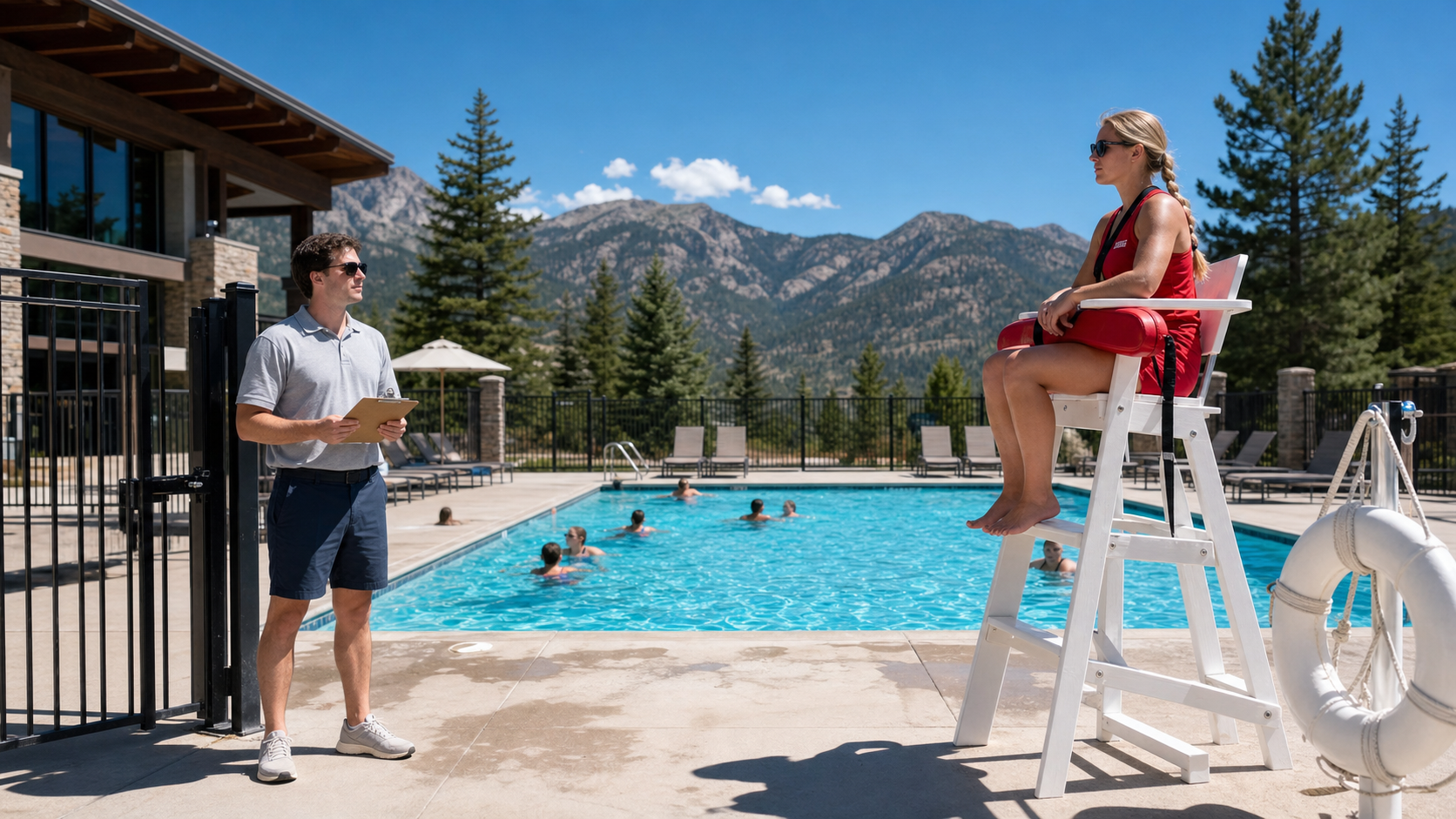
The difference between a pool attendant and a lifeguard is not a job title. It is a rescue capability, documented certification, and legal responsibility. A lifeguard is a rescue-trained professional accountable for active bather surveillance and water rescue. A pool attendant handles non-rescue work such as access control, rule enforcement, and deck monitoring.
Confusing the two is one of the more expensive mistakes a Colorado facility can make. If an attendant is staffed where rescue-trained supervision is required, the operator faces inspection findings, insurance complications, and real exposure after an incident. Drawing that line clearly is part of what professional pool management exists to resolve before the season starts rather than after a claim.
This guide covers what each role does, what certification applies in Colorado, when unguarded operation is permitted, and how the distinction shapes liability.
Quick Answer
A lifeguard holds current rescue certification, is assigned a defined surveillance zone, and is responsible for recognizing and responding to aquatic emergencies. A pool attendant is a non-rescue staff member who supports operations and cannot substitute for a certified lifeguard.
Colorado adds a layer that surprises some boards. Public and semi-public pools in the state fall under 5 CCR 1003-5, administered by the Colorado Department of Public Health and Environment, and each facility must have a Certified Pool Operator or Aquatic Facility Operator on staff or under contract. Since 2020, amendments to that regulation also authorize certain local entities to apply the Model Aquatic Health Code, 3rd Edition, along with locally adopted construction standards where the two conflict. In practice, that means your county or city health department, not a single statewide rule, often defines your supervision obligation.
What a Lifeguard Actually Does
A lifeguard is defined by responsibility for life safety, not by presence on the deck.
Local Colorado regulation frames this directly. Denver’s pool rules require every pool to have a competent, trained lifeguard in complete charge with authority to enforce safety rules, holding current first aid and CPR certification plus a recognized lifeguard credential, and require guards to be on duty at all times the pool is open to bathers.
Core responsibilities include:
- Continuous, active scanning of an assigned surveillance zone
- Recognizing a distressed or submerged swimmer quickly
- Performing water rescues and extrication
- Delivering CPR, AED use, and first aid
- Activating and executing the facility’s emergency action plan
- Enforcing the safety rules that prevent injuries in the first place
- Documenting incidents and completing required reports
Staffing ratio matters as much as credentials. Where lifeguards are required under Denver’s regulation, the minimum is one lifeguard per 50 people in the pool water, or fraction thereof. Zone design then determines whether that minimum is actually sufficient, since a guard has to be able to see and reach the full extent of an assigned area.
How those teams are recruited, credentialed, scheduled, and supervised is its own operational workload, which is why many operators structure lifeguard services across Colorado as a managed program rather than a seasonal hiring scramble.
What a Pool Attendant Does
A pool attendant, sometimes called a pool monitor or deck attendant, supports facility operation without providing rescue coverage. The work is operational rather than life-safety based.
Typical duties include:
- Verifying resident, member, or guest access
- Checking passes, badges, or key fobs
- Enforcing posted facility rules
- Monitoring guest counts and capacity limits
- Reporting hazards, chemical concerns, or equipment issues
- Keeping the deck clear and organized
- Managing furniture, towels, or amenity setup
- Contacting emergency services when needed
Colorado districts already make this distinction explicit in their own paperwork. One metro district waiver states plainly that pool staff such as pool monitors present to enforce rules are not lifeguards and do not assume lifeguard duties. An attendant can improve compliance and reduce nuisance problems, but presenting one as equivalent to a guard creates a false sense of protection for patrons and a real exposure for the operator.
Side-by-Side Comparison
| Factor | Lifeguard | Pool attendant |
| Primary purpose | Life safety and rescue response | Access control and facility support |
| Rescue certification | Required and current | Not required for the role |
| CPR, AED, first aid | Standard expectation | Often encouraged, not a rescue credential |
| Active water surveillance | Yes, assigned zone with response expectations | No, monitoring is operational |
| In-water rescue duties | Yes | No |
| Ratio-driven staffing | Yes, tied to bather load | Not applicable |
| In-service training | Ongoing facility requirement | Facility orientation only |
| Satisfies a lifeguard mandate | Yes, when qualified | No |
| Liability profile | Managed through training, documentation, and protocol | Higher risk if used as a guard substitute |
Certification: Where the Legal Line Sits
The clearest separation between the roles is documented certification. A lifeguard’s authority to supervise bathers comes from a recognized training program, a current certificate, and continuing facility-level training.
Colorado’s local regulations name acceptable credentials rather than leaving it open. Denver’s rules list American Red Cross Lifeguard Training, YMCA Lifeguard, National Lifeguard Service Canada, National Pool and Waterpark Lifeguard Training, or another current nationally recognized lifeguard program, alongside current first aid and CPR.
Practical implications for Colorado facility managers:
- Verify certificates are current, not merely on file.
- Confirm the certifying agency is recognized by your authority having jurisdiction, since local departments may apply the MAHC.
- Track expiration dates before the season opens rather than mid-July.
- Keep your CPO or AFO credential current, because it is a standing requirement for public and semi-public pools.
- Document pre-service evaluations for each guard.
- Maintain in-service training records with dates and attendance.
Support roles are treated differently and should be documented differently. Slide attendants, feature attendants, and similar positions supplement rescue-trained staff and never replace them. That single principle should govern every staffing decision you make.
Because credential tracking, seasonal recruiting, and ratio compliance run together, they are usually easier to sustain when supervision sits inside a broader Colorado pool management program with defined accountability for each piece.
When Lifeguards Are Typically Required in Colorado
Requirements vary by county and municipality, so your local health department and code determine the standard. Several triggers recur across Colorado jurisdictions and the MAHC framework local entities may apply.
Rescue-trained supervision is more likely to be required when:
- The pool is classified as a public facility rather than a limited-access or semi-public
- The venue is open for general public use rather than restricted to residents or members
- Water depth exceeds locally defined thresholds
- Unsupervised minors below a specified age are permitted
- Youth groups, swim teams, camps, or organized programs use the pool
- Slides, wave systems, or activity features are in operation
- Bather load or layout requires more than one surveillance zone
Denver’s regulation illustrates how the classification distinction works: pools generally require a trained lifeguard in charge, but limited-access pools are not obligated to employ or maintain a lifeguard on duty, provided a manager or other designated responsible person is on duty whenever swimming is permitted.
Facilities with attractions sit at the demanding end of this range. Multiple zones, moving water, and dedicated feature supervision change the math considerably, which is why staffing for waterpark operations in Colorado is built around zone coverage rather than a single headcount.
Non-Guarded Pool Rules
Some Colorado facilities may lawfully operate without lifeguards. No lifeguard does not mean no obligations, and jurisdictions that permit unguarded operation attach conditions in exchange.
Signage is the most prescriptive of these. Denver requires pools where no lifeguards are needed to post a warning sign in plain view reading “WARNING – NO LIFEGUARD ON DUTY” in legible letters at least four inches high. Guidance circulated to Colorado special districts goes further in practice, recommending signs at each entrance stating no lifeguard on duty and swim at your own risk, restricting younger patrons, and using annual liability waivers.
Practical takeaways for unguarded Colorado facilities:
- Letter height and wording are often specified, so a generic sign may not comply
- A designated responsible person may be required on duty during swimming hours
- Access control is frequently a condition of the exemption
- Age restrictions and solo-swimming limits are commonly posted
- Waivers supplement signage but do not replace regulatory requirements
- Requirements should be confirmed in writing with your local department
This is where the attendant role is legitimate and genuinely valuable. At a facility lawfully operating without guards, an attendant can satisfy access control, monitoring, and rule enforcement conditions without pretending to provide rescue coverage. Community associations weighing guarded against unguarded models will find that decision is usually the central question in HOA pool management in Colorado, because it drives budget, hours, and board exposure at the same time.
How the Distinction Drives Liability
Exposure usually comes less from the absence of lifeguards than from the gap between what a facility represents and what it actually provides.
| Exposure | What creates it | What reduces it |
| Non-compliant staffing | An attendant used where guards are required | Written confirmation of classification with the local department |
| Implied rescue capability | Rescue-style uniforms, elevated chairs, rescue tubes on non-guards | Distinct uniforms and clear patron messaging |
| Lapsed credentials | Certificates expiring mid-season | Expiration tracking before opening |
| Missing documentation | No zone plan, in-service logs, or emergency action plan | Written, dated records kept on site |
| Signage violations | Wrong wording, letter height, or placement | Signs matching local specifications |
| Distracted surveillance | Guards checking passes or cleaning during coverage | Attendants assigned to non-rescue tasks |
Volunteer boards carry particular risk here, because amenity decisions get made without an aquatics specialist in the room. Documenting exactly which role is covering the water, during which hours, is the first step in any aquatic management program in Colorado that is meant to hold up under review.
Building a Defensible Staffing Model
Strong facilities do not choose between attendants and lifeguards. They define both roles and staff each deliberately.
- Written role definitions stating clearly whether the position includes water rescue responsibility
- Verified certifications from recognized agencies, tracked with expiration dates
- A current CPO or AFO of record for the facility
- A documented zone plan with defined coverage and response expectations
- A written, practiced emergency action plan known to guards and attendants alike
- Visual distinction between rescue-trained staff and non-rescue attendants
- Patron communication that reflects actual coverage, including unguarded hours
- Protected surveillance time, with guards free of duties that pull attention from the water
- In-service training records for all rescue staff
- Consistent incident, near-miss, and rule-violation reporting
- Periodic review against current local code rather than last season’s assumptions
Hotels and amenity-driven properties frequently run both roles at once, with guards on the main pool and attendants managing access and rule enforcement across the deck. That combined model is standard in resort pool management in Colorado, where occupancy swings and extended hours make a single staffing pattern impractical.
Which Role Does Your Facility Need?
Work through these questions before finalizing a schedule:
- How does your local department classify the pool – public, semi-public, or limited access?
- Does that classification require a lifeguard on duty whenever the pool is open?
- Do you permit unsupervised minors below a specified age?
- Do youth groups, teams, camps, or programs use the water?
- Do slides or features require dedicated supervision?
- Can one guard view and reach the full extent of each zone?
- At expected bather loads, does the applicable ratio require more than one guard?
- If operating unguarded, are signage, access control, and a designated responsible person all in place?
- Is access control currently unmanaged?
- Do residents believe someone is watching the water when no guard is present?
- Are all lifeguard, CPR, and operator credentials current and documented?
If the answer to any lifeguard-requirement question is yes, rescue-trained staffing is the baseline, with attendants layered on where access and rule enforcement need attention.
Common Misconceptions
An attendant is basically a lifeguard without the swimming part.
Rescue capability is the defining element. Remove it and the role changes entirely.
A swim-at-your-own-risk sign transfers liability.
Signage is generally a regulatory requirement with specified wording and letter height, not a shield.
Our attendant is CPR certified, so we are covered.
CPR is valuable but is not a lifeguard credential and does not establish rescue-trained supervision.
We only need guards during busy hours.
Where guards are required, they are typically required whenever the pool is open for use.
Last year’s certifications are still fine.
Lifeguard and CPR credentials run on renewal cycles and must be current during active duty.
One guard can cover the whole facility.
Coverage depends on zone visibility, reach, and the applicable bather ratio.
Final Recommendation
Treat the attendant-versus-lifeguard question as a compliance boundary, not a scheduling preference. Attendants strengthen access control, rule enforcement, and daily operations. Lifeguards provide rescue-trained supervision that no attendant can replace.
Confirm your classification with the local health department, verify every credential including your operator certification, document your zone and emergency plans, and make sure resident communication matches the coverage you actually provide.
If you are working through staffing levels, certification tracking, or unguarded-operation conditions for the coming season, the specifics for your facility can be reviewed as part of a bid request.
Frequently Asked Questions
What is the difference between a pool attendant and a lifeguard?
A lifeguard is rescue certified and responsible for active bather surveillance and emergency response within an assigned zone. A pool attendant performs non-rescue duties such as access control, capacity monitoring, and rule enforcement, and Colorado district documents state directly that pool monitors do not assume lifeguard duties.
Can a pool attendant replace a lifeguard in Colorado?
No. Where a lifeguard is required, an attendant does not satisfy the requirement. Limited-access pools that are exempt still need a manager or designated responsible person on duty whenever swimming is permitted.
What certification does a Colorado lifeguard need?
Current first aid and CPR plus a nationally recognized lifeguard credential such as American Red Cross Lifeguard Training or an equivalent recognized program. Confirm which agencies your local department accepts.
Does my facility need a certified operator as well?
Yes. Public and semi-public pools in Colorado must have a Certified Pool Operator or Aquatic Facility Operator on staff or under contract for each facility.
What signage is required when no lifeguard is on duty?
A conspicuous warning sign is required, with Denver specifying “WARNING – NO LIFEGUARD ON DUTY” in letters at least four inches high. Many Colorado districts add swim-at-your-own-risk wording and age restrictions.
How many lifeguards does a Colorado pool need?
Where guards are required, Denver’s rule sets a minimum of one lifeguard per 50 people in the water, or fraction thereof. Zone layout, features, and rotation needs can push the actual requirement higher.