
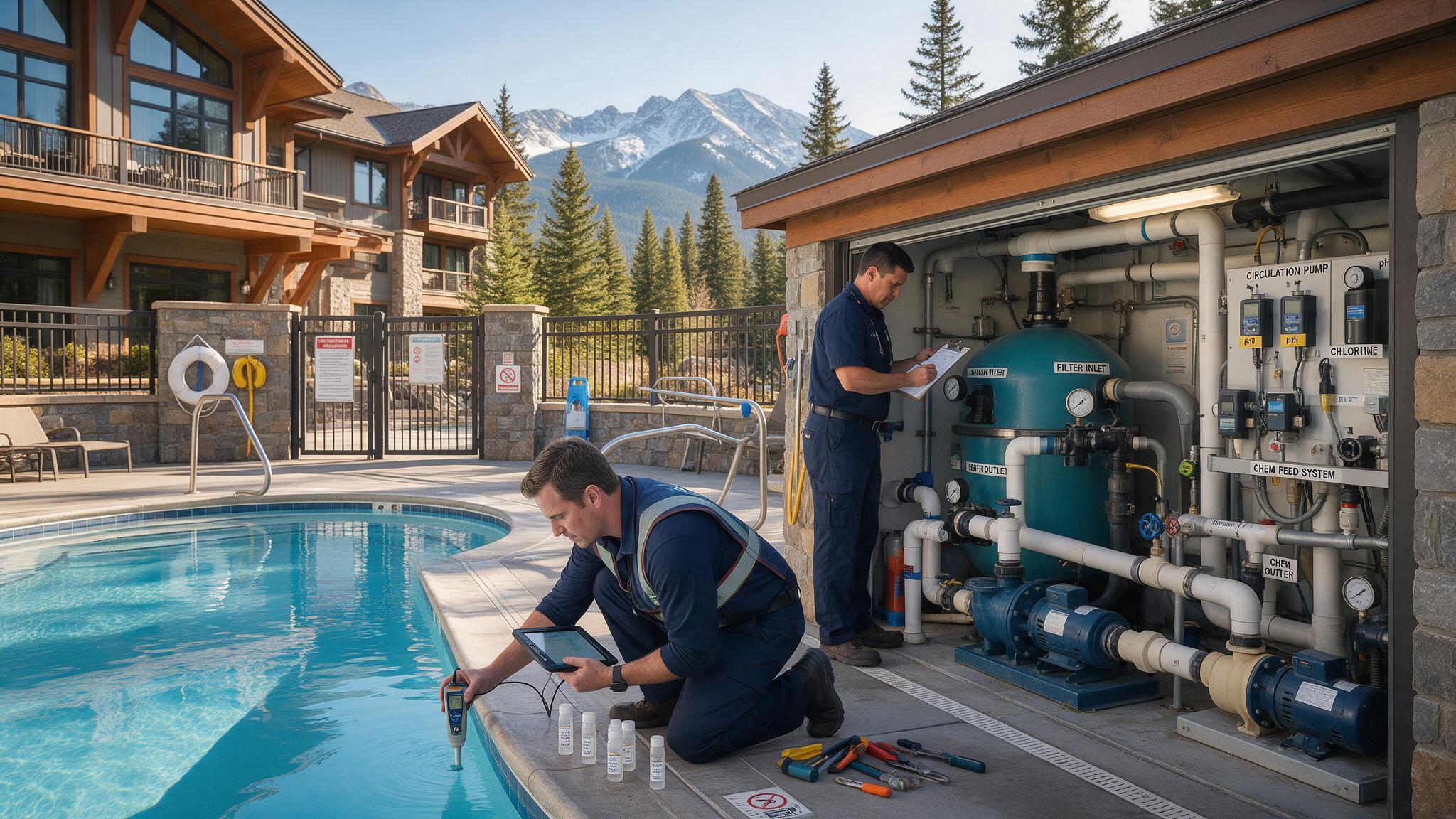
Effective Colorado resort pool management connects daily aquatic management in Colorado with guest service, preventive maintenance, staffing and local regulatory requirements. The pool may appear to guests as a single amenity, but operating it requires coordination across engineering, housekeeping, security, recreation and hotel leadership.
Colorado adds another layer of complexity. Denver resort pools deal with dry air, strong sunlight and fluctuating outdoor temperatures. Mountain properties must also plan for higher elevations, freeze-thaw cycles, seasonal staffing, winter access and longer lead times for parts or specialist support.
This guide outlines a practical operating model for hotels and resorts across Colorado.
| Quick Answer Colorado resort pool management should cover six connected areas:Water quality and circulationPreventive equipment maintenanceSafety and facility inspectionsStaffing and operating proceduresSeasonal and high-altitude planningGuest communication and experienceA resort should maintain written operating procedures for opening checks, water testing, cleaning, equipment review, incident response and closing duties. The plan should distinguish between routine work, urgent corrections and issues that require the pool to close. |
Colorado public pools and mineral baths are regulated under 5 CCR 1003-5. Local authorities may also enforce additional requirements or use locally adopted standards, so operators should confirm the rules that apply to each property rather than relying on one statewide checklist.
Build the Operating Plan
A resort pool should not depend on informal knowledge held by one engineer or recreation manager. The operating plan needs to define responsibilities, schedules and escalation procedures that other trained staff can follow.
Map Every Aquatic Venue
Begin with a complete inventory.
A Colorado resort may operate:
- Indoor swimming pool
- Outdoor pool
- Spa or hot tub
- Children’s pool
- Therapy pool
- Waterslide
- Splash feature
- Sauna or steam area
- Seasonal water feature
Each venue has different circulation, heating, chemical, inspection and staffing requirements.
Create an asset register containing:
| Item | Information to record |
| Venue | Pool, spa, slide or water feature |
| Location | Building, deck or property area |
| Capacity | Design or posted capacity |
| Operating season | Year-round or seasonal |
| Equipment | Pumps, filters, heaters and controllers |
| Safety systems | Gates, signs, alarms and rescue equipment |
| Documentation | Manuals, warranties and inspection records |
| Responsible team | Engineering, recreation or external service |
| Critical parts | Replacement items that should remain available |
Include connected equipment rather than documenting only the visible pool. A spa heater, chemical controller or circulation pump can affect operations even when it is located in a separate mechanical room.
Assign Ownership
Every recurring task needs a named role.
| Responsibility | Possible owner |
| Opening inspection | Aquatics or engineering lead |
| Water testing | Trained pool operator |
| Mechanical review | Engineering team |
| Deck cleaning | Housekeeping or aquatics |
| Safety equipment check | Aquatics supervisor |
| Guest communication | Front desk or recreation |
| Incident escalation | Manager on duty |
| Corrective maintenance | Engineering or service contractor |
| Documentation review | Operations leadership |
Avoid assigning tasks only to a department. “Engineering checks the equipment” is less useful than a schedule that identifies the role, time and required record.
The plan should also identify who has authority to restrict access when water quality, visibility, circulation or safety equipment does not meet the applicable requirement.
Establish Daily Routines
Daily work should follow a repeatable sequence.
An opening routine may include:
- Check water clarity and appearance.
- Record required water measurements.
- Verify circulation.
- Review controller readings.
- Inspect drains, covers and fittings.
- Check gates, latches and barriers.
- Confirm signs are visible.
- Inspect rescue and first-aid equipment.
- Walk the deck for trip or slip hazards.
- Check lighting and emergency communication.
- Confirm temperatures.
- Record unresolved defects.
Closing duties may include final readings, deck review, equipment checks, cleaning, access control and notes for the next shift.
These routines should become part of a broader aquatic facility maintenance programme rather than separate tasks performed only when a problem becomes visible. The facility-maintenance scope should extend beyond chemistry to circulation, equipment, surfaces and supporting systems.
Use Inspection Records
Inspection records create consistency between shifts and help management identify recurring problems.
A practical facility inspection checklist can cover:
- Test kits and supplies
- Rescue equipment
- Safety signs
- Gates and latches
- Skimmers and drain covers
- Filters and pressure gauges
- Pumps and motors
- Chemical feed equipment
- Pool lighting
- Maintenance tools
- Deck and shell condition
- Handrails and ladders
- Covers and winter equipment
The existing facility checklist also records photographic evidence for items such as drain grates, filter tanks, motor condition, tile, decks and drains.
Do not treat a completed checklist as proof that every problem was corrected. Assign each failed item an owner, priority and target date.
Manage Colorado Conditions
Colorado hotel pool operations should account for elevation, weather, water loss and seasonal demand.
Conditions can differ significantly between Denver, the Front Range and mountain resort communities.
Plan for High Altitude
High-altitude pool management requires closer attention to water loss, sanitizer demand and equipment performance.
Stronger ultraviolet exposure can accelerate sanitizer loss in outdoor pools, while dry air and wind can increase evaporation. Evaporation leaves dissolved minerals behind, which can change water balance over time.
Operational responses may include:
- Testing according to the applicable operating plan
- Trending results rather than viewing readings in isolation
- Checking automatic controllers against manual tests
- Monitoring make-up water
- Reviewing calcium and total dissolved solids
- Inspecting exposed finishes
- Adjusting schedules after heavy use or weather changes
- Following manufacturer guidance for equipment at elevation
Do not copy chemical dosing from a lower-elevation property. Each pool has a different volume, bather load, source water, treatment system and operating environment.
Separate Denver and Mountain Needs
| Operating factor | Denver and Front Range | Mountain resort communities |
| Elevation | High compared with many US markets | Often substantially higher |
| Seasonality | Outdoor season plus year-round indoor demand | Strong ski, holiday and summer peaks |
| Weather | Heat, dry air, hail and rapid changes | Snow, ice, freeze-thaw and cold starts |
| Staffing | Larger local labour pool | Seasonal recruitment and housing constraints |
| Supply access | Generally shorter delivery times | Longer lead times and weather disruption |
| Guest demand | Business, leisure and group travel | Vacation peaks and après-ski spa use |
| Equipment planning | UV and heat exposure | Freeze protection and cold-weather access |
A Denver property may focus on outdoor summer demand and conference-group turnover. A mountain resort may experience its heaviest spa use during winter, when exterior access and mechanical-room ventilation present different challenges.
Account for Seasonal Demand
Resort demand is rarely constant.
Review occupancy forecasts alongside:
- Pool and spa operating hours
- Staffing schedules
- Testing frequency
- Cleaning schedules
- Towel demand
- Group bookings
- Holiday periods
- Weather forecasts
- Planned maintenance
High occupancy can increase bather load quickly. A spa that performs well during a quiet midweek period may require closer operational attention during a sold-out holiday weekend.
Plan preventive work during lower-demand windows. Do not wait until peak season to identify failing heaters, worn pump seals or damaged deck surfaces.
Prepare for Winter
Outdoor venues need a documented winter plan.
Depending on the facility, planning may cover:
- Draining or protecting exposed lines
- Winterizing water features
- Inspecting covers and anchors
- Protecting pumps and valves
- Controlling access
- Removing standing water from decks
- Monitoring ice formation
- Documenting equipment status
- Scheduling reopening inspections
Indoor facilities also need winter planning. Condensation, ventilation and heating problems can affect the pool enclosure, ceilings, windows and adjacent spaces.
Freeze damage or recurring surface deterioration may require planned pool renovations rather than repeated temporary repairs.
Coordinate Safety and Staffing
Safety at a resort pool depends on the facility design, operating model, staffing plan and response procedures.
A staffed aquatic venue and an unstaffed hotel pool require different controls.
Confirm Local Requirements
Colorado’s statewide regulations apply to public pools and mineral baths, but local agencies may handle plan reviews, licensing or inspections.
Denver’s public-health agency regulates public swimming facilities in hotels, apartment complexes, recreation centres, hospitals and health clubs. New or extensively remodelled aquatic venues in Denver require health plan review.
Summit County states that commercial and public pools require plan review for new construction or major remodelling and must have a certified pool operator on staff while operating.
Because requirements can vary, operators should verify:
- Which agency has jurisdiction
- Whether a licence is required
- Operator-certification requirements
- Inspection frequency
- Recordkeeping requirements
- Plan-review requirements
- Local closure criteria
- Renovation approval procedures
Confirm these points directly with the relevant state or local authority before opening, renovating or changing operations.
Define Inspection Priorities
Pool inspections should cover more than water measurements.
| Inspection area | Examples |
| Water | Clarity, temperature and required chemical readings |
| Circulation | Flow, skimmers, drains, filters and gauges |
| Chemical systems | Feeders, controllers, storage and ventilation |
| Access | Gates, latches, doors and restricted areas |
| Deck | Drainage, slip hazards, cracks and obstructions |
| Safety equipment | Rescue devices, signs and communication |
| Electrical | Lighting, panels and applicable protection |
| Accessibility | Lifts, rails and accessible routes |
| Documentation | Logs, incidents, maintenance and corrective actions |
Denver identifies conditions such as inadequate disinfection, unacceptable pH, insufficient water clarity, unsecured drain grates and unavailable emergency communication as reasons for immediate closure.
Site procedures should specify who verifies corrections and who authorizes reopening.
Decide When Lifeguards Are Needed
The staffing model should be based on the venue, activities, guest profile and applicable requirements.
Factors include:
- Pool depth and shape
- Slides or diving features
- Planned programmes
- Children’s activities
- Expected attendance
- Visibility
- Operating hours
- Local regulations
- Property risk assessment
If lifeguards are used, define qualifications, zones, breaks, rotations, equipment and supervision. A Colorado lifeguard services plan should also address recruitment, training records, attendance and replacement coverage.
Lifeguards should not be assigned maintenance or guest-service duties that interfere with active surveillance.
Prepare Incident Procedures
Written procedures should cover:
- Medical emergency
- Water rescue
- Missing guest
- Contamination event
- Chemical exposure
- Equipment failure
- Severe weather
- Power interruption
- Water-quality failure
- Guest complaint
- Temporary closure
Post emergency responsibilities by role. Staff should know who contacts emergency services, who manages the scene, who communicates with guests and who preserves records.
General pool safety planning should be integrated with the resort’s wider emergency and security procedures rather than maintained as an isolated aquatic document.
Protect the Guest Experience
Guests notice water appearance, temperature, cleanliness and availability long before they see an operations log.
Reliable management should support the guest experience without hiding necessary closures or maintenance.
Set Service Standards
Define measurable standards for:
- Opening readiness
- Water appearance
- Temperature
- Deck cleanliness
- Towel availability
- Furniture arrangement
- Sign condition
- Lighting
- Response to guest reports
- Communication during closures
Avoid using vague standards such as “pool looks good.” Staff should know what to inspect and what requires escalation.
Communicate Closures Clearly
When a pool or spa must close, provide consistent information across:
- Front desk
- Guest messaging
- Property app
- In-room materials
- Signage
- Concierge
- Recreation staff
State what is unavailable, when the next update will occur and whether another facility is available. Do not promise a reopening time before the required checks and repairs are complete.
Review Guest Feedback
Track comments involving:
- Water temperature
- Cleanliness
- Odour
- Crowding
- Noise
- Towel supply
- Furniture
- Accessibility
- Operating hours
- Unexpected closures
A repeated complaint can reveal an operational problem even when individual inspection readings appear acceptable.
Plan Aquatic Programming
Programming may include:
- Family swim periods
- Lap swimming
- Fitness sessions
- Private events
- Children’s activities
- Seasonal recreation
- Instruction
Programmes affect staffing, bather load, equipment and deck layout. If the property offers swim lessons, the operating plan should account for instructor space, class scheduling, participant flow and coordination with regular guests.
Use a Management Scorecard
A monthly scorecard helps general managers see whether the aquatic operation is improving or simply responding to emergencies.
| Measure | What it reveals |
| Unplanned closures | Operational reliability |
| Preventive work completed | Maintenance discipline |
| Repeat equipment failures | Root-cause problems |
| Inspection deficiencies | Safety and compliance gaps |
| Water-quality exceptions | Treatment stability |
| Labour coverage | Staffing resilience |
| Guest complaints | Experience problems |
| Energy and water use | Resource efficiency |
| Corrective-action age | Speed of issue resolution |
| Training completion | Workforce readiness |
Review trends by venue. Combining an indoor pool, outdoor pool and spa into one total can hide a recurring problem in one system.
Frequently Asked Questions
What Does Colorado Resort Pool Management Include?
It typically includes water-quality monitoring, equipment maintenance, inspections, cleaning, staffing, documentation, incident planning and guest communication.
The exact scope depends on the facility and local requirements.
How Does Altitude Affect Colorado Resort Pools?
Higher elevation, stronger sunlight, dry air and wind can increase evaporation and sanitizer demand in outdoor pools.
Operators should trend water measurements, monitor make-up water and follow site-specific operating procedures.
Are Denver Hotel Pools Inspected?
Denver’s public-health agency regulates and routinely inspects public swimming facilities, including hotel pools.
Operators should confirm licensing, inspection and plan-review requirements directly with the city.
Do Colorado Resorts Need Certified Pool Operators?
Requirements should be confirmed with the authority responsible for the property.
For example, Summit County states that commercial and public pools must have a certified pool operator on staff while operating.
How Often Should Resort Pools Be Inspected?
Daily operational checks should follow the facility’s written procedures and applicable regulations.
Mechanical, structural and regulatory inspections should also follow planned schedules, with additional checks after repairs, incidents or severe weather.
What Should a Resort Pool Opening Checklist Cover?
It should cover water quality, clarity, circulation, equipment, gates, signs, rescue equipment, deck conditions, temperatures and unresolved defects.
The results should be recorded and reviewed before guests enter.
How Should Mountain Resorts Prepare Pools for Winter?
Planning may include freeze protection, line and equipment winterization, cover inspection, ice control, restricted access and a documented reopening process.
Indoor venues should also monitor heating, ventilation and condensation.
What Should General Managers Track?
Track closures, equipment failures, water-quality exceptions, corrective-action time, staffing gaps, inspection findings, guest complaints and preventive maintenance completion.
These measures connect technical performance with risk, cost and guest experience.