
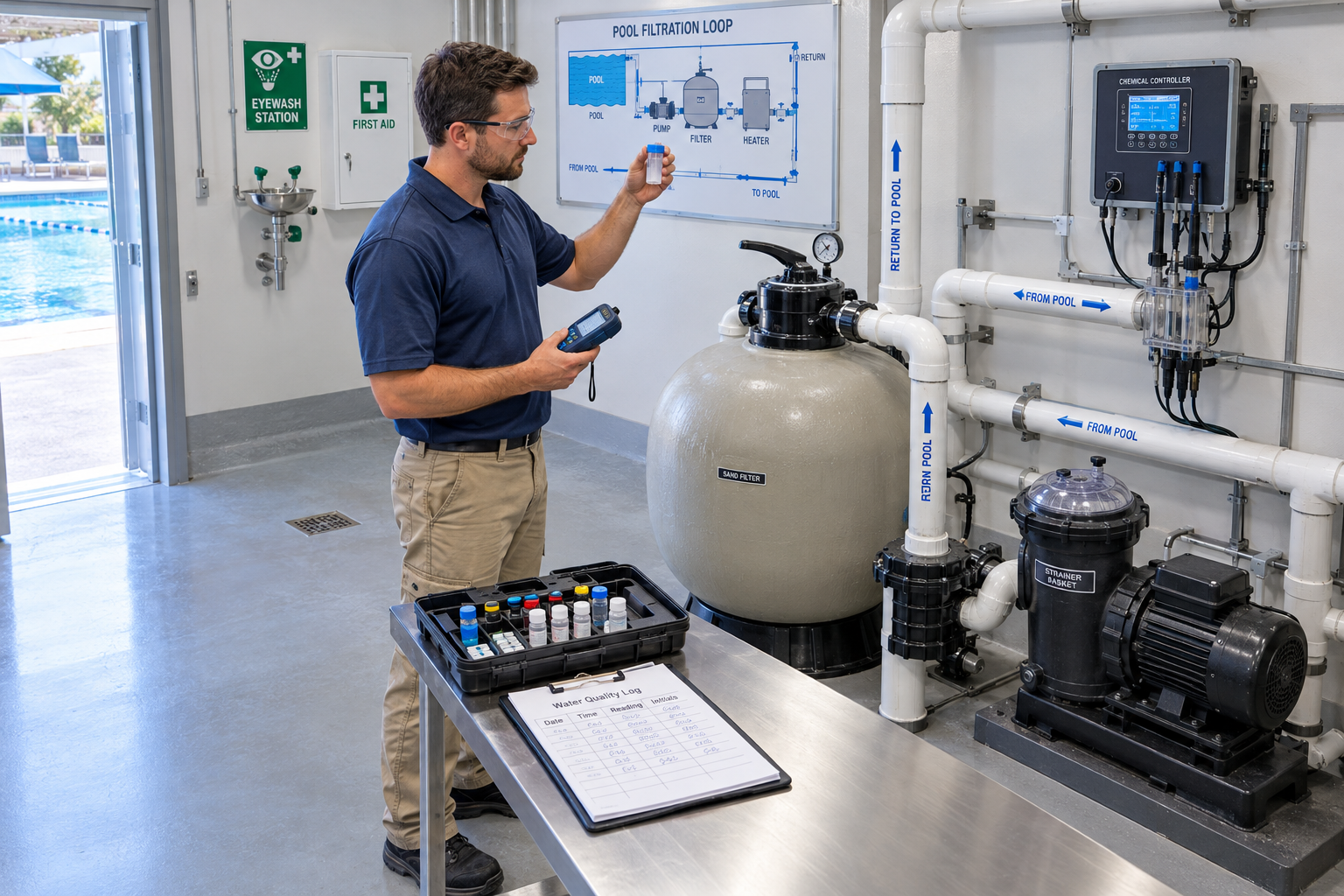
A certified pool operator helps manage the water quality, equipment and operating procedures that support a well-maintained aquatic facility. Within a broader aquatic facility management program, the operator connects technical checks with documented action.
The work goes beyond adding chemicals or cleaning the pool. It involves understanding how disinfection, filtration, circulation, equipment condition and operating rules affect one another.
For facility managers, knowing what the role includes makes it easier to assign responsibility and evaluate service coverage. For aspiring operators, it clarifies what certification teaches and what still needs to be learned at the facility.
| Quick Answer A certified pool operator monitors water chemistry, checks operating equipment, maintains records and helps address unsafe conditions. The Certified Pool & Spa Operator credential, commonly called CPO, is administered by the Pool & Hot Tub Alliance. Certification demonstrates completion of its training and examination requirements, but it does not automatically replace local licensing, facility permits or lifeguard qualifications. |
Understand the Operator’s Responsibilities
What Is a Certified Pool Operator?
In everyday use, “certified pool operator” can describe someone holding an accepted pool-operation credential.
CPO also identifies a specific certification: the Certified Pool & Spa Operator credential administered by the Pool & Hot Tub Alliance, or PHTA. Its training addresses disinfection, water balance, chemical testing, troubleshooting, recordkeeping and operational hazards.
The distinction matters when reviewing a job application or service proposal. Ask which credential the person holds rather than relying on a general statement that they are “pool certified.”
Also verify whether that credential satisfies the requirements of the authority responsible for your facility.
Monitor Water Quality
One of the operator’s central responsibilities is understanding what the water-test results mean and what action is needed.
Depending on the facility and applicable requirements, monitoring may include disinfectant levels, pH, alkalinity, calcium hardness, stabilizer concentration and water clarity.
The operator should understand the testing method, appropriate operating limits and the response to an unacceptable result.
A complete pool maintenance program should define who performs testing, how results are recorded and when the operator must be notified.
Avoid assuming that one set of targets or one testing schedule applies to every pool, spa and aquatic feature.
Check Circulation and Filtration
Water treatment depends on more than chemical readings. The operator also needs to understand how water moves through the treatment system.
Typical checks may include flow readings, filter pressure, pump operation, visible leaks and chemical-feed equipment.
| Operating area | What the operator evaluates | Why it matters |
| Circulation | Flow readings and signs of interrupted movement | Helps identify problems with water movement through the system |
| Filtration | Pressure readings, loading and maintenance needs | Supports removal of suspended material |
| Chemical feed | Equipment condition, alarms and delivery problems | Helps identify failures affecting treatment |
| Controls | Readings, settings and unusual trends | Supports troubleshooting and informed adjustments |
| Physical condition | Leaks, damage and abnormal noise | Helps identify maintenance needs |
These checks do not authorize every operator to perform every repair.
Electrical work, major equipment modifications and other specialist tasks may require separate qualifications, permits or licensed contractors.
Maintain Useful Records
An operating log should explain what happened, not simply show that someone checked a box.
Useful entries identify the time, measurement, person performing the test and any corrective action. Follow-up readings help establish whether the response worked.
An operator may also maintain records of equipment service, chemical use, incidents, closures and communication with management or inspectors.
The required format and retention period depend on the jurisdiction. Do not assume that a convenient spreadsheet or automated report satisfies every local requirement.
Recognize When Operation Must Stop
A qualified operator needs to recognize conditions that require restricting use, closing a feature or escalating a problem.
Examples can include unacceptable water quality, impaired visibility, treatment-system failure or a contamination incident.
The response should follow the facility’s written procedures and applicable requirements. Staff should know who can initiate a closure, who must be notified and what evidence is needed before reopening.
Certification does not give an operator authority to disregard an inspector’s closure order or approve reopening when regulatory permission is required.
Support Inspections and Corrective Work
An operator helps make inspections more productive by maintaining accessible records and understanding the facility’s equipment and operating history.
Internal reviews can identify missing documentation, recurring equipment problems and unresolved hazards before an official inspection.
A structured aquatic facility inspection can support this process, but it does not replace an official inspection or regulatory approval.
After a finding, assign responsibility for the correction and document how completion will be verified.
Handle Chemicals Within Training Limits
Pool chemicals require appropriate handling procedures, storage arrangements and staff training.
The operator should understand the products in use, their labels, safety data sheets and required protective measures. Chemical work should follow manufacturer instructions and the facility’s procedures.
A broader pool safety program should also explain how staff report leaks, spills, equipment faults and suspected exposure.
Holding a certificate is not a reason to improvise a spill response or perform unfamiliar chemical work without appropriate training.
Understand the Lifeguard Boundary
Pool operators and lifeguards perform different functions.
The operator focuses on treatment systems, water quality and operational conditions. A lifeguard focuses on patron surveillance, rescue and emergency response within their training.
| Role | Primary focus | What should not be assumed |
| Certified pool operator | Water treatment, equipment monitoring and operating records | Automatically qualified to provide lifeguarding |
| Lifeguard | Surveillance, rescue and emergency response | Automatically qualified to operate treatment systems |
| Maintenance technician | Assigned cleaning, servicing and repair tasks | Holds an accepted operator credential |
| Aquatics manager | Staffing, procedures, communication and overall coordination | Personally holds every credential required for the team |
Someone may hold more than one qualification. However, that does not mean they can perform conflicting duties simultaneously.
When arranging pool lifeguard coverage, keep surveillance assignments separate from tasks that pull attention toward equipment rooms, testing or repairs.
See the Role in Practice
Consider a hypothetical facility where morning readings are acceptable, but disinfectant levels begin dropping during heavy afternoon use.
An operator’s response should involve more than repeatedly adding chemicals.
The investigation may include confirming the result, reviewing recent readings, checking treatment equipment and following the facility’s response procedures. If conditions require closure, staff should implement it rather than continue operating while troubleshooting.
This example illustrates the value of training: connecting measurements with equipment performance, documentation and decisions.
It is not a treatment procedure. The correct response depends on the facility, applicable requirements and the cause of the problem.
Understand CPO and AFO Credentials
Who Issues CPO Certification?
PHTA administers the Certified Pool & Spa Operator certification program.
The published prerequisites include completing the CPO course and passing the examination. Prior industry experience is not required.
The credential is valid for five years. PHTA also provides a digital CPO badge that can help verify certification.
“PHTA certification” is a broader description than “CPO certification,” because the organization offers multiple credentials. Always confirm the exact designation.
How Do You Become a CPO?
Start by confirming that the credential and course format are accepted for the work you intend to perform.
PHTA describes a 16-hour classroom course delivered over two days. It also offers a blended route combining online learning with one day of instructor-led classroom instruction, totaling 16 hours.
Virtual instruction is available where approved. Confirm the current course arrangements, examination process and local acceptance before registering.
A practical sequence is:
- Identify the requirements for your intended facility or jurisdiction.
- Choose an authorized course and accepted delivery format.
- Complete the required instruction.
- Pass the CPO examination.
- Keep your credential documentation accessible.
- Complete facility-specific training before taking responsibility for unfamiliar systems.
Completing an online learning component alone should not be confused with earning the full certification.
What Does the AFO Credential Cover?
The Aquatic Facility Operator credential, or AFO, is administered by the National Recreation and Park Association, known as NRPA.
Its subject areas include water chemistry and disinfection, mechanical systems, health and safety, daily operations and maintenance.
NRPA states that candidates should be at least 18 years old. There are no education or experience prerequisites for taking the examination.
The AFO examination is open-book and contains 50 questions. Certification is valid for five years.
How Do CPO and AFO Compare?
Both credentials address pool operation, but they come from different organizations and have different certification pathways.
Neither should be described as automatically superior or universally accepted.
| Feature | CPO | AFO |
| Full credential name | Certified Pool & Spa Operator | Aquatic Facility Operator |
| Issuing organization | Pool & Hot Tub Alliance | National Recreation and Park Association |
| Core subject areas | Water treatment, testing, troubleshooting, recordkeeping and operational safety | Water chemistry, mechanical systems, health and safety, operations and maintenance |
| Certification requirement | Complete the required course and pass the examination | Pass the AFO examination |
| Published learning routes | Classroom and blended options; virtual availability where approved | In-person, virtual and blended courses; a proctored exam-only option |
| Credential validity | Five years | Five years |
| Local acceptance | Confirm with the responsible authority | Confirm with the responsible authority |
Choose based on the facility’s requirements, employer expectations, available instruction and accepted credentials.
Do not assume that either certificate is equivalent to a government-issued license.
Is Certification a Pool Operator License?
A professional certification demonstrates that an individual has met the issuing organization’s requirements.
A pool operator license, registration or other governmental approval is a separate matter. The terminology and requirements vary by jurisdiction.
Some authorities accept specified national credentials as part of their operator requirements. Others may require additional steps or impose different conditions.
Before assigning responsibility, confirm:
- Which credentials the authority accepts.
- Whether local registration or licensing is required.
- Whether the chosen course format is accepted.
- Whether on-site attendance or specified visit frequency is required.
- Whether additional training applies to particular equipment or features.
An individual’s credential also does not replace the facility’s operating permit.
Does Certification Guarantee Competence?
Certification provides a foundation. It does not prove that someone has experience with every treatment system or facility type.
A newly certified operator may still need supervised practice with the property’s equipment, testing procedures and emergency arrangements.
Ask how the person would investigate an abnormal reading, document a correction or respond to equipment failure. These questions help distinguish familiarity with course material from practical readiness.
Broader aquatic water safety procedures should explain how the operator works with management, lifeguards and other staff.
What Should Managers Verify?
Review the person who will actually be responsible for your facility, not just the qualifications of a company owner or supervisor.
Request current certification documentation and check the issuing organization, credential name and expiration date.
| Verification area | Question to ask |
| Credential | What certification does the assigned operator hold? |
| Current status | When does it expire, and how can it be verified? |
| Local acceptance | Does it satisfy this jurisdiction’s requirements? |
| Relevant experience | Has the operator worked with comparable equipment and features? |
| Coverage | Who responds during weekends, absences and after-hours problems? |
| Documentation | How are readings, corrections and unresolved issues recorded? |
| Escalation | When are managers, contractors or authorities contacted? |
| Authority | Who can close the pool, authorize repairs and approve reopening? |
Include these responsibilities in the operating plan or service agreement.
A credential listed in a proposal is not a complete staffing or coverage arrangement.
Plan Renewal Before Expiration
Both CPO and AFO credentials have a five-year validity period.
Track expiration dates and confirm the issuing organization’s current recertification requirements well before the credential expires.
Do not assume that employer training, years of experience or unrelated continuing education automatically renews either certification.
Maintain qualified coverage if an operator leaves, becomes unavailable or allows a credential to lapse. The facility still needs its assigned tasks completed.
Contact Us
Start with your facility type, location, operating schedule and current staffing arrangements. Identify whether you need operator oversight, maintenance support or a clearer division of responsibilities.
To discuss those needs with Pool Management Inc., contact our aquatic management team. Confirm the assigned personnel, qualifications and service coverage before work begins.
Frequently Asked Questions
What Does CPO Stand For?
CPO stands for Certified Pool & Spa Operator, a certification administered by the Pool & Hot Tub Alliance. “Certified pool operator” is also used informally to describe the role.
Can You Become a CPO Without Experience?
Yes. PHTA does not require prior industry experience, but candidates must complete the required course and pass the examination. Facility-specific training remains important afterward.
Can You Earn CPO Certification Online?
Virtual instruction is available where approved. Confirm that the course includes the full certification requirements and that its format is accepted by the relevant authority. An online learning component alone is not the complete credential.
How Long Does CPO Certification Last?
CPO certification is valid for five years. Check current recertification requirements and arrange renewal before expiration.
Is AFO the Same as CPO?
No. They are separate credentials issued by different organizations. Both cover aquatic facility operation, but their pathways and local acceptance should be checked individually.
Does a CPO Replace a Lifeguard?
No. CPO certification does not establish lifeguard qualifications. A person performing both roles needs the appropriate credentials and assignments that do not compromise surveillance.
Must a Certified Operator Be On-Site?
That depends on the jurisdiction, facility type and applicable operating conditions. Do not assume that either continuous presence or occasional visits will satisfy every facility’s requirements.
How Much Does Certification Cost?
Pricing depends on the provider, course format and included materials or examination fees. Request a complete price and check rescheduling, retesting and renewal terms before enrolling.