
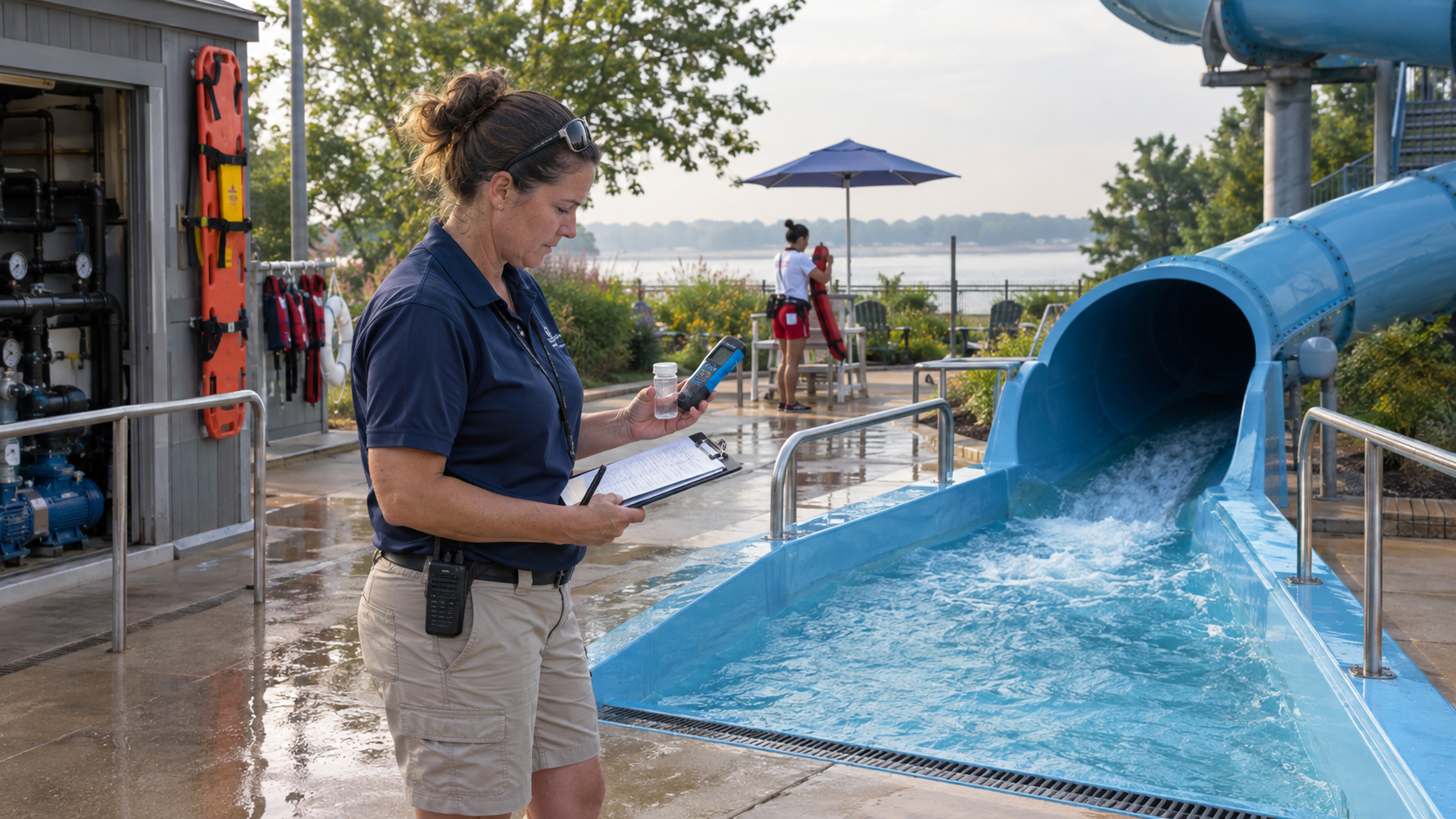
Maryland waterpark management brings together public health compliance, amusement-attraction safety, lifeguard supervision, mechanical maintenance and guest-flow planning. Each responsibility must operate as part of one coordinated system.
From Baltimore-area aquatic centers to coastal attractions, effective commercial aquatic operations begin with documented procedures and clear accountability. Maryland operators must also account for seasonal demand, local weather and the requirements of both state and local authorities.
The following best practices provide a practical framework for managing Maryland waterparks without treating compliance as a once-a-year inspection task.
| Quick Answer Maryland waterpark management requires daily ride inspections, documented water-quality testing, certified operator oversight, trained attraction staff and defined emergency procedures. Operators must coordinate COMAR 10.17 public pool requirements with Maryland amusement-attraction rules under COMAR 09.12 while addressing staffing, guest flow, weather and regional maintenance risks. |
Maryland Compliance
Waterparks may contain swimming pools, plunge pools, waterslides, wave pools, spray features and mechanical attractions. Different requirements can apply to each component.
Management should create a regulatory inventory listing every attraction, its classification, required permit or certificate, inspecting authority and responsible employee.
Public pool requirements
Maryland public swimming pools and spas are regulated under COMAR 10.17.01. The chapter covers design, operation, disinfection, water chemistry, supervision, safety equipment and recordkeeping.
A certified pool and spa operator must be on-site whenever a recreational pool is open. The operator is responsible for required measurements, filtration maintenance, disinfectant residuals and water chemistry.
Water recreational attractions must minimize hazards such as entrapment, slipping, impact injuries and drowning. COMAR also requires a communication system for supervisors, watchers and lifeguards, with safety personnel positioned at potentially hazardous activity areas.
Wave pools must have an emergency shut-off switch at each guard station. Tube rides require designated entry and exit points, while slides must discharge into an approved plunge pool or runout.
Water-quality records
Recording frequency depends on the facility type and whether an approved automatic controller is used.
For recreational pools without an approved automatic controller, required disinfectant, combined chlorine and pH readings are recorded at two-hour intervals. When an approved controller is used, readings are recorded at least three times daily: before opening, between noon and 2 p.m., and two hours before closing.
Other operational measurements include:
- Water clarity
- Water temperature when heated
- Flow rate
- Filter pressure
- Pump vacuum
- Total bather count
- Chemical additions
- Filter cleaning or backwashing
- Injuries and accidents
- Broken or malfunctioning equipment
Maryland requires a daily pre-opening entrapment-hazard check covering drain covers, suction outlets, skimmer components, return fittings, safety signs and pump switches. Pool operating records must remain on the premises for at least three years.
Water chemistry
Maryland requires water pH between 7.2 and 7.8, total alkalinity between 60 and 180 ppm, and calcium hardness between 150 and 400 ppm. Water clarity must allow the main drain or a six-inch Secchi disc in the deepest area to remain clearly visible.
For swimming, diving and water recreational attractions using chlorine, free chlorine must remain between 1.5 and 10 ppm. Combined chlorine may not exceed 0.2 ppm.
These ranges are regulatory boundaries, not automatic operating targets. Facility-specific targets should consider bather load, equipment, manufacturer instructions and local health-department direction.
Amusement-attraction requirements
Maryland’s Department of Labor regulates amusement attractions under COMAR 09.12. A qualifying attraction cannot operate unless it has been registered, inspected and issued a certificate of inspection.
The owner must maintain an operating manual addressing:
- Ride-cycle time
- Loading and unloading
- Rider distribution
- Emergency procedures
- Environmental conditions
- Rider limitations
- Water-flow limits
- Staff responsibilities
- Maintenance procedures
- Testing requirements
- Pre-opening inspections
Each attraction must remain under the control of an operator trained specifically for that attraction. The owner must also designate a ride safety supervisor to monitor operations whenever attractions are running.
Daily ride inspections
Maryland requires each amusement attraction to be inspected and tested before daily operation.
The inspection covers rider-carrying devices, safety controls, fencing, gates, guardrails, structural supports, electrical components, entrances, exits, stairs and communication systems. The attraction must complete at least one operating cycle before carrying riders.
Signed daily inspection reports must remain with the attraction or in an on-site office for at least 30 days. Electrical systems also require a documented daily pre-opening inspection by a qualified person.
A structured facility inspection program can combine health, mechanical and attraction checks into one traceable schedule without replacing inspections required by public authorities.
Regulatory responsibilities
| Operating area | Primary authority | Required management control | Record or verification |
| Public pools and plunge pools | Maryland Department of Health and local health departments | Certified operator, disinfection, chemistry and clarity | Operating logs retained for at least three years |
| Water recreational attractions | COMAR 10.17.01 | Hazard controls, communication and safety staffing | Approved plans and daily operational checks |
| Waterslides and qualifying attractions | Maryland Department of Labor | Registration, inspection certificate and safe operation | Current certificate and attraction records |
| Daily ride readiness | COMAR 09.12.60 | Pre-opening mechanical, structural and control inspection | Signed report retained for at least 30 days |
| Electrical systems | COMAR 09.12.60 | Daily inspection by a qualified person | Signed daily electrical report |
| Staff competence | COMAR 09.12.60 | Attraction-specific training and evaluation | Individual training records |
Operators should confirm requirements with the applicable county or municipal authority because local permits and enforcement procedures may add responsibilities.
Daily Operating Controls
Daily best practices should convert regulatory obligations into repeatable opening, operating and closing procedures.
Checklists must identify who performs each task, who verifies it and what condition prevents an attraction from opening.
Pre-opening inspection
The opening team should begin early enough to correct defects before guests arrive. An inspection completed immediately before opening leaves little time for repair or retesting.
The pre-opening process should cover:
- Water chemistry and clarity
- Drain and suction-outlet integrity
- Pump and filtration performance
- Slide surfaces and joints
- Stairs, railings and platforms
- Emergency stops and communication equipment
- Landing areas and runouts
- Safety signs and height markers
- Rescue and first-aid equipment
- Barriers, gates and controlled-access points
An attraction should remain closed when an inspection identifies a condition that could affect safe operation. The issue, corrective action and authorization to reopen should be documented.
Mechanical systems
Waterpark pumps, surge tanks and filtration systems experience fluctuating loads throughout the day. Operators should compare actual flow, pressure and vacuum readings with normal operating ranges.
Routine aquatic facility maintenance should include strainers, chemical feeders, controller probes, valves, filters, water-level systems and secondary disinfection equipment where installed.
Maintenance teams should use trend data rather than waiting for complete equipment failure. A gradual rise in filter pressure or decline in flow can indicate debris loading, obstruction or equipment wear.
Lifeguard deployment
Waterpark surveillance plans should reflect moving water, glare, surface turbulence, slide runouts and changes in guest density.
Each zone needs a defined viewing position and backup coverage. Rotations should never leave a body of water, slide landing area or hazardous transition point without required supervision.
Staff providing Maryland lifeguard services should receive facility-specific training in addition to their underlying certification. A guard familiar with a conventional pool may still need instruction on wave cycles, tube rides and attraction shutdowns.
Rotation schedules should account for:
- Heat and sun exposure
- Elevated guard positions
- Noise
- Glare
- High-activity assignments
- Meal and hydration breaks
- Opening and closing duties
- Predictable attendance peaks
Supervisors should conduct active surveillance audits and emergency drills throughout the operating season.
Slide dispatch
Dispatchers control rider separation, loading position and attraction throughput. Their decisions directly affect collision and landing-area risks.
Operators must follow manufacturer instructions on minimum and maximum water flow, rider limitations, cycle timing and loading procedures. Maryland also requires trained operators to remain at the controls and enforce applicable restrictions.
If the operator cannot clearly see the loading or unloading area, a functioning voice or signal system is required. Communication systems must be tested before operation.
Guest flow
Queue length is not only a customer-service metric. Overcrowded stairs, blocked exits and congested landing areas can create operational hazards.
Guest-flow plans should address:
- Queue entry and exit
- Height screening
- Tube collection
- Stair capacity
- Accessible routes
- Spectator areas
- Wave-pool transitions
- Locker-room traffic
- Emergency egress
- Maximum bather loads
Rules should be enforced at the earliest practical point. Checking height or ride eligibility at the bottom of a tower prevents conflicts after guests have waited and climbed the stairs.
Daily schedule
| Time or phase | Primary activities | Responsible roles |
| Before opening | Chemistry, entrapment, ride, electrical and safety-equipment inspections | Certified operator, maintenance lead and ride safety supervisor |
| Staff briefing | Assignment review, weather, expected attendance and emergency updates | Aquatic manager and supervisors |
| Opening period | Verify positions, communications and initial guest flow | Deck supervisors and attraction operators |
| Peak attendance | Increase queue monitoring, adjust rotations and confirm water quality | Operations manager, guards and certified operator |
| Weather event | Suspend affected operations and account for guests and staff | Incident lead and attraction supervisors |
| Late afternoon | Review staffing, fatigue, chemistry and remaining capacity | Shift manager |
| Closing | Clear attractions, complete sweeps and secure access points | Operations, security and maintenance |
| Post-closing | Clean, backwash as needed, complete reports and prepare repairs | Maintenance lead and closing supervisor |
Emergency response
Waterparks need written procedures for medical emergencies, missing children, water rescues, attraction failures, contamination, severe weather and evacuation.
Each procedure should define who stops the attraction, who provides care, who calls emergency services, who manages surrounding guests and who documents the event.
General pool safety procedures should be adapted to each attraction. A wave pool, spray feature and slide tower require different shutdown, rescue and evacuation actions.
Biological contamination should be handled according to current public-health guidance and the facility’s approved response plan. Operators should avoid relying on outdated chemical-response charts copied from old manuals.
Regional and Seasonal Planning
Maryland waterparks operate across different environments. Coastal facilities face different maintenance pressures from urban Baltimore-area centers or inland municipal parks.
Management plans should translate these differences into inspection frequency, staffing levels and inventory requirements.
Baltimore operations
Baltimore-area facilities may experience concentrated attendance during school breaks, heat events and weekends.
Best practices include timed admissions when necessary, separate entry and exit routes, visible queue rules and staffing plans tied to attendance thresholds. Transit access and group visits should also be included in daily forecasts.
High bather turnover can increase sanitizer demand and organic contamination. Operators should use actual water-quality readings and bather counts to determine whether testing or operational adjustments need to occur more frequently than the minimum schedule.
Coastal waterpark safety
Coastal Maryland facilities must account for salt-laden air, windblown sand, high humidity and severe weather.
Salt exposure can accelerate corrosion on fasteners, stairs, electrical enclosures and structural steel. Sand can increase filtration demand and contribute to wear in pumps and water-feature components.
Useful coastal practices include:
- Frequent freshwater rinsing
- Corrosion inspections
- Coating and sealant checks
- Electrical-enclosure inspections
- Sand removal around drains
- More frequent filter-pressure monitoring
- Secure storage for wind-sensitive equipment
- Written storm shutdown procedures
Maintenance frequency should reflect observed conditions rather than a generic calendar.
Seasonal staffing
Maryland waterparks often depend on seasonal lifeguards, dispatchers, admissions employees and maintenance assistants.
Recruitment should begin early enough to allow certification, background procedures, onboarding and attraction-specific training before opening. Returning employees should still complete refresher training and demonstrate current competence.
A seasonal plan should include:
- Required positions by attraction
- Minimum coverage by attendance level
- Break and rotation relief
- Weather-related schedule changes
- Weekend and holiday staffing
- Late-summer employee availability
- Call-out replacements
- Supervisor succession
- Certification expiration dates
- Training documentation
Broader aquatic management in Maryland should coordinate staffing with mechanical readiness, permitting and the operating calendar rather than treating recruitment as a separate project.
Seasonal readiness framework
| Period | Operational priority | Recommended management action |
| Preseason | Permits, inspections and recruitment | Confirm certificates, hire staff and order critical parts |
| Training period | Attraction-specific competence | Test emergency procedures, dispatch and communication |
| Opening weeks | Workflow validation | Audit queues, rotations, water testing and maintenance logs |
| Peak summer | Capacity and heat management | Increase supervision, hydration and testing when conditions require |
| Late season | Staff availability | Adjust schedules before school and college calendars change |
| Closing period | Winterization and records | Drain or protect systems, document repairs and archive records |
| Off-season | Capital planning | Review incidents, equipment life and renovation priorities |
Performance review
Useful management metrics include attraction downtime, rescue frequency, first-aid events, water-quality exceptions, employee turnover, queue time and inspection completion.
Metrics should be reviewed together. Reducing wait times has little value if it requires unsafe dispatch intervals, while minimizing labor hours may create uncovered rotations.
Regional pool management in Maryland should use these operating trends to inform maintenance budgets, staffing forecasts and future facility improvements.
Frequently Asked Questions
What rules govern Maryland waterparks?
Public pools and water recreational attractions are governed primarily by COMAR 10.17.01. Qualifying waterslides and amusement attractions are also subject to Maryland Department of Labor rules under COMAR 09.12.
Does a recreational pool need a certified operator on-site?
Yes. COMAR 10.17.01.43 requires a certified pool and spa operator to be on-site whenever a recreational pool is open.
How frequently must Maryland waterparks record chemistry?
Recreational pools generally record disinfectant, combined chlorine and pH at two-hour intervals. Pools using approved automatic controllers may record required information at least three times daily according to the schedule specified in COMAR.
How long must pool operating records be kept?
Maryland requires public pool and spa operating records to remain on the premises for at least three years and to be submitted to the Secretary upon request.
Are daily waterslide inspections required?
Yes. Maryland requires amusement attractions to be inspected and tested before daily operation. Water slides also have attraction-specific inspection requirements under COMAR 09.12.63.
How long must ride inspection reports be retained?
Signed daily amusement-attraction and electrical inspection reports must be retained on-site for at least 30 days. Other records, such as certain nondestructive testing results, have longer retention requirements.
What should coastal waterparks inspect more frequently?
Coastal operators should pay particular attention to corrosion, electrical enclosures, structural connections, coatings, sand accumulation and filter loading. Inspection frequency should reflect site conditions and manufacturer recommendations.
What is the most important management practice?
The most important practice is integrating health, mechanical, staffing and ride-safety responsibilities into one documented operating system.
Strong aquatic safety management depends on clear ownership, verified inspections and a defined response whenever conditions move outside approved limits.