
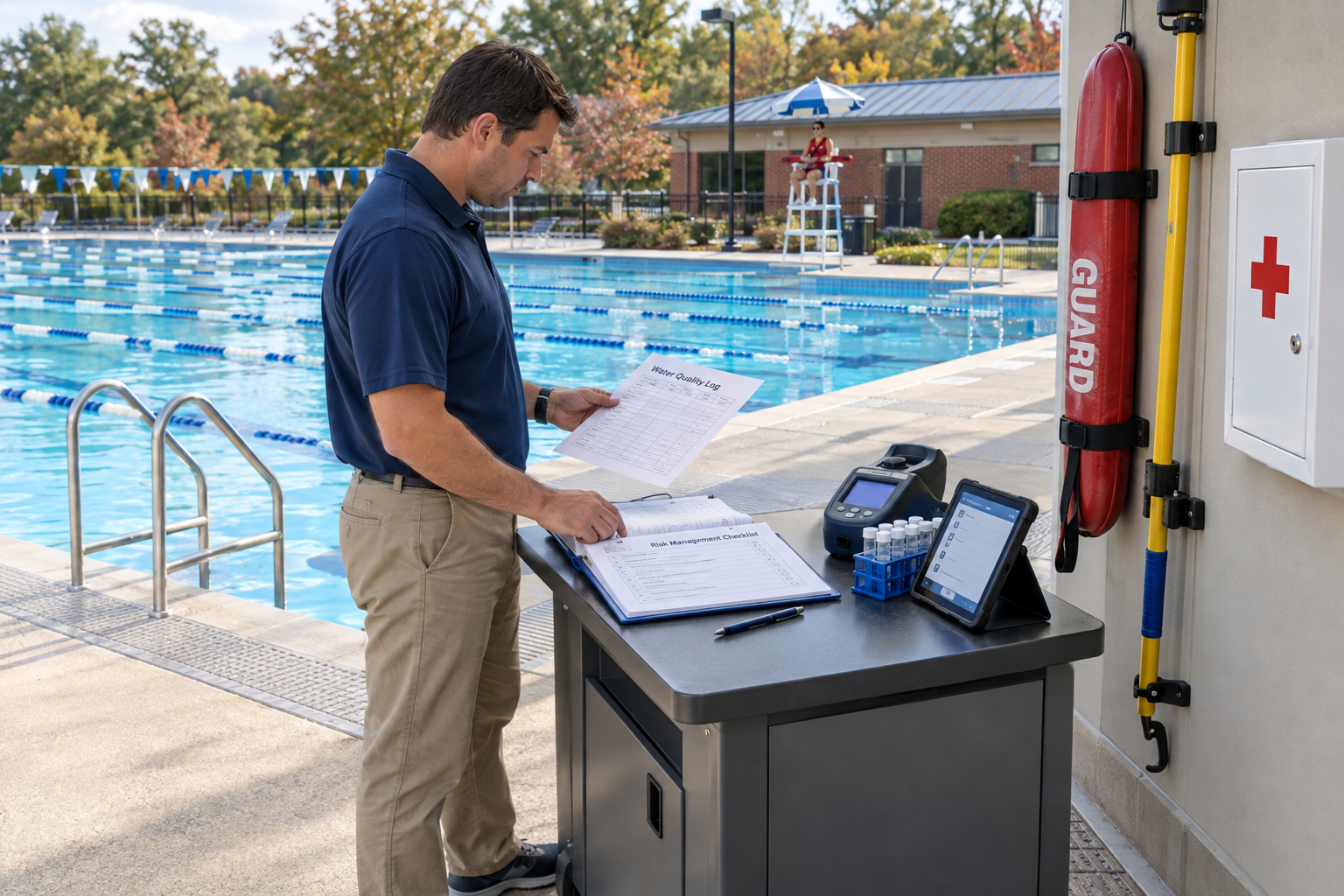
Aquatic risk management in Virginia starts with identifying the rules governing your facility, then assigning responsibility for inspections, staffing and emergency response. Effective commercial pool management connects those requirements to daily operations rather than treating compliance as an annual inspection task.
Virginia pool requirements depend on facility classification and locality. State tourist-establishment regulations, local ordinances, building requirements and applicable federal obligations may all affect the same property.
This guide explains how to organize those responsibilities, including Richmond-specific contacts and insurance questions. It distinguishes regulatory requirements from recommended management practices.
| Quick Answer Aquatic risk management in Virginia combines facility-specific compliance checks with inspections, water-quality monitoring, appropriate staffing and emergency procedures. Confirm requirements with the local health department and building official. Document hazards and corrective actions, review contractor responsibilities, and have a licensed insurance professional assess coverage against the facility’s actual operations. |
Establish Your Virginia Compliance Framework
Identify the facility’s classification
Begin with the type of facility and its use. A hotel pool, residential community pool and municipal aquatic center should not automatically share one compliance checklist.
Virginia’s 12VAC5-460 defines the swimming pools covered by that chapter around facilities provided for guests of transient lodging establishments. Its title alone should not be used to determine coverage for every pool.
Ask the local health department which operating requirements apply to your venue. Separately confirm building, accessibility and other relevant obligations.
Document the answer for each pool, spa or other aquatic feature. A multi-venue property may need more than one operating procedure.
Account for local differences
Virginia does not provide one identical permitting process for every locality. Local requirements need to be checked rather than inferred from another facility.
For example, the Pittsylvania/Danville health district states that pools in Danville need an operating permit. Its guidance says Pittsylvania County pools do not need that permit but must undergo inspection.
This is a useful illustration of why statewide assumptions can fail. It is not a permitting rule for the rest of Virginia.
Build a facility-specific reference file before reviewing aquatic management responsibilities in Virginia. Include the responsible agencies and current approval conditions.
Separate health and building approvals
Health approval and building approval address different responsibilities. Do not assume that completing one process satisfies the other.
For covered tourist-establishment pools, 12VAC5-460-30 requires specified plans and written approval before operation following construction, remodeling or major alteration.
The chapter also states that applicable local requirements apply in addition to its provisions. These include relevant plumbing, building, electrical and zoning requirements.
Before changing equipment or facilities, ask which reviews are necessary. Resolve that question before ordering work that may affect approved plans.
Include federal requirements
State and local review does not replace applicable federal obligations.
The VGB Act addresses suction-entrapment protection at covered public pools and spas. ADA obligations address accessibility at covered facilities, with different frameworks for new construction, alterations and existing properties.
Include both in the compliance register. Have qualified professionals review the actual installation and facility circumstances.
CDC’s Model Aquatic Health Code can also inform operations, but it is guidance unless adopted by the relevant jurisdiction. Do not present every MAHC provision as Virginia law.
Clarify Richmond pool compliance
For a facility within Richmond, confirm the property’s actual jurisdiction rather than relying only on its mailing address.
Richmond City Health Department’s Environmental Health Division lists swimming pool inspections among its responsibilities. Its published contact number is 804-205-3912.
Richmond’s Permits and Inspections office lists 804-646-4169 for building-permit questions. The city’s guidance identifies swimming pools and required pool barriers as matters that can involve permitting.
| Question | Starting point |
| Which health rules apply? | Local health department |
| What inspection schedule applies? | Environmental Health staff responsible for the facility |
| Does proposed work need a permit? | Local building official or permit office |
| What accessibility obligations apply? | Qualified accessibility adviser and relevant authorities |
| What coverage does the policy provide? | Licensed insurance professional |
| Who is responsible under the contract? | Facility management and legal counsel |
Record the guidance received and any follow-up requirements. A general webpage should not replace clarification of an unusual facility or project.
Control Daily Operational Risks
Create a practical risk register
List hazards by location and activity. Include the pool itself, deck, access points, equipment rooms and organized programs.
For each item, record the existing control, responsible person and response to failure. Avoid a list that identifies problems without assigning action.
| Hazard area | Example concern | Control to document |
| Access | Gate or latch does not secure the enclosure | Inspection and immediate access-control response |
| Surveillance | Glare or an obstructed view | Coverage review and operating adjustments |
| Water quality | Readings outside applicable limits | Retesting, corrective action and closure criteria |
| Equipment | Recirculation or chemical-feed failure | Shutdown and qualified repair procedure |
| Deck conditions | Standing water or damaged surfaces | Isolation, repair and verification |
| Weather | Thunderstorms during outdoor operations | Suspension, shelter and reopening procedure |
| Emergency response | Unclear roles or inaccessible equipment | Training, drills and readiness checks |
The register is a management tool, not a substitute for mandatory requirements. Safety-critical findings should receive immediate attention.
Inspect barriers, decks and access
Check gates, latches, ladders, handrails and walking surfaces before opening. Record defects and the action taken.
For pools covered by 12VAC5-460, required barriers and gates must remain in good operating condition. The chapter also addresses nonslip deck surfaces, drainage and maintained ladders and handrails.
Pay attention to changes during the day. Furniture movement, deliveries or temporary repairs can affect access after an opening inspection.
Use a facility inspection checklist to structure the review. Adapt it to the actual site and governing requirements.
Connect water testing to action
Use the applicable operating limits and test schedule for the venue. Do not copy a generic chemical range into the manual without checking its relevance.
For facilities covered by 12VAC5-460-270, operating records must include pH, free chlorine residual, water clarity and cleanliness. The section requires those records to be kept for one year.
That one-year rule does not establish the retention period for every facility document. Other requirements or insurance instructions may call for longer retention.
Build corrective-action instructions into the aquatic facility maintenance plan. Staff should know what to do when a result is unacceptable.
Treat water clarity as a safety condition
Water appearance is not merely a presentation issue. The applicable Virginia tourist-establishment regulation includes a specific visibility test using a six-inch black-and-white disc at the deepest point.
Confirm the exact clarity requirement governing your pool. Do not continue operating simply because disinfectant readings appear acceptable.
Record the action taken when visibility deteriorates. Define who can close the venue and what must be verified before reopening.
Review staffing requirements carefully
Do not assume that staffing requirements are identical across every Virginia pool.
For covered transient lodging establishments, 12VAC5-460-320 states that management must designate and have on duty a reliable and competent lifeguard, with appropriate lifesaving equipment.
Local guidance can differ in how staffing and signage are described. If instructions appear inconsistent, ask the responsible authority for facility-specific clarification rather than selecting the least restrictive interpretation.
When evaluating Virginia lifeguard staffing arrangements, review qualifications, coverage, breaks and site-specific training. A staffing contract should explain how those responsibilities are fulfilled.
Check surveillance conditions
Evaluate sightlines during actual operating conditions. Glare, activity levels and the position of equipment can affect visibility.
For pools covered by 12VAC5-460, lighting must allow lifeguards to see the pool and surrounding features without being blinded by glare during nighttime use.
Include changing conditions in the coverage review. An arrangement that works for quiet lap swimming may need reassessment for an event.
If visibility or required coverage cannot be maintained, follow the facility’s restriction or closure procedure.
Control chemical access and handling
Limit chemical handling to trained personnel. CDC recommends separating incompatible chemicals and maintaining appropriate protective equipment and safety information.
Check storage access, ventilation and equipment controls. Treat chemical areas as part of the risk assessment, not simply maintenance storage.
CDC recommends automatic deactivation of chemical feed pumps when recirculation flow is absent or too low. Never bypass a failed safety control to keep the venue operating.
Use qualified personnel to investigate equipment failures. Document the repair and verification before returning the system to service.
Prepare for thunderstorms
Assign responsibility for weather monitoring and decisions. Staff should know when activities stop, where people go and who authorizes resumption.
The National Weather Service recommends a written lightning plan for organized outdoor activities. Substantial buildings or enclosed hard-topped vehicles provide protection; open shelters and small sheds do not.
Its guidance recommends waiting at least 30 minutes after the last thunder before resuming outdoor activities. Treat this as safety guidance and incorporate any additional applicable facility requirements.
Clearing the water alone is not a complete plan. Identify where swimmers and staff can shelter safely.
Practice emergency procedures
Write procedures for rescue, medical emergencies, chemical incidents and equipment failure. Assign roles rather than expecting staff to improvise.
CDC recommends developing, training and testing emergency action plans for aquatic facilities. Chemical incidents require specific preparation.
Record drill findings and correct weaknesses. A completed drill is more useful when it produces changes to communication, access or equipment readiness.
After an incident, preserve factual records and follow required reporting procedures. Notify the appropriate authorities and insurer according to applicable requirements.
Manage Liability, Insurance and Records
Separate prevention from insurance
Insurance is one part of aquatic risk management, not a substitute for safe operation.
Virginia’s Bureau of Insurance explains that commercial general liability coverage commonly addresses premises and operations exposures. Actual protection depends on the policy’s terms, limits and exclusions.
Do not assume a general business policy covers every pool activity. Describe the facility and its programs accurately when discussing coverage.
Ask about swimming instruction, events, subcontracted staffing and other activities that may affect the assessment.
Review pool insurance in Virginia
Request a review with a licensed insurance professional experienced in the relevant commercial risks. Compare coverage, not only the premium.
The Bureau of Insurance advises businesses to understand exclusions and discuss additional coverage where needed. It also describes umbrella liability as protection above underlying policy limits, subject to its terms.
| Coverage question | What to clarify |
| Insured operations | Are the pool and its activities accurately described? |
| Liability limits | How do per-occurrence and aggregate limits apply? |
| Exclusions | Which aquatic activities or losses may be excluded? |
| Contractors | How does coverage apply to outsourced work? |
| Property and equipment | What damage or breakdown is covered? |
| Business interruption | Which events trigger coverage? |
| Reporting | When and how must incidents or claims be reported? |
| Changes | When must new features or programs be disclosed? |
These are review questions, not a statement that any particular policy includes the coverage.
Avoid treating an advertised limit as proof of adequate protection. Ask how deductibles, exclusions and endorsements affect the actual risk.
Clarify contractor responsibilities
A management agreement should identify who performs testing, staffing, maintenance and reporting. It should also explain who can close the pool.
Have legal counsel review responsibility, indemnity and insurance provisions. Do not assume outsourcing removes the owner’s exposure.
Request the insurance documentation required by the agreement. Ask the insurance professional to verify relevant coverage and endorsements.
Use the facility management contact page to clarify proposed service responsibilities. Legal and insurance interpretations should come from the appropriate professionals.
Review changes before implementation
A new feature, altered schedule or expanded program should trigger a risk review. Examine staffing, equipment, approvals and insurance together.
For covered tourist-establishment facilities, construction, remodeling and major alteration bring plan-review requirements under 12VAC5-460-30.
Before undertaking pool renovations, confirm health and building approvals. Include applicable accessibility and equipment requirements.
Tell the insurer about relevant operational changes. Virginia’s commercial insurance guide recommends reviewing protection when property or operations are added.
Keep records that show follow-through
Records should show more than the discovery of a problem. They should document the response and verification of completion.
For an equipment defect, record when it was identified, any closure or restriction, who repaired it and who checked the result.
Preserve original incident information and document later corrections transparently. Follow legal, regulatory and insurer instructions for retention.
| Record category | Information to retain |
| Compliance | Applicable rules, permits and approval conditions |
| Water quality | Results, corrective actions and operating notes |
| Equipment | Service history, defects and repair verification |
| Staffing | Qualifications, schedules and training |
| Emergencies | Plans, drills and incident reports |
| Contractors | Scope, responsibilities and required insurance records |
| Changes | Review and approval of renovations or new activities |
A passed inspection does not replace continuing oversight. VDH describes inspections as a snapshot of conditions operators must maintain throughout the season.
Use a recurring review cycle
Create a schedule that separates routine checks from technical and management reviews. Follow mandatory frequencies wherever they apply.
As a planning framework:
- Before opening, check readiness, access, water conditions and required coverage.
- During operations, monitor changes and complete required testing.
- At scheduled reviews, examine equipment trends, staffing and unresolved actions.
- Before changes, reassess approvals, procedures and insurance.
- After incidents, review causes and verify corrective measures.
Assign each task to a named role. A schedule without ownership is difficult to enforce.
Frequently asked questions
Does one Virginia pool code apply to every facility?
No single checklist should be assumed to cover every venue. Facility classification and local requirements matter. Virginia’s tourist-establishment pool chapter also expressly recognizes additional applicable local requirements.
Who handles Richmond pool compliance questions?
Richmond City Health Department’s Environmental Health Division addresses pool health matters. Building and alteration questions should also be directed to the city’s Permits and Inspections office.
How long must operating records be kept?
For facilities covered by 12VAC5-460-270, specified pool operating records must be retained for one year. Confirm whether other rules, contracts or insurance requirements call for longer retention.
Can a hotel pool rely on a sign instead of a lifeguard?
Do not assume that it can. The text of 12VAC5-460-320 requires an on-duty lifeguard at covered transient lodging establishments. Obtain facility-specific clarification from the responsible authority.
Does insurance eliminate aquatic liability?
No. Coverage depends on policy terms, limits and exclusions, and it does not replace prevention. Review both operational controls and insurance with qualified advisers.
How often should the risk plan be updated?
Review it when regulations, staffing, equipment or activities change, and after incidents or significant findings. Keep routine operational checks active between those reviews.