
Texas has some of the most detailed public pool rules in the country, and cities like Houston and Dallas add their own permits and inspections on top. For operators, keeping up is a year-round job, which is why many facilities rely on experienced commercial pool management to stay compliant.
This guide explains the state laws and rules that apply to Texas public and semi-public pools, what they require in daily operation, and how local codes in Houston and Dallas fit in.
| Quick Answer Texas pool safety laws come from three layers: State law: Texas Health and Safety Code §341.064 (sanitation and local permits) and §341.0645 (pool safety and drowning prevention). State rules: 25 Texas Administrative Code (TAC) Chapter 265, Subchapter L, enforced by the Texas Department of State Health Services (DSHS) and local authorities. Local codes: City and county ordinances, such as Houston’s pool program and Dallas City Code Chapter 43A, which may add permits, inspections and stricter standards.For most operators, the key obligations are:A trained and certified operatorCorrect water chemistry and testing logs kept for three yearsRequired signs and rescue equipmentAn emergency phone within 200 feet of the waterCompliant enclosures and gatesAnti-entrapment drain coversLifeguards where the rules require them |
Who Do Texas Pool Rules Apply To?
Subchapter L covers public pools and spas. In Texas, “public” includes many privately owned pools. The rules classify facilities by how they are used:
| Class | What It Covers | Examples |
| Class A | Pools used for accredited competitive events | High school, college and club competition pools |
| Class B | Pools open to the general public, with or without a fee | City pools, water parks, public aquatic centers |
| Class C | Pools limited to residents, members, students and their guests | HOAs, apartments, condos, hotels, RV parks, private clubs, youth camps, school pools used for classes |
Spas follow the same A, B and C structure.
Residential pools serving a single-family home or duplex are not covered by Subchapter L.
One rule catches many operators by surprise. A pool must meet the standard that matches its actual use. If a Class C pool is opened to the general public, even for one event, it must meet Class B standards during that time, including lifeguard requirements.
Operators with mixed-use facilities often benefit from dedicated pool management in Texas, so classification issues are handled before they become violations.
The State Laws: HSC 341.064 and 341.0645
Texas Health and Safety Code §341.064
This section sets the baseline for public swimming pools and artificial swimming lagoons. It requires owners and operators to keep pools sanitary and within safe bacterial limits. It also allows counties and municipalities to require operating permits for public pools within their jurisdiction.
Texas Health and Safety Code §341.0645
HSC 341.0645 is the state’s pool safety law. It was created by Senate Bill 1732 in 2009, following the federal Virginia Graeme Baker Pool and Spa Safety Act (VGBA).
It requires anyone in charge of a public swimming pool, wading pool, baby pool, hot tub, in-ground spa, water park, spray fountain or similar recreational water to comply with state pool safety standards. It also directs the state to adopt drowning-prevention standards that are at least as stringent as the federal VGBA.
The section also allows minor additions, alterations, renovations and repairs to existing pools to follow the construction standards in place when the pool was built. Pools that complied with state law on August 31, 2021 may continue to be used, maintained and repaired under the laws that applied on that date.
How Subchapter L Puts the Laws Into Practice
25 TAC Chapter 265, Subchapter L implements both sections. It covers:
- Operation and management
- Water quality
- Signage
- Enclosures
- Safety features
- Lifeguards
- Enforcement
For construction, alteration and repair of commercial pools, it adopts the 2021 International Swimming Pool and Spa Code (ISPSC) with specific exceptions.
Local regulatory authorities may adopt different standards on topics the ISPSC does not address, but only if they are equivalent to or stricter than the state rules.
Certified Operator Requirements
Every Class A, Class B and Class C pool and spa must be maintained under the supervision of a trained and certified operator. Under Subchapter L §265.194:
- Certification can come from the NRPA Aquatic Facility Operator course, the PHTA Certified Pool Operator course, the ASPSA Licensed Aquatic Facility Technician course, or an equivalent tested course approved by the local regulatory authority.
- The operator does not have to be on-site while the pool is open.
- One operator may oversee multiple pools and spas.
- The operator’s name and contact details must be available to on-site staff, property managers and inspectors.
- The operator must make sure staff are trained in day-to-day circulation system operation.
Staff who handle chemicals when the certified operator is not on-site must also be trained and given protective equipment, such as rubber gloves and goggles, along with safety data sheets.
Facilities that need ongoing operator oversight across several sites often turn to structured aquatic management in Texas to keep certification, training and records in one place.
Water Quality and Testing Requirements
Subchapter L §265.193 sets chemical ranges that apply whenever a pool or spa is open.
Required Chemical Levels
| Parameter | Minimum | Ideal | Maximum |
| Pool free available chlorine | 1.0 ppm | 2.0 to 3.0 ppm | 8.0 ppm |
| Spa free available chlorine | 2.0 ppm | 3.0 ppm | 8.0 ppm |
| Pool bromine | 3.0 ppm | 4.0 to 6.0 ppm | 10.0 ppm |
| Spa bromine | 4.0 ppm | 5.0 ppm | 10.0 ppm |
| Combined chlorine | None | None | 0.4 ppm |
| pH | 7.0 | 7.2 to 7.6 | 7.8 |
| Cyanuric acid | None | 30 to 50 ppm | 100 ppm |
| ORP (where meters are used) | 600 mV | 650 to 750 mV | 900 mV |
Cyanuric acid and stabilized chlorine must not be used in indoor pools, indoor spas or therapy pools. If cyanuric acid exceeds 100 ppm, free chlorine must be raised to at least 2.0 ppm and tested daily until levels drop.
Minimum Testing Frequency
| Facility Type | Disinfectant and pH Testing |
| Class A and Class B, manual | Every two hours while open |
| Class A and Class B, with automatic controller | At least three times per day, plus controller readings |
| Class C with on-site pool staff, such as lifeguards | At least three times per day |
| Class C with on-site staff and automatic controller | At least once per day, plus controller readings |
| Class C without on-site pool staff | At least once per day |
Class C pools without on-site staff may reduce kit testing to once a week if a qualifying automated system reports levels to the certified operator daily.
Alkalinity, calcium hardness and water balance must be tested at least every 10 days. Cyanuric acid must be tested weekly where it is used. Free chlorine and bromine must be measured with the DPD method.
Water Clarity
The bottom of the pool, including any submerged suction outlets, must be clearly visible when the water is still. If it is not, the pool must not be open for use.
Records
All water tests and corrective actions must be logged, either electronically or on paper, and kept for at least three years. Logs stored off-site must be provided to inspectors within five business days of a request.
Consistent aquatic facility maintenance makes these daily tests, corrective actions and records far easier to keep in order.
Required Safety Features and Signs
Rescue Equipment
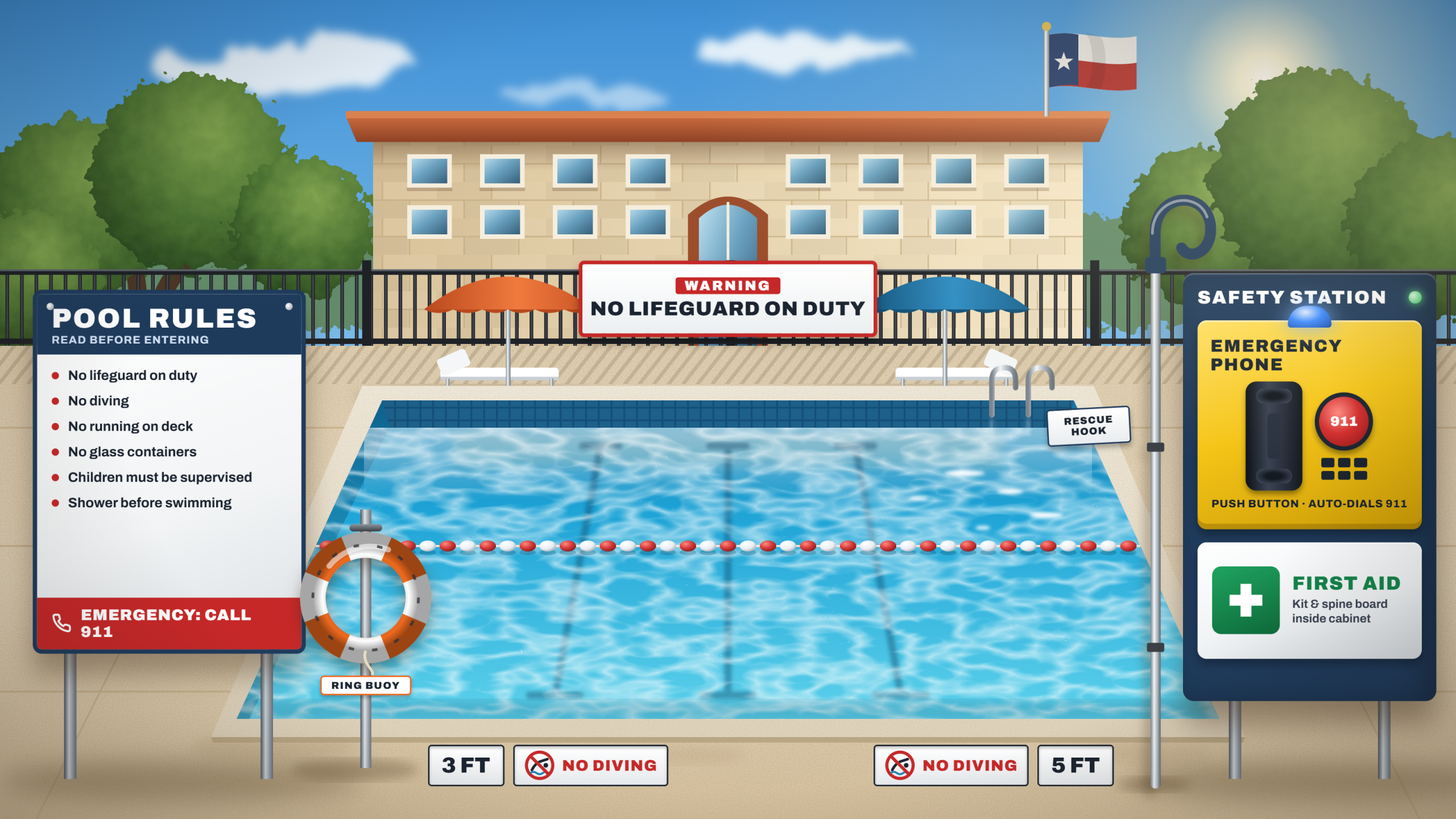
Pools must have at least one ring buoy with throwing rope and one reaching pole for every 2,000 square feet of water surface, up to 6,000 square feet, with more equipment for larger pools.
- Reaching pole: At least 12 feet long, non-telescoping, non-conductive and fitted with a body hook or shepherd’s crook.
- Throwing rope: 1/4 to 3/8 inch in diameter and at least two-thirds of the pool’s maximum width, attached to a USCG-approved ring buoy.
Emergency Summoning Device
Every pool and spa must have an emergency phone, monitored emergency device or approved alternative communication system:
- Location: Within 200 feet of the water, readily accessible and working whenever the pool is open.
- Who answers: It must reach 911 or an emergency service. It must not ring an on-site office, except in limited remote-area cases.
- Instructions: Clear operating instructions must be posted.
- Location sign: A sign above the device must show the pool’s precise location, such as an address or building number.
Depth and No Diving Markers
Depth markers are required:
- At least two per pool
- Spaced no more than 25 feet apart
- Placed near the top of the wall
- With numbers and letters at least 4 inches high
Where no diving markers are required, they must be slip-resistant, at least 4 inches high and within 18 inches of the water’s edge on the deck.
Key Pool Signs
| Sign | When Required |
| “WARNING-NO LIFEGUARD ON DUTY” | Where no lifeguard is required or provided |
| “NO DIVING” with symbol | Where no lifeguard is required or provided |
| “IN CASE OF EMERGENCY, DIAL 911” | All pools |
| Precise pool location at the emergency phone | All pools |
| Hours of operation and maximum user load | All pools |
| Persons under 14 must not be in the pool without adult supervision | Where no lifeguard is required or provided |
| No swimming after diarrheal illness within the past 2 weeks | All pools |
| No diaper changing within 6 feet of the pool | All pools |
| Glass items not allowed in the pool yard | All pools |
| Pets in the pool are prohibited | All pools |
| Extended breath-holding activities are dangerous and prohibited | All pools |
Spas have their own sign set, including a warning not to use the spa above 104 degrees Fahrenheit and the location of the emergency spa shutoff.
Many of these items are quick to check but easy to overlook during a busy season. A structured pool safety program helps keep equipment and signs inspection-ready.
Lifeguard Requirements in Texas
Lifeguards are not required at every pool, but Subchapter L §265.191 requires at least two lifeguards at:
- Class A pools during competitive events
- Class B pools whenever they are open
- Any pool where users can enter from above the deck, including diving boards, platforms, drop slides, waterslides, starting platforms, zip lines or climbing walls that are open
- Any wave pool or surf pool
- Any pool while it is used by youth groups, such as youth camps, visiting childcare groups or school groups
Diving boards, slides and similar features count as open unless they are locked or blocked and posted as closed. Lifeguards are not required at spas.
When Lifeguards Are Provided or Required
The rules also require:
- Certification: Each lifeguard must hold current lifeguard, first aid and CPR/AED certifications from a recognized organization.
- Staffing plan: A written plan, available on-site, that sets the number of on-duty lifeguards.
- Surveillance and rotation: Assigned surveillance areas, rotation procedures and breaks.
- Training: Pre-season training plus at least 60 minutes of in-service training for every 40 hours worked.
- Emergency action plan: A plan covering submersion, spinal injury, weather and contamination incidents.
- Equipment access: A first aid kit, backboard, AED and bag-valve mask.
- Lifeguard stands: Required where water depth exceeds 5 feet.
- Records: Lifeguard certification and training records kept for three years.
Facilities that need certified staff and documented training often work with professional lifeguard services in Texas to meet these standards consistently.
Water Parks and Aquatic Attractions
Wave pools, surf pools, waterslides and leisure rivers carry extra rules, including emergency shutoff switches on both sides of wave and surf pools and specific depth marker placement on leisure rivers. Slides and play features that qualify as amusement rides must also comply with the Texas Amusement Ride Safety Inspection and Insurance Act.
Operators running complex attractions often need specialized waterpark management in Texas to coordinate these overlapping requirements.
Enclosures, Gates and Drain Safety
Pool Yard Enclosures
All pool and spa yards must be fully enclosed. The requirements depend on the class:
| Facility | Key Enclosure Rules |
| Class A, Class B and resident youth camps | At least 6 feet high, no openings that pass a 4-inch sphere, no climbable mid-rails, gates that open outward and are supervised or locked |
| Multiunit rental complexes and property owners associations | Must meet Texas Health and Safety Code Chapter 757, Pool Yard Enclosures |
| Other Class C and day camp pools | At least 48 inches high, no openings that pass a 4-inch sphere, self-closing and self-latching gates that open outward and lock when closed |
Gates must never be propped open, except while staff or contractors are actively working in the pool yard.
Furniture, planters and other objects must be kept at least 36 inches from the outside of the enclosure so children cannot climb over.
Because Chapter 757 applies directly to apartment communities and property owners associations, many communities rely on HOA pool management in Texas to keep fences, gates and latches compliant.
Drain Covers and Entrapment Prevention
This is where HSC 341.0645 has the most direct impact:
- Suction outlets: Must comply with ANSI/APSP-16.
- Safety vacuum release and automatic shutoff systems: Must meet the applicable standards.
- Documentation: Records for both must be kept on-site or provided within five business days of a request.
- Pump rule: A pump must not be run if a drain grate, suction outlet or cover is missing, broken or loose. In that case, the pool must close until the problem is fixed.
Other Operational Rules
- Chemical storage: Chemicals and equipment rooms must be inaccessible to users, with warning signs on entry doors.
- Glass: Glass containers and glass furniture are prohibited in the pool yard.
- Drinking water: Drinking water must be available at pools built on or after October 1, 1999.
- Water level: Pools must close if water drops below the skimmer or gutter operating range.
- Electrical work: Must be performed by a licensed electrician.
Houston Pool Codes
Houston layers city requirements on top of state rules.
- Who regulates: The Houston Health Department regulates public pools under Chapter 43 of the City of Houston Code of Ordinances, which draws on the Texas Administrative Code and Chapter 757.
- What counts as commercial: Pools at hotels, apartments, condos, schools, natatoriums and similar facilities, along with spas, wading pools and interactive water features.
- New construction: New commercial pools need a building permit through the Houston Permitting Center, plan review and a health inspection scheduled with the Houston Health Department.
- Ongoing inspections: Public pools, including multifamily and community pools, are subject to annual inspections.
- Closures: Critical violations can lead to immediate closure until they are corrected and reinspected.
Pools in unincorporated Harris County fall under Harris County Public Health rather than the city. Facilities near city limits should confirm which authority has jurisdiction.
Dallas Pool Regulations
Dallas also applies its own code on top of state rules.
- Operating permit: Dallas City Code Chapter 43A requires an operating permit for all public and semi-public pools and spas. Operating without one can lead to closure and a citation.
- Manager of operations: Each permit application must name a manager of operations. That person must complete City of Dallas training before the permit can be issued.
- Construction: Chapter 62, the Dallas Swimming Pool and Spa Code, adopts the 2021 ISPSC with local amendments.
Many other Texas cities and county health districts adopt Subchapter L by reference and add their own permits and inspection schedules. Always check with the local authority where your pool is located.
Inspections and Enforcement
DSHS and local authorities may inspect pools, equipment rooms and records at any reasonable time, without advance notice. Interfering with or delaying an inspection is itself a violation.
Violations of HSC 341.064, HSC 341.0645 or Subchapter L can lead to:
- Civil suits seeking penalties or injunctions
- Criminal penalties under state law
- Local closures, citations and permit actions
If a pool closes for any reason, public access must be blocked and a closure notice posted on the gates.
Regular internal facility inspections help you find and fix issues before an official inspector does.
A Practical Texas Compliance Checklist
Use this as a starting point, then adjust for your class and local code.
- Confirm your pool class and whether local permits apply
- Name a trained and certified operator and share their contact details
- Post all required pool and spa signs
- Test and log water chemistry at the required frequency
- Keep water logs, lifeguard records and drain documentation for three years
- Check emergency phone function and location signage daily
- Inspect ring buoys, reaching poles and first aid supplies
- Verify gates self-close, self-latch and lock
- Inspect drain covers and suction outlets before opening
- Prepare lifeguard staffing and emergency action plans where required
- Review local code changes before each season
Contact Us
Keeping up with Texas pool safety laws, local codes and daily operations takes time and expertise. Pool Management Inc. helps Texas HOAs, apartment communities, hotels, clubs and public facilities manage operations, staffing and compliance. Contact us to discuss your facility’s needs.
Frequently Asked Questions
What is HSC 341.0645 in Texas?
It is the Texas Health and Safety Code section on pool safety. It requires operators of public pools, spas, water parks and similar facilities to follow state pool safety standards, which must be at least as stringent as the federal Virginia Graeme Baker Pool and Spa Safety Act.
Which agency regulates public pools in Texas?
DSHS sets statewide rules in 25 TAC Chapter 265, Subchapter L. Cities and counties, such as the Houston Health Department and the City of Dallas, often handle permits and inspections locally.
Do HOA and apartment pools in Texas follow public pool rules?
Yes. Most HOA, apartment, condo and hotel pools are Class C pools under Subchapter L. Pools at multiunit rental complexes and property owners associations must also meet Texas Health and Safety Code Chapter 757 for enclosures.
Does a Texas pool need a certified pool operator?
Yes. Class A, B and C pools and spas must be supervised by a trained and certified operator, such as a CPO or AFO holder. The operator does not need to be on-site at all times.
Are lifeguards required at Texas HOA pools?
Usually not, unless the pool is open to the general public, has open diving boards or slides, or is used by youth groups. Where no lifeguard is provided, specific warning signs are required.
How long must Texas pools keep water testing records?
At least three years. Records stored off-site must be provided to inspectors within five business days of a request.
Do Houston and Dallas have their own pool rules?
Yes. Houston enforces pool requirements through its Health Department and city code, and Dallas requires operating permits and trained managers of operations under Chapter 43A. Both build on state rules.