
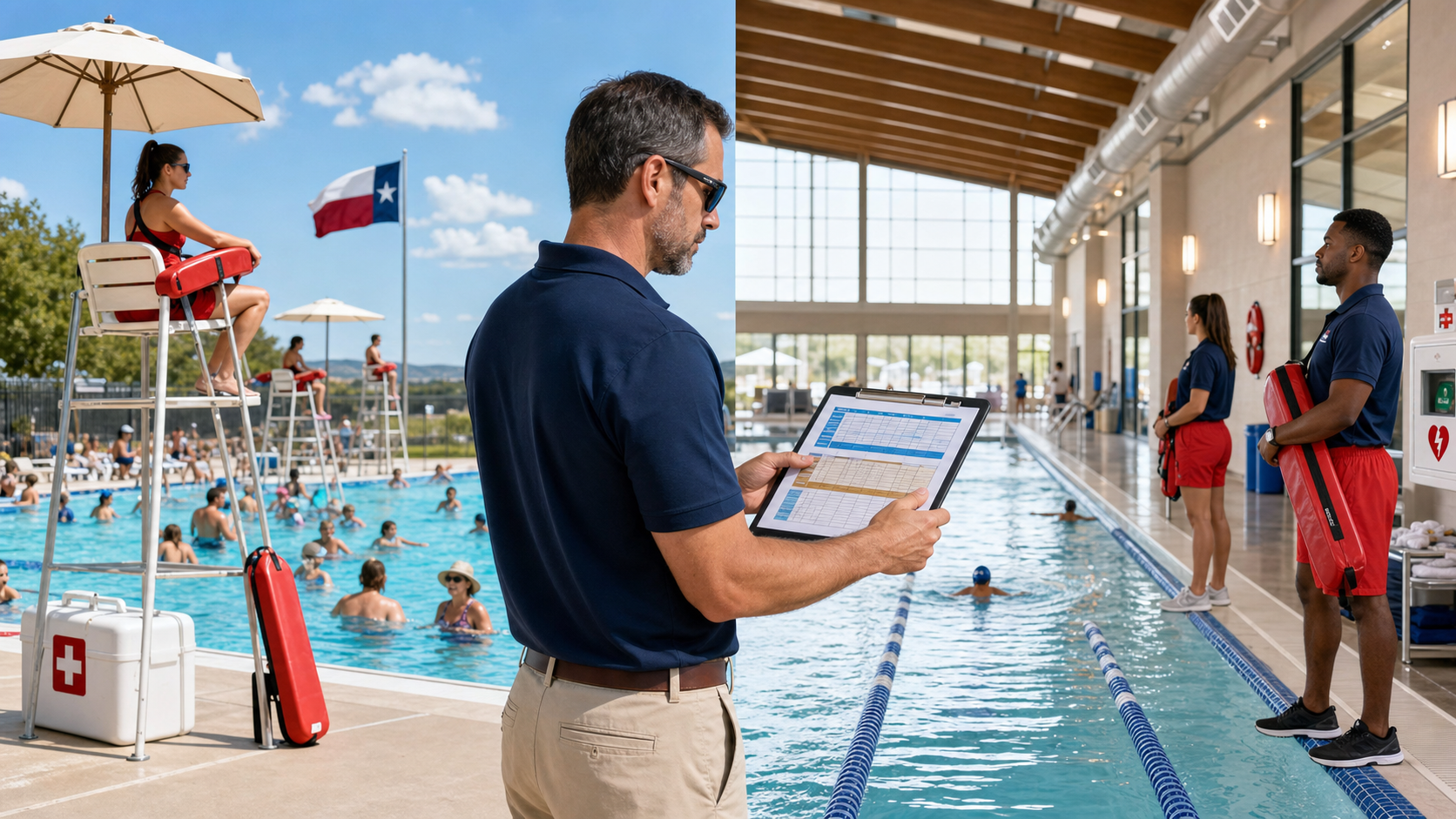
Seasonal lifeguard staffing concentrates hiring, training and coverage around a defined operating period. Year-round staffing maintains an aquatic workforce across every season, often combining lifeguarding with instruction, programming or other qualified aquatic responsibilities.
Texas facility owners comparing these models should consider more than payroll. Climate, operating hours, attendance, pool classification and the ability to maintain every surveillance zone affect the decision. The wider scope of commercial pool management also includes training, equipment, water quality, emergency planning and regulatory documentation.
Outdoor HOA pools frequently use seasonal teams, while indoor recreation centers and continuously operating resorts may require year-round staff. Facilities with permanent operations and large summer attendance increases often benefit from a hybrid workforce.
| Quick answer Seasonal lifeguard staffing generally suits Texas outdoor pools with defined summer schedules. Year-round staffing is more appropriate for indoor pools, resorts and aquatic centers that remain open continuously. Seasonal teams reduce off-season payroll but require concentrated annual recruitment and training. Permanent teams offer continuity but create ongoing labor costs. A hybrid model combines experienced year-round leaders with additional summer guards. Texas facilities must also maintain adequate supervision, assigned surveillance areas, rotations, training and staffing documentation. |
Texas Staffing Context
Texas has a long outdoor swimming season, but operating patterns differ across the state. A community pool in North Texas may follow a traditional Memorial Day-to-Labor Day schedule, while a South Texas resort may operate outdoors for most of the year.
The correct staffing model depends on actual operating demand rather than the assumption that every Texas pool is seasonal.
Facilities commonly using seasonal staff
Seasonal lifeguard staffing is often appropriate for:
- HOA and neighborhood pools
- Apartment community pools
- Country clubs
- Outdoor municipal pools
- Summer camps
- Seasonal waterparks
- School-break recreation programs
- Outdoor pools with limited annual schedules
These facilities can align labor with the months when the pool is open. They avoid maintaining a large guard team when no patron surveillance is required.
However, seasonal facilities must recruit, certify and train enough people before opening. Delayed hiring can lead to reduced hours, postponed openings or insufficient backup coverage.
Facilities needing year-round staff
Year-round aquatic staffing is more common at:
- Indoor recreation centers
- Fitness clubs
- Hotels and resorts
- Universities
- Schools with aquatic programs
- Rehabilitation facilities
- Municipal aquatic centers
- Facilities offering continuous lessons
- Properties with heated pools open throughout the year
Permanent staff can preserve operational knowledge and support recurring training. Their schedules can also be adjusted as attendance changes between school terms, holidays and summer.
Texas facilities evaluating continuous service can review the scope of pool management in Texas when separating surveillance, maintenance, supervision and programming responsibilities.
When a hybrid model fits
A hybrid workforce maintains a smaller permanent team and adds temporary guards during high-demand periods.
For example, a facility may retain an aquatic director, supervisors and several indoor-pool lifeguards throughout the year. It can then add seasonal employees when an outdoor pool, summer camp or expanded lesson schedule opens.
A hybrid model may provide:
- Year-round operational continuity
- Experienced supervisors for seasonal staff
- Greater summer schedule capacity
- More efficient seasonal onboarding
- Lower off-season payroll than a fully permanent workforce
- A promotion path for returning lifeguards
- Backup coverage during attendance peaks
The permanent group must have enough time to train and supervise temporary staff without weakening existing operations.
Texas facility examples
| Facility type | Likely model | Main staffing reason |
| Outdoor HOA pool | Seasonal | Defined community swimming season |
| Indoor recreation center | Year-round | Continuous public access and programming |
| Resort with heated pools | Year-round or hybrid | Guest access continues while demand fluctuates |
| Outdoor waterpark | Seasonal or hybrid | Large peak workforce and specialized attractions |
| Municipal indoor and outdoor complex | Hybrid | Permanent indoor operations with summer expansion |
| School aquatic facility | Year-round | Academic-year programs, teams and lessons |
| Country club outdoor pool | Seasonal | Limited operating calendar |
| Apartment pool | Seasonal or extended-season | Schedule depends on property policy and pool classification |
This table is a starting point. The final model should reflect the pool’s classification, operating schedule, attractions and surveillance plan.
Comparing the Models
A staffing model affects recruitment, training, payroll, retention and schedule resilience. Facility owners should compare total annual requirements rather than hourly wages alone.
Seasonal lifeguard staffing
A seasonal model works best when opening and closing dates are predictable.
The primary advantage is that wages are concentrated during operating months. The facility does not maintain peak staffing through periods when the pool is closed or attendance is minimal.
The primary challenge is rebuilding a qualified workforce each year. Even when former employees return, availability may change because of school, relocation or competing jobs.
A seasonal hiring plan may include:
- Forecasting headcount several months before opening
- Contacting returning employees
- Advertising open roles
- Confirming accepted certifications
- Conducting interviews and skill screenings
- Scheduling certification or renewal
- Completing employment requirements
- Conducting preseason training
- Building schedules before opening
- Identifying backup staff
Organizations using external or managed Texas lifeguard services should still understand who handles certification verification, scheduling, supervision and training documentation.
Year-round aquatic staff
Permanent aquatic teams preserve knowledge about the facility’s layout, equipment and emergency procedures.
Experienced employees become familiar with:
- Surveillance blind spots
- Normal attendance patterns
- Rescue-equipment locations
- Rotation procedures
- Emergency communication
- Severe-weather protocols
- Recurring patron issues
- Local inspection expectations
- Water-attraction procedures
- Facility opening and closing routines
Year-round employment also creates more opportunities for recurring drills. Training can be distributed throughout the year rather than compressed into a short preseason.
The disadvantage is ongoing labor cost. Facilities must determine whether permanent guards can be scheduled productively during low-attendance periods.
Cross-trained permanent staff
Year-round staff may hold several roles if they possess the appropriate qualifications.
Possible responsibilities include:
- Lifeguarding
- Swim instruction
- Program administration
- Equipment inspections
- Deck preparation
- Emergency-drill coordination
- Patron communication
- Training support
- Record management
These duties must not distract a guard who is actively supervising swimmers. Texas rules state that guards conducting surveillance cannot be assigned tasks that interfere with observation or immediate assistance.
Administrative or maintenance work should be scheduled away from active surveillance assignments.
Hybrid aquatic workforce
The hybrid approach separates year-round leadership from peak seasonal capacity.
A permanent team can manage training, facility knowledge and emergency procedures. Seasonal staff can then provide extra surveillance positions, extended hours and coverage for summer programs.
The approach works particularly well when:
- An indoor pool operates all year
- An outdoor pool opens in summer
- Attendance rises sharply during school breaks
- The facility runs seasonal camps or lessons
- Permanent supervisors can train new guards
- The budget cannot support peak staffing year-round
Managing two employment groups adds complexity. Policies, performance expectations and communication should remain consistent across permanent and seasonal employees.
Side-by-side comparison
| Factor | Seasonal | Year-round | Hybrid |
| Best fit | Outdoor pools with set dates | Continuous indoor or resort operations | Year-round base with seasonal peaks |
| Recruitment | Large annual campaign | Smaller continuing effort | Core hiring plus seasonal campaign |
| Training | Concentrated before opening | Distributed across the year | Permanent team supports seasonal training |
| Payroll | Limited mainly to operating months | Ongoing throughout the year | Permanent base plus peak increase |
| Retention | Return rates vary | Greater continuity | Retains leaders and some experienced guards |
| Schedule flexibility | Strong if hiring succeeds | Stable but may need part-time backup | High when seasonal recruitment is sufficient |
| Institutional knowledge | May be lost each year | Remains within the team | Preserved by the core team |
| Main risk | Opening with vacancies | Paying for underused capacity | Managing two workforce structures |
No model eliminates staffing risk. The goal is to choose the structure that makes shortages, training lapses and uncovered zones least likely.
Texas Rules and Planning
Texas pool rules affect how facilities translate a workforce model into daily coverage. Seasonal or year-round status does not change the obligation to provide required supervision.
Facility owners should also confirm municipal and county requirements because local authorities may administer or supplement state rules.
When Texas requires lifeguards
Under 25 Texas Administrative Code §265.191, at least two lifeguards are required at:
- Class A pools during competitive events
- Class B pools whenever open
- Pools with an open diving board, platform or drop slide
- Pools with open waterslides, starting platforms, zip lines or climbing walls
- Wave or surf pools
- Pools used by youth camps, childcare groups or school groups
An attraction allowing entry from above the deck is considered open unless access is physically prevented and signage indicates closure.
A facility normally operated under another classification may need to meet Class B lifeguard standards when opened to the public.
Written staffing plan
When lifeguards are required or provided, Texas rules require a written plan specifying the number of on-duty guards.
The plan must provide adequate supervision and close observation of users. A copy must remain available on-site for the Texas Department of State Health Services or the local regulatory authority.
The plan should account for:
- Number of surveillance zones
- Pool dimensions and depth
- Attendance
- Attractions and diving areas
- Visibility and glare
- Guard rotations
- Break coverage
- Supervisory roles
- Emergency-response assignments
- Programs affecting normal use
The number of scheduled employees may need to exceed the number of active stands. Additional people may be necessary for rotations, breaks, supervision and predictable absences.
Texas facilities coordinating these responsibilities may consider how aquatic management in Texas separates staffing from operations, programming and maintenance.
Assigned surveillance areas
Texas requires each guard to receive an assigned surveillance area appropriate to the person’s ability and training. The guard must be able to view the entire area.
The schedule should not enlarge a zone simply because an employee is absent. If qualified coverage is unavailable, management may need to close an attraction, reduce capacity or modify operating hours.
A staffing plan should also explain how zones remain covered during rotations. Texas rules require rotation procedures and break time from guarding activities consistent with the recommendations of the applicable aquatic-safety organization.
Preseason and in-service training
Texas requires a preseason training program and continuing in-service training when lifeguards are required or provided.
The minimum in-service requirement is 60 minutes for every 40 hours of employment by a lifeguard or other aquatic-safety employee.
Training may cover:
- Active and passive victim recognition
- Rescue-tube use
- Submerged-victim recovery
- Backboarding
- CPR and AED response
- Missing-person procedures
- Severe-weather response
- Chemical exposure
- Team communication
- Facility-specific surveillance
- Contamination response
Texas rules also call for alertness and response drills, performance audits and review of the facility emergency action plan.
Emergency planning and equipment
The emergency action plan must address events such as submersion, suspected spinal injury, medical emergencies, missing people, severe weather and chemical exposure.
It must identify:
- Emergency phone numbers and contacts
- First-aid and rescue-equipment locations
- AED, bag-valve-mask and backboard locations
- Inclement-weather response
- Evacuation areas
- Contamination-response procedures
Required equipment includes an accessible first-aid kit, a backboard with a head immobilizer and straps, an AED and a bag-valve mask.
Each guard must also receive identifying attire, a rescue tube, a resuscitation mask, disposable gloves and a signaling device.
Record retention
Texas requires lifeguard training to remain current. Facilities must retain each guard’s certification and expiration date and records of current training for three years.
Training records should identify:
- Date
- Duration
- Topic
- Trainer
- Attendees
Records must be available when requested. If they are not kept on-site, the facility must provide them to the relevant authority within five business days.
Youth employment requirements
Seasonal pools often rely on high-school students, so age and scheduling rules must be considered during workforce planning.
Federal rules allow properly certified 15-year-olds to work as lifeguards at traditional swimming pools and most water-amusement facilities. Different restrictions apply to natural environments and certain duties.
For employers covered by federal law, 14- and 15-year-olds generally may work:
- No more than eight hours on a non-school day
- No more than 40 hours during a non-school week
- No more than three hours on a school day
- No more than 18 hours during a school week
- Between 7 a.m. and 9 p.m. from June 1 through Labor Day
Texas and federal requirements can differ. The Texas Workforce Commission advises covered employers to follow the stricter rule when both apply.
Age restrictions may reduce late-evening coverage and affect opening and closing assignments. HR should build these limits into the schedule rather than correcting violations after publication.
Cost and Decision Framework
The least expensive staffing model on paper may not have the lowest total operational cost.
Vacancies, overtime, canceled programming and delayed openings can offset the payroll savings of a temporary workforce.
Calculate total staffing cost
A practical annual calculation is:
Total staffing cost=wages+payroll expenses+benefits+recruitment+training+overtime+administration+backup coverage\text{Total staffing cost} = \text{wages} + \text{payroll expenses} + \text{benefits} + \text{recruitment} + \text{training} + \text{overtime} + \text{administration} + \text{backup coverage}Total staffing cost=wages+payroll expenses+benefits+recruitment+training+overtime+adminis
Seasonal operators should include the cost of rebuilding the team. Year-round operators should include wages paid during periods of lower patron demand.
Cost comparison
| Cost category | Seasonal model | Year-round model |
| Regular wages | Concentrated during open months | Distributed throughout the year |
| Benefits | Often lower for temporary roles | Potentially higher for permanent staff |
| Recruitment | Larger annual campaign | Smaller ongoing requirement |
| Onboarding | Repeated each season | Primarily for new hires |
| Certification | Concentrated before opening | Distributed through the year |
| In-service training | Intensive during the season | Spread across all seasons |
| Overtime | May increase during shortages | May increase during demand peaks |
| Supervisor time | High during startup | Distributed across the year |
| Vacancy risk | Highest before opening and late summer | Present throughout the year |
| Off-season payroll | Limited | Ongoing |
Facility owners should also estimate the cost of reducing hours when staffing falls below operational requirements.
HOA pools
Seasonal staffing usually aligns well with Texas HOA pools that operate mainly during summer.
The board or manager should still consider early and late-season weekends, holiday attendance, youth employment limits and end-of-summer staff departures.
An HOA with an extended pool season may benefit from retaining a smaller group after the main summer schedule ends. The requirements of Texas HOA pool management can differ from those of public waterparks or continuous resort operations.
Resorts
Texas resorts may operate outdoor or heated pools for much of the year. Guest demand can still increase during summer, holidays, conferences and special events.
A hybrid model may work well: permanent supervisors and selected guards provide continuity, while seasonal staff support peak demand.
Resort staffing also needs to consider extended hours, food and beverage activity, multiple pools and special events. These operational factors are relevant when comparing resort pool management in Texas with a simple seasonal pool schedule.
Waterparks
Waterparks often need large seasonal teams because each slide, attraction or water feature may create additional surveillance and dispatch positions.
Recruitment should begin early enough to complete certification, attraction-specific training and emergency drills before opening.
A permanent or extended-season leadership team can preserve knowledge between seasons. The staffing structure for Texas waterpark management must account for attractions, dispatch roles, rotations and specialized response procedures.
Questions before choosing
Facility owners should answer:
- How many months will the pool operate?
- How many guards are required under its classification?
- Which attractions increase staffing requirements?
- How many surveillance zones are needed?
- Who covers rotations and breaks?
- What percentage of seasonal staff normally returns?
- When do certifications expire?
- How quickly can qualified backup arrive?
- Can permanent staff perform other qualified roles?
- What are the costs of reduced hours or canceled programs?
- How will in-service training be documented?
- Where will the three-year training records be stored?
A staffing decision should not be final until these questions can be answered in writing.
Choosing the Right Model
Seasonal staffing suits summer-only pools, while year-round staffing supports facilities with continuous operations. A hybrid approach can provide permanent leadership with added summer coverage. Explore aquatic management in Texas to develop a staffing plan suited to your facility.
Frequently Asked Questions
Is seasonal lifeguard staffing best for every Texas outdoor pool?
No. Seasonal staffing fits many outdoor pools, but resorts and properties with heated pools may need extended or year-round coverage.
Does Texas require at least two lifeguards?
Texas requires at least two guards in several situations, including Class B pools when open, Class A competitive events, wave pools and pools with open attractions allowing entry from above deck level.
Does a Texas facility need a written staffing plan?
Yes, when lifeguards are required or provided. The plan must specify on-duty staffing and provide adequate supervision and close observation. It must be available on-site.
How much in-service training is required?
Texas requires at least 60 minutes of continuing in-service training for every 40 hours worked by lifeguards or other aquatic-safety personnel.
Can seasonal guards be 15 years old?
Properly certified 15-year-olds may work as lifeguards at traditional pools and most water-amusement facilities, subject to federal and state restrictions on duties and working hours.
Is year-round staffing more expensive?
It creates ongoing payroll, but it can reduce repeated recruitment and onboarding costs. The answer depends on how permanent employees are used during lower-demand periods.
Can lifeguards perform maintenance while watching swimmers?
No. Texas rules prohibit assigning duties that distract guards from surveillance or prevent immediate assistance.
What is the main benefit of hybrid staffing?
A hybrid model preserves experienced year-round leadership while adding enough seasonal guards for summer attendance and expanded programming.
What happens if a facility cannot fill every position?
Management may need to reduce capacity, close attractions, shorten hours or suspend programs. Surveillance areas should not simply be expanded beyond effective coverage.
How long must Texas lifeguard records be retained?
Texas requires records of lifeguard certifications and current training to be kept for three years.