
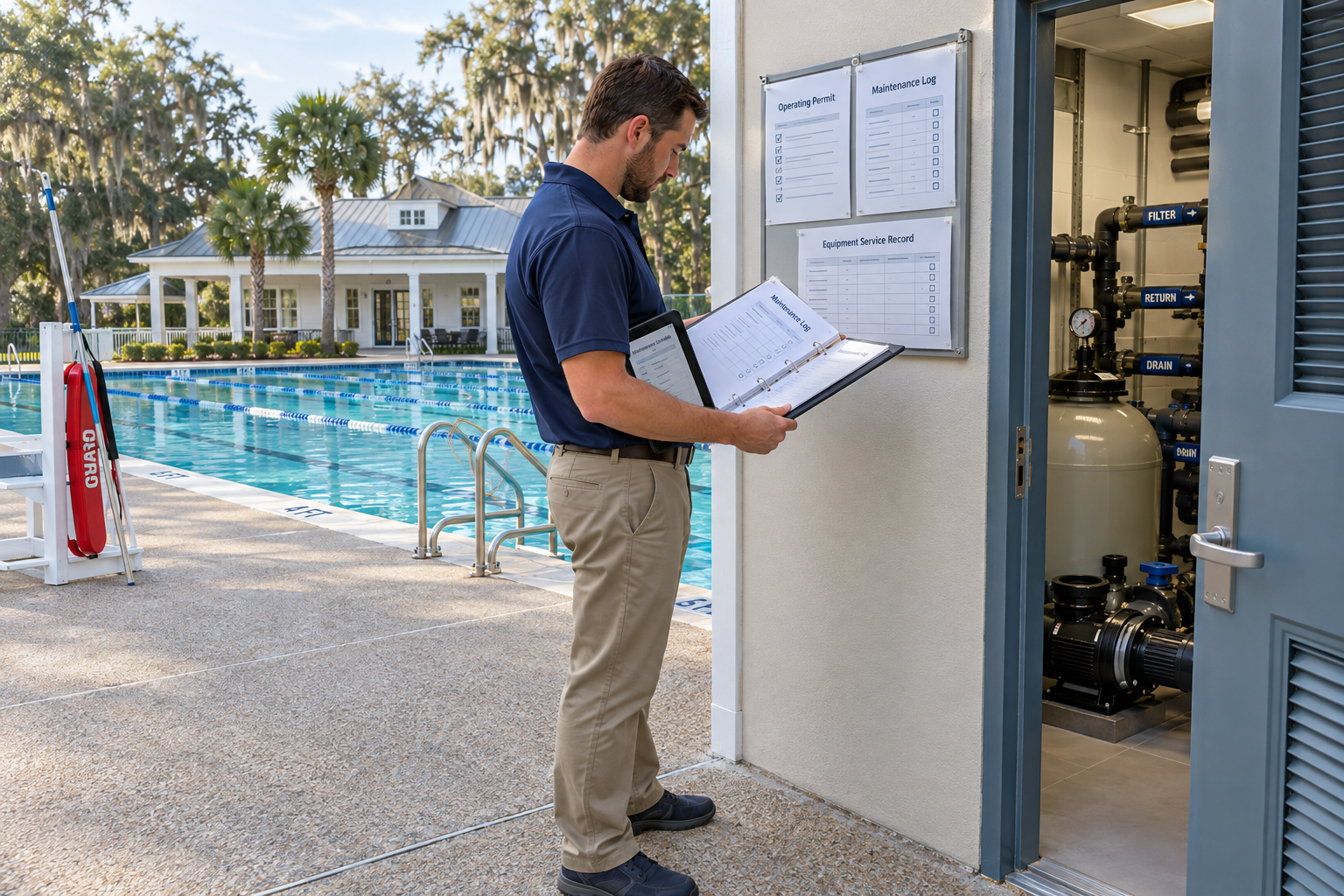
Pool compliance in South Carolina involves permits, water-quality testing, qualified operators, safety equipment and reliable records. Structured commercial pool management services can organize these responsibilities, but owners and designated agents must still ensure that deficiencies are corrected.
The current state regulator is the South Carolina Department of Environmental Services, or SCDES. Although owners still search for “SC DHEC pool regulations,” public-pool oversight transferred to SCDES following the July 1, 2024, agency restructuring.
This guide explains the main requirements for commercial and community pools. Use it alongside your facility’s permits, approved plans and instructions from the authorities having jurisdiction.
| Quick Answer To maintain pool compliance in South Carolina, confirm the pool’s classification, keep a valid operating permit and designate a qualified certified operator. Complete required testing and records, maintain safety systems and provide applicable lifeguard coverage. Obtain approval for alterations and address local construction requirements separately from state public-pool requirements. |
Understand South Carolina Pool Requirements
Use the Current Regulatory Authority
SCDES’s Recreational Waters Program oversees public pools, spas, waterparks and other regulated recreational waters.
South Carolina Regulation 61-51 establishes the principal requirements for classification, construction, operation, maintenance and enforcement. Consult the official Public Swimming Pools Regulation 61-51 when confirming the requirements for your facility.
Older permits and regulatory text may still refer to DHEC. Do not assume a permit became invalid solely because the agency changed.
Keep the permit number, approved plans and agency correspondence together. The applicable requirements depend on the facility and its approved configuration.
Confirm the Pool Classification
“Public swimming pool” is a regulatory category, not simply a description of whether anyone can enter.
Hotel, apartment, condominium, subdivision and club pools fall within the regulation’s classifications. Residents-only access does not automatically make a community pool exempt.
| Pool category | Examples covered by the regulation | Main compliance consideration |
| Type A | Pools generally open to the public, subject to stated exclusions | Lifeguard requirements depend on pool size and patron numbers |
| Type B | Hotel, apartment, condominium, subdivision and club pools | Classification-specific operating requirements |
| Type C | Wading pools, kiddie pools and certain recirculating spray features | Different design and equipment requirements |
| Type D | Spas and hot tubs | Temperature and other specific operating requirements |
| Type E | Waterpark attractions and certain subdivision pools with slides | Attraction supervision and lifeguard coverage |
These examples summarize the definitions rather than replace them. The regulation also recognizes special-purpose and hybrid pools.
Confirm the approved classification before adding an attraction or changing how a feature operates. A property’s description of itself as a hotel or HOA does not resolve every classification question.
Separate Construction and Operating Approvals
Construction approval and permission to operate serve different purposes.
A public pool or spa requires the appropriate construction approval before building begins. Newly constructed or altered facilities must complete the required final inspection process and receive written approval before opening.
Keep the following documents accessible:
- Construction permits and approved plans.
- Approved change orders.
- Final inspection and operating approvals.
- The current operating permit.
- Applicable local building and trade permits.
- Written conditions and approved variances.
A contractor’s completion notice does not authorize the pool to open.
When arranging commercial pool maintenance, identify who stores these documents and reports proposed changes that may affect the approved configuration.
Track Annual Permit Deadlines
Operating permits run from April 1 through March 31. The current permit must be prominently displayed at the pool on or near the rules sign.
Annual operating permit fees are due February 15 and become delinquent if not received by March 15. SCDES publishes the dates and applicable charges in its operating permit fee guidance.
| Milestone | Required action |
| Before February 15 | Review the fee notice and arrange payment |
| February 15 | Annual operating permit fees are due |
| March 15 | Unpaid fees become delinquent |
| April 1 | The new operating permit period begins |
| During operation | Display the current permit and maintain required conditions |
Assign responsibility for deadlines rather than assuming the owner, property manager and contractor are each handling them.
These dates concern annual operating permits. Construction projects and alterations have separate approval requirements.
Understand Charleston Inspection Responsibilities
Charleston pool inspections can involve both state public-pool oversight and local construction requirements.
For projects within the City of Charleston, local inspections may include electrical bonding, deck bonding, electrical final and building final inspections. Applicable barrier requirements must also be satisfied before final approval.
Local construction approval does not replace SCDES public-pool approval. Track both processes and confirm project-specific conditions before scheduling an opening.
Verify the property’s actual jurisdiction. City of Charleston requirements should not automatically be applied to every address in Charleston County or neighboring municipalities.
Obtain Approval Before Alterations
A project can require review even when the pool’s overall shape remains unchanged.
Changes to approved equipment, coatings, structures or other specifications may require a change order. SCDES explains the application and approval process in its swimming pool change-order guidance.
Submit the required description, drawings or revised plans before making changes. Some projects require plans prepared and sealed by an appropriately licensed architect or engineer.
Do not assume that a replacement pump, resurfacing project or deck modification falls outside regulatory review.
Maintain Compliance During Operation
Appoint a Qualified Pool Operator
Public pools must operate under the direction of a qualified operator holding valid South Carolina Pool Operator certification from an approved issuing party.
The operator of record must inspect each pool at least three times per week during operation. Findings must be recorded and initiated in the facility’s bound logbook.
When arranging coverage with certified pool operators, verify the assigned individual’s current qualifications and responsibilities.
Operator inspections are separate from daily water testing and official SCDES inspections. Identify who performs each task and who responds when a problem is found.
Test Water and Record Results
South Carolina’s operating requirements establish water-quality limits and testing duties. Clear-looking water is not enough to demonstrate compliance.
Section J.14 of Regulation 61-51 specifies the following limits.
| Parameter | Requirement |
| Free chlorine | 1–8 parts per million |
| Bromine | 2.3–17.6 parts per million |
| pH | 7.0–7.8 |
| Cyanuric acid, where used | No more than 100 parts per million |
These are regulatory limits, not instructions to operate routinely at either extreme. The qualified operator should establish suitable targets and procedures for the particular facility.
Chlorine or bromine and pH must be checked daily, or more frequently during operating hours as needed to maintain the required standards. Cyanuric acid must be tested and recorded weekly where applicable.
Include corrective-action procedures in the scope for pool water testing and chemical management. Staff should know how to respond to unacceptable results, not simply how to record them.
Maintain the Required Logbook
The regulation requires a bound log with consecutively numbered pages acceptable to the Department.
Entries must include the date, time and actual numerical reading. Each reading must be initiated, and the report must be signed by the operator or designated agent.
The previous 18 months of reports must remain available at the facility.
Automatic instrument monitoring does not replace physical poolside sampling. Do not assume a digital dashboard alone satisfies the prescribed sampling or recordkeeping requirements.
Keep records current rather than reconstructing them before an inspection.
Inspect Barriers and Emergency Equipment
Include access control, safety equipment and emergency communication in routine operating checks.
Check for:
- Gates that close and latch as required.
- Damaged barriers or unauthorized openings.
- Missing or inaccessible safety equipment.
- Illegible rules, warning signs or depth markers.
- Loose ladders and handrails.
- Avoidable deck hazards.
- Inaccessible equipment rooms or operating records.
The regulation requires an approved, permanently mounted emergency notification device within a 200-foot walking distance of the pool. It must be accessible during operating hours, with the pool’s physical address displayed.
A staff member’s mobile phone is not an acceptable substitute under the stated requirement.
Match Lifeguard Coverage to Classification
Not every South Carolina pool has the same lifeguard obligation.
Type A and Type E pools require lifeguard coverage during operation. Type A staffing depends on pool surface area and patron numbers, while Type E facilities must follow the applicable requirements and approved coverage arrangements.
Where only one lifeguard is required, an additional pool staff employee must be present and available to make an emergency call.
When arranging commercial lifeguard services, provide the facility’s classification, dimensions, attractions and expected attendance.
Current certifications must be available for inspection. On-duty lifeguards must supervise swimmers rather than simultaneously perform unrelated duties.
Review Federal Requirements Separately
State approval does not replace applicable federal requirements.
Public pools and spas must meet applicable Virginia Graeme Baker Pool and Spa Safety Act requirements, including appropriate anti-entrapment protections. A broken or missing drain cover requires the pool to remain closed until corrected.
Accessibility requires a separate review based on the type of entity and whether the pool is new, altered or existing.
Do not assume an older pool is automatically exempt or that every facility has identical obligations. Have qualified professionals review the actual installation and operating circumstances.
Prepare for State Inspections
SCDES describes a 34-point public-pool inspection checklist covering chemistry, signage, barriers, emergency communication, applicable lifesaving equipment and circulation systems.
The agency states that it inspects recreational waters at least twice during May through August and once per quarter during September through April. Follow-up visits may be required. These details appear in its public-pool inspection and enforcement overview.
Use a pool safety inspection checklist to organize internal reviews. An internal checklist is not an official inspection or approval.
Make sure staff can locate permits, logs, certifications and previous findings. They should also know who can authorize repairs or close the facility.
Commonly observed violations include out-of-range chemistry, damaged or missing signs, and noncompliant fences or gates. Use these findings to guide internal reviews without neglecting other requirements.
Respond Correctly to Closures
Serious deficiencies can result in an emergency closure.
For an SCDES-ordered closure, address the violations and contact the agency for the required follow-up. Its published process includes reinspection and reopening when the facility is compliant.
Biological or chemical contamination also requires immediate closure and the applicable response procedures. Do not reopen solely because the water looks clear.
Record the problem, corrective work, test results and any required reopening authorization.
The regulation requires written reporting within 72 hours of a death, injury or accident requiring an EMS response, emergency room visit or hospitalization. Assign responsibility for submitting the prescribed report.
Contact Us
Gather the current permit, latest inspection report, approved classification, operator information and planned renovation details before requesting assistance.
To discuss your facility’s needs with Pool Management Inc., contact our pool management team. Define responsibilities for maintenance, staffing, documentation and corrective work before services begin.
Frequently Asked Questions
Does DHEC Still Regulate Pools?
Public-pool oversight now sits with SCDES. Older permits and regulatory text may retain DHEC wording, but current applications and questions should follow the responsible agency’s guidance.
Do HOA Pools Need Operating Permits?
Subdivision and condominium pools fall within the regulation’s public-pool classifications. Residents-only access does not automatically make a community pool exempt.
What Permits Do Commercial Pools Need?
New public pools require construction approval and approval to operate. Alterations require appropriate review, and local building or trade permits may also apply.
Are Charleston Inspections Separate From SCDES?
Yes. City construction inspections address local requirements, while SCDES oversees state public-pool permitting and operational compliance. Confirm the property’s jurisdiction before planning the approval process.
How Often Must Water Be Tested?
Chlorine or bromine and pH must be checked daily, or more frequently during operation as needed to maintain the required standards. Cyanuric acid must be tested and recorded weekly where applicable.
How Long Must Logs Be Kept?
The previous 18 months of required operating reports must remain available at the facility. The regulation specifies a bound log with consecutively numbered pages, numerical readings and the required initials and signatures.
Can a Closed Pool Reopen Immediately?
Not simply because a repair is complete. For an SCDES-ordered closure, follow the agency’s correction, follow-up inspection and reopening process.