
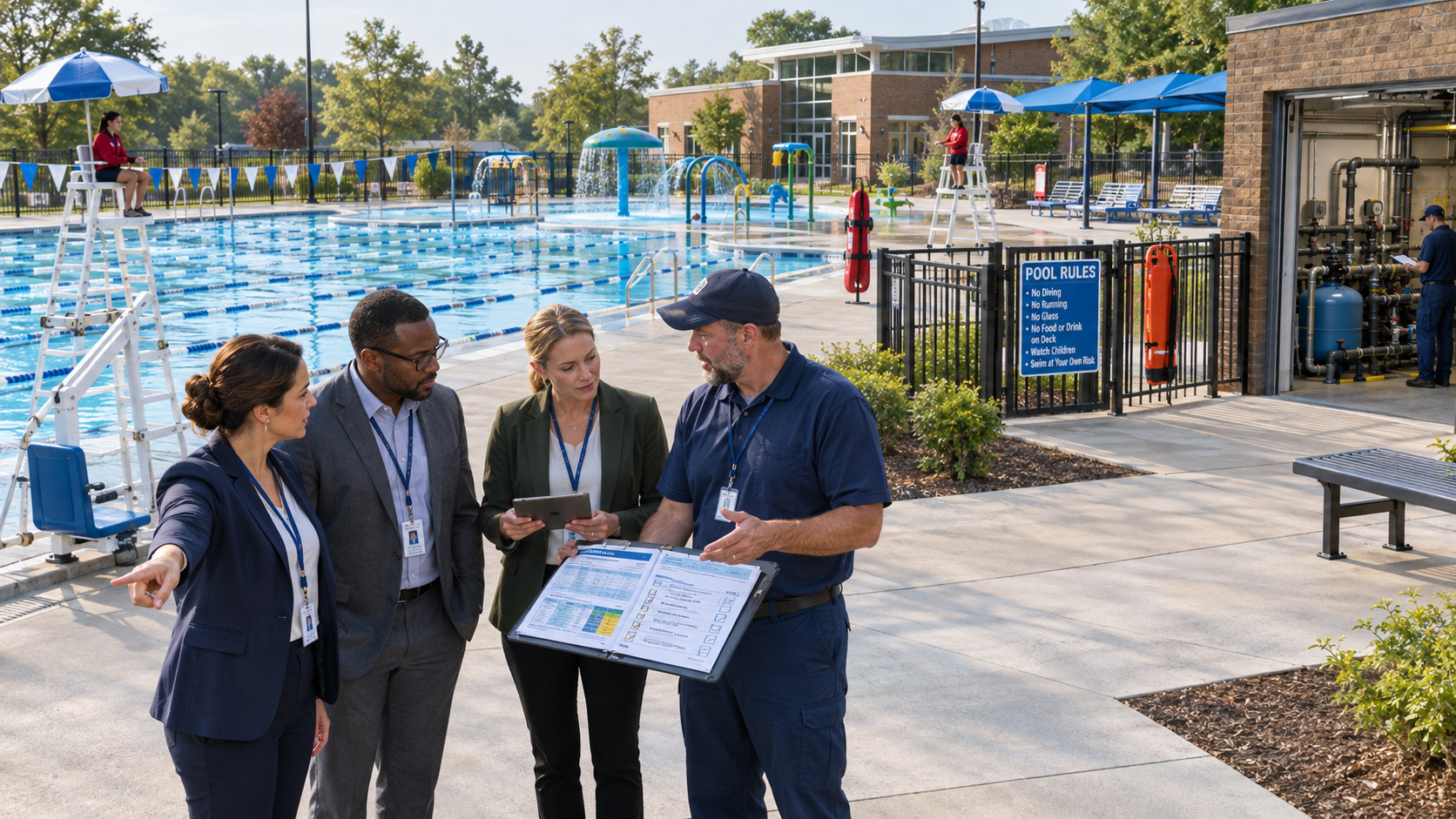
Municipal pool management combines aquatic management services with public procurement, staffing, maintenance, programming, safety oversight and community access. A city is not simply purchasing lifeguard hours or chemical service. It is defining how a public facility will operate, how performance will be measured and who will respond when conditions change.
That distinction matters when preparing city pool contracts. An unclear scope can leave maintenance, staffing or incident responsibilities split between departments and contractors. A well-written agreement identifies the required outcomes, establishes measurable standards and gives both parties a practical way to manage the season.
This guide explains how city officials and parks and recreation directors can define the operating model, prepare a community pool RFP, evaluate proposals and monitor performance after award.
| Quick Answer A municipal pool management plan should define facilities, operating hours, staffing, maintenance, safety, programming, reporting and city-contractor responsibilities.The RFP should use measurable outcomes and clear evaluation criteria. Separate core operations from optional services such as lessons, concessions, repairs and private events for accurate pricing. |
Define the Operating Model
Municipal aquatic facilities differ in size, purpose and community expectations. The appropriate model depends on the city’s staff capacity, facilities and desired level of control.
Inventory the Facilities
Begin with an accurate list of every venue included in the contract.
The inventory may cover:
- Competition pool
- Recreation pool
- Wading pool
- Therapy pool
- Diving well
- Splash pad
- Water slide
- Bathhouse
- Concession area
- Pump and chemical rooms
- Outdoor deck
- Parking and entrance areas
For each facility, record:
| Requirement | Information to include |
| Location | Address and site access |
| Venue type | Pool, splash pad, slide or related feature |
| Operating season | Opening and closing dates |
| Public schedule | Days and hours |
| Programmes | Lessons, teams, camps and fitness |
| Capacity | Posted or design capacity |
| Equipment | Pumps, filters, heaters and controllers |
| Condition | Known defects and planned improvements |
| Staff areas | Offices, storage and break rooms |
| Historical demand | Attendance, rentals and programme use |
Provide recent inspection reports, equipment lists, operating records and known capital needs when procurement rules permit. Hidden conditions make proposals harder to compare and often produce change requests later.
Compare Management Models
Cities generally choose among three operating models.
| Model | City responsibility | Contractor responsibility | Potential fit |
| In-house | Staffing, maintenance and programmes | Limited specialist support | Cities with established aquatic teams |
| Full-service contract | Governance and contract oversight | Staffing, maintenance and daily operations | Cities seeking one accountable operator |
| Hybrid | Selected staff, assets or programmes | Defined operational services | Cities retaining some internal capability |
A hybrid agreement might place lifeguard recruitment and daily operations with a contractor while the city retains mechanical maintenance. Another city may keep programming internal but outsource water treatment and facility care.
The model matters less than the clarity of the boundary. Every task should have one primary owner.
Create a Responsibility Matrix
A responsibility matrix prevents gaps between city departments and contractors.
| Activity | City | Contractor | Shared |
| Establish public hours | ✓ | ✓ | |
| Recruit and schedule operational staff | ✓ | ||
| Set programme fees | ✓ | ||
| Daily water testing | ✓ | ||
| Major equipment replacement | ✓ | ||
| Routine cleaning | ✓ | ||
| Emergency closure communication | ✓ | ✓ | |
| Programme delivery | Depends on scope | Depends on scope | Possible |
| Capital planning | ✓ | ✓ | |
| Performance reporting | ✓ | ✓ |
Do not use “as needed” without defining who decides when a service is needed, how it is authorized and whether it is included in the contract price.
Separate Operations From Capital Work
Daily public pool operations should be distinguished from renovation and replacement projects.
Routine work may include:
- Water testing
- Cleaning
- Filter operation
- Minor adjustments
- Consumable replacement
- Opening and closing checks
Capital work may include:
- Pump replacement
- Filter replacement
- Deck reconstruction
- Pool resurfacing
- Plumbing changes
- Major accessibility improvements
- New chemical-control systems
If significant pool renovations are expected, define a separate approval, pricing and inspection process. A management contractor should not be able to authorize major work without the controls required by the city.
Build the Community Pool RFP
A community pool RFP should help qualified respondents understand the service, risk and staffing requirements well enough to submit comparable proposals.
Define the Scope
The scope should state:
- Contract objectives
- Facility locations
- Operating period
- Public hours
- Programme schedules
- Required services
- City-provided assets
- Contractor-provided resources
- Performance standards
- Required reports
- Pricing format
- Renewal options
NIGP guidance recommends including the project background, the public entity’s challenge or desired outcome, technical requirements and performance requirements in the scope and specifications.
Write requirements in plain language. If a respondent needs to guess which team supplies test kits, uniforms or cleaning products, the scope is not complete.
Specify Staffing Outcomes
Staffing requirements may include:
- Aquatic manager
- Facility manager
- Lifeguards
- Head lifeguards
- Pool operators
- Swim instructors
- Cashiers or gate attendants
- Maintenance staff
- Programme coordinators
For each role, define qualifications, supervision, scheduling expectations and documentation.
A public pool lifeguard scope may address training, first aid and CPR credentials, rule enforcement, hazard identification, incident reports and recurring skills assessments.
Avoid evaluating staffing only by hourly rates. A low hourly price may not account for recruitment, supervision, training, absences, overtime or replacement coverage.
Require respondents to explain:
- How staff will be recruited
- How credentials will be verified
- How schedules will be filled
- How absences will be covered
- How supervisors will monitor performance
- How training records will be maintained
- What happens when staffing falls below the required level
Some municipal RFPs specify different staffing levels by day, holiday or programme. Others allow the proposer to recommend coverage based on facility conditions and anticipated attendance.
Define Maintenance Responsibilities
Maintenance should be described at the asset and task level.
A comprehensive aquatic facility maintenance scope may cover water quality, circulation systems, equipment, surfaces and supporting spaces rather than chemistry alone.
Include responsibility for:
- Required water testing
- Operating records
- Filter and pump checks
- Chemical-feed systems
- Deck cleaning
- Restrooms and changing rooms
- Waste removal
- Inventory
- Minor repairs
- Work-order submission
- Seasonal opening and closing
- Emergency maintenance
The CDC recommends maintaining accurate water-quality and maintenance records, operating filtration and recirculation systems according to manufacturer guidance and using preventive maintenance to replace components before they fail.
Do not copy generic chemical values into an RFP without checking the rules adopted by the state or local authority. Require compliance with the regulations and operating criteria that apply to each facility.
Include Inspections and Safety
The RFP should describe the required inspection system.
A facility inspection checklist can include:
- Rescue equipment
- Signs
- Gates and latches
- Decks and drains
- Skimmers
- Filter tanks
- Pumps and motors
- Chemical equipment
- Lighting
- Handrails and ladders
- Restrooms
- Storage areas
Define how deficiencies will be classified, reported and corrected. A missing sign and an equipment condition requiring immediate closure should not enter the same queue without different priorities.
Broader pool safety procedures should also address emergency communication, severe weather, contamination events, missing persons, medical incidents and reopening authority.
Address Programming
Programmes may include:
- Swim instruction
- Water fitness
- Team practice
- Open recreation
- Camps
- Private rentals
- Community events
- Therapy sessions
- Senior programmes
If the contractor will provide swim lessons, define instructor qualifications, registration responsibilities, refunds, class sizes, revenue collection and reporting.
Programming also affects staffing and maintenance. A heavily scheduled teaching pool may have different cleaning, water-testing and deck-configuration needs from an open-swim facility.
Request Comparable Pricing
Require a pricing form that separates major cost categories.
| Pricing category | Possible unit |
| Mobilization | Fixed price |
| Seasonal management | Monthly or seasonal fee |
| Lifeguards | Hourly rate by role |
| Pool operators | Hourly or monthly rate |
| Maintenance | Fixed fee or task schedule |
| Chemicals and supplies | Included, allowance or unit prices |
| Programmes | Fixed fee or revenue share |
| Private events | Per event or hourly |
| Emergency work | Hourly rates |
| Optional years | Annual price |
| Capital work | Separate authorization |
State whether prices should include recruitment, payroll taxes, uniforms, training, supervision, equipment and administrative overhead.
A single lump sum may be appropriate, but the city still needs enough detail to understand what drives costs and how changes will be priced.
Evaluate and Award the Contract
The lowest price is not necessarily the lowest-risk proposal. Evaluation should consider whether the respondent can deliver the full operating plan.
Publish Evaluation Criteria
Possible evaluation factors include:
- Relevant municipal experience
- Qualifications
- Staffing and recruitment plan
- Operating approach
- Maintenance plan
- Safety and quality systems
- Transition plan
- References
- Reporting capability
- Price
One municipal pool-maintenance solicitation weighted experience and qualifications at 35%, work plan at 25%, staffing at 20% and cost at 20%.
The exact weights should reflect the city’s priorities and procurement rules. Publish them in the solicitation so every respondent understands the basis for evaluation.
Assess Experience Carefully
Ask respondents to describe projects with comparable:
- Facility types
- Operating seasons
- Attendance
- Programmes
- Staffing levels
- Regulatory environment
- Contract value
- Scope complexity
A company experienced with small seasonal pools may not have the systems needed for a large aquatic centre with year-round programmes. Conversely, a large operator may not provide the local attention needed by a single community facility.
Contact references using consistent questions. Ask about staffing reliability, reporting, issue resolution, budget control and transition performance.
Review the Work Plan
A strong work plan should explain:
- Pre-opening preparation
- Recruitment timeline
- Training
- Scheduling
- Daily supervision
- Maintenance routines
- Inspection process
- Incident reporting
- Communication
- Seasonal closing
- Transition at contract end
Look for operational detail rather than promises to provide “excellent service.”
A realistic plan should also acknowledge risks such as delayed hiring, severe weather, equipment failure and unexpected demand.
Verify Commercial Requirements
The procurement team should confirm:
- Business licensing
- Required insurance
- Bonds where applicable
- Financial capacity
- Background-check requirements
- Subcontracting
- Litigation disclosures
- Conflicts of interest
- Record-retention requirements
- Data and payment security
- Public-record obligations
Insurance limits and contract terms should reflect the municipality’s legal and risk-management advice rather than being copied from another city without review.
Conduct a Pre-Award Discussion
When permitted, clarify assumptions before award.
Topics may include:
- Staffing start date
- Facility access
- Equipment condition
- Supply ownership
- Office and storage use
- Payment handling
- Work-order approval
- Reporting format
- Transition responsibilities
- Outstanding repairs
Document every clarification through the procurement process. Informal conversations should not create obligations that differ from the solicitation or final contract.
Monitor Public Pool Operations
Contract oversight begins after award. Municipal pool management should be measured against the standards written into the agreement.
Use Performance Measures
Government contract-monitoring guidance recommends a detailed statement of work, performance measures and a post-award meeting. The statement of work should describe objectives, requirements, deliverables and how performance will be monitored.
A municipal scorecard may include:
| Performance area | Example measure |
| Opening readiness | Percentage of scheduled days opened on time |
| Staffing | Percentage of shifts meeting requirements |
| Credentials | Percentage verified before assignment |
| Water quality | Percentage of required checks completed |
| Maintenance | Preventive tasks completed on schedule |
| Incidents | Reports submitted within required time |
| Cleanliness | Inspection score or deficiency count |
| Programmes | Classes delivered versus scheduled |
| Complaints | Response and resolution time |
| Budget | Actual cost against approved amount |
| Corrective action | Average age of open deficiencies |
| Reporting | Reports delivered by deadline |
Targets should be achievable and tied to actual public outcomes. Avoid collecting metrics that no one reviews or uses.
Hold a Post-Award Meeting
Before operations begin, bring together:
- Contract administrator
- Parks and recreation
- Procurement
- Risk management
- Finance
- Facility staff
- Contractor leadership
- Relevant public-safety personnel
Review the scope, reporting, invoices, communication, emergency contacts, access, work orders and escalation procedures.
Confirm which city representative can issue instructions or approve additional work. Multiple unofficial points of direction can create conflicting priorities and disputed charges.
Monitor More Than Reports
Use several oversight methods:
- Scheduled site visits
- Unannounced observations where appropriate
- Document review
- Credential checks
- Invoice verification
- Facility inspections
- Corrective-action tracking
- Staff and community feedback
- Performance meetings
Reports are useful, but they should be compared with actual site conditions.
Some municipal aquatic contracts also use recurring operational audits and annual facility-maintenance inspections.
Control Contract Changes
Changes may result from:
- Extended operating hours
- New programmes
- Added facilities
- Minimum-wage changes
- Equipment failure
- Renovation delays
- Weather closures
- New regulatory requirements
- Attendance increases
Define how changes will be requested, priced, approved and documented.
Do not allow an urgent operational request to become an ongoing service without formal authorization and budget review.
Plan the End of the Contract
The contract should address:
- Final operating records
- Equipment and key return
- Data export
- Outstanding work orders
- Inventory reconciliation
- Staff transition
- Programme registrations
- Refund obligations
- Facility condition
- Knowledge transfer
Exit planning matters even when renewal is expected. A city should be able to transition operators without losing records, access or control of the facility.
Frequently Asked Questions
What Does Municipal Pool Management Include?
It can include staffing, supervision, water-quality monitoring, maintenance, cleaning, programming, inspections, reporting and incident response.
The exact scope depends on the facility and operating model.
Should a City Outsource All Pool Operations?
Not necessarily.
Cities may operate pools internally, outsource the full operation or use a hybrid model. The best approach depends on internal capacity, risk, cost and service expectations.
What Should a Community Pool RFP Include?
Include facilities, schedules, required services, staffing outcomes, maintenance responsibilities, programmes, performance measures, pricing forms and contract terms.
Provide enough facility information for respondents to submit comparable proposals.
How Should City Pool Proposals Be Evaluated?
Evaluate relevant experience, staffing, work plan, maintenance, safety systems, reporting, transition and price.
Publish the criteria and weights in the solicitation.
Should Price Be the Main Evaluation Factor?
Price is important, but it should be considered with operating capability and risk.
A low-priced proposal may create additional costs if staffing, maintenance or supervision assumptions are incomplete.
How Should Contractor Performance Be Measured?
Use measurable indicators for opening readiness, staffing, inspections, maintenance, incidents, programmes, reporting and budget performance.
Track corrective actions until they are verified as complete.
Who Should Manage the Contract?
Assign one city contract administrator with defined authority.
Parks and recreation, procurement, finance, risk management and facility staff may support oversight, but contractor direction should follow a clear communication structure.
What Should Happen Before the Pool Opens?
Confirm staffing, credentials, training, equipment, supplies, inspections, records, emergency procedures and facility readiness.
Complete a post-award meeting and resolve critical deficiencies before public operations begin