
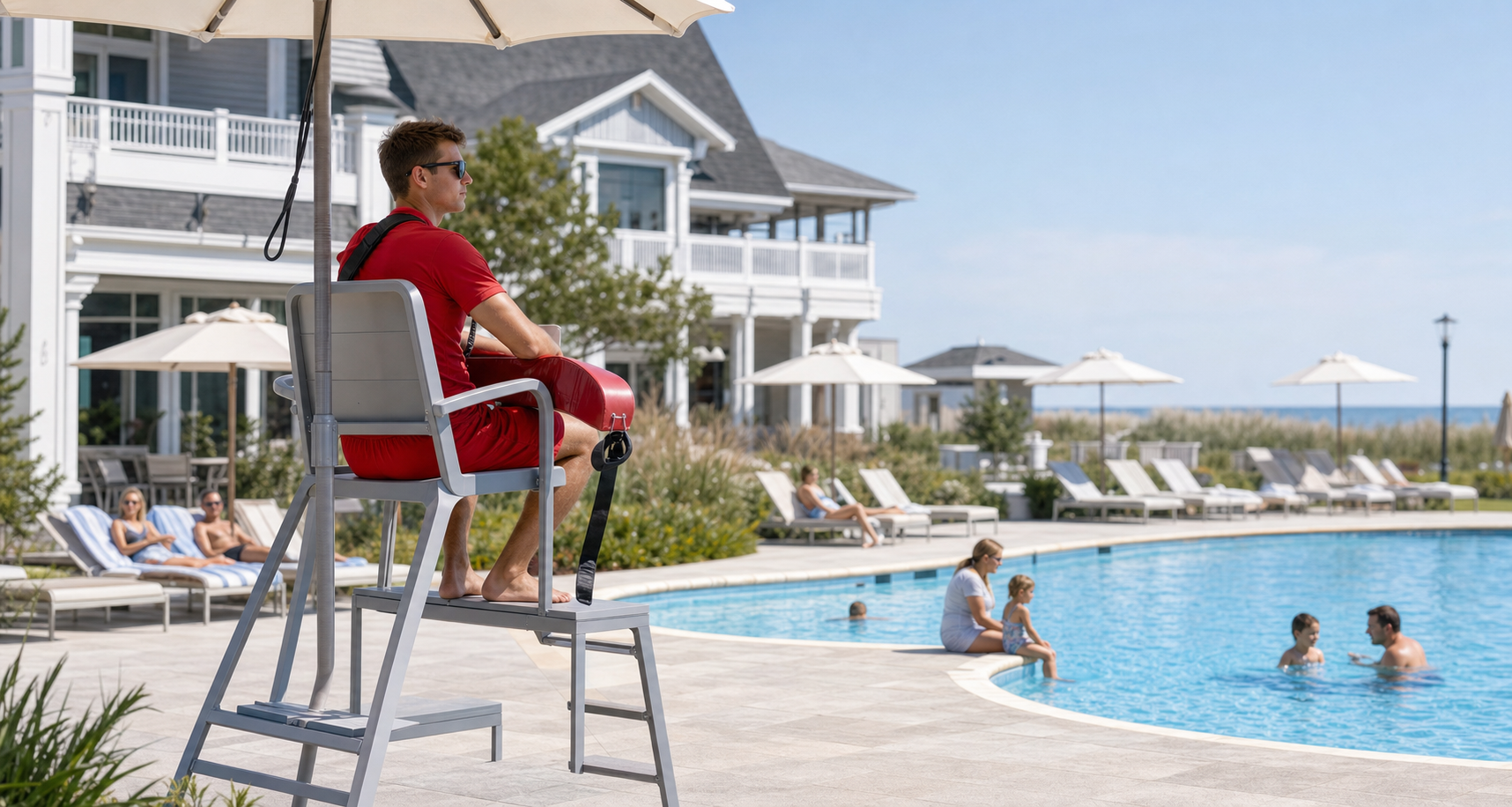
A resort pool is more than a recreational feature. It influences guest satisfaction, property reputation, operating costs, and the overall impression visitors take home. Effective commercial pool management combines trained staffing, documented safety procedures, maintenance coordination, and clear operational accountability.
For Delaware hospitality operators, managing that amenity becomes especially demanding during summer. Pool attendance increases, operating hours expand, and seasonal employees must maintain consistent safety and service standards throughout the busiest part of the year.
Professional lifeguard services in Delaware help resorts prepare for those demands. Rather than treating lifeguards as temporary employees who simply watch the water, an experienced aquatic staffing program can support recruitment, certification tracking, scheduling, supervision, emergency planning, documentation, and daily operations.
The result is a more organized aquatic facility and a pool experience aligned with the standards guests expect from a professionally managed resort.
The Demands of Resort Pools
Delaware resorts serve a varied guest population. A single pool may be used by young children, families, older adults, experienced swimmers, and visitors unfamiliar with the facility.
Usage can change quickly. A quiet morning may be followed by a crowded afternoon when families return from the beach. Weekends, holidays, special events, and group bookings can create sudden increases in attendance.
Hospitality operators must account for:
- Seasonal attendance changes
- Children and non-swimmers
- Multiple pool depths and aquatic features
- Extended operating hours
- Guest access control
- Water quality
- Deck cleanliness
- Weather interruptions
- Emergency communication
- Employee breaks and absences
- Certification documentation
- Guest questions and rule enforcement
A resort may have an attractive pool and reliable equipment but still encounter problems if its staffing plan is inconsistent. Comprehensive Delaware aquatic management can connect staffing with water-quality management, inspections, scheduling, safety procedures, and compliance documentation.
For hospitality operators, the objective is not simply to keep the pool open. It is to operate it consistently throughout the season without placing excessive aquatic responsibilities on hotel managers or employees whose primary training is in other areas.
Delaware Pool Regulations
Delaware’s public swimming pool regulations establish requirements for facility supervision, safety, and operations. The requirements that apply depend on the property and pool.
The regulations state that a lifeguard is not required at a motel, hotel, or private campground pool, although an attendant is required. For non-exempt pools, a lifeguard is generally required when any part of the pool is deeper than four feet.
Where lifeguards are required, Delaware regulations address credentials in lifeguarding, CPR, and first aid. Current certification documentation must be retained at the pool while it is open. Pools with more than 2,000 square feet of water surface must also have at least one lifeguard stand.
| Operating issue | Delaware regulatory baseline | Resort consideration |
| Hotel or motel pool | A lifeguard may not be required, but an attendant is required | A resort may voluntarily provide trained lifeguards |
| Deeper non-exempt pool | A lifeguard is generally required if any portion exceeds four feet | Staffing must cover all pool operating hours |
| Lifeguard credentials | Current lifeguarding, CPR, and first-aid credentials are required | Certification records need regular review |
| Solo lifeguard leaving poolside | Swimmers must be prevented from remaining in or entering the pool | Relief coverage can prevent interruptions |
| Large pool | A lifeguard stand is required above the stated surface-area threshold | Sightlines and surveillance positions need assessment |
| Exempt facility | The minimum legal requirement may differ | Management must still plan supervision and emergency response |
Hospitality operators should review the requirements that apply to their specific facility. Pool depth, access, aquatic features, facility classification, and regulatory changes may affect the operating plan.
This article provides general operational information rather than legal advice. Resorts should verify current requirements with Delaware authorities and qualified advisers.
Going Beyond Compliance
Legal compliance establishes a baseline. It does not automatically provide a complete aquatic safety program.
Even when a hotel pool is exempt from a lifeguard requirement, management must determine how the pool will be supervised, who will respond during an emergency, and how guest behavior will be managed.
A professional program can address:
- Water surveillance responsibilities
- Emergency-action procedures
- Rescue equipment checks
- Staff certification records
- Opening and closing procedures
- Pool rules and signage
- Incident documentation
- Severe-weather procedures
- Staff rotations and breaks
- Guest access
- Communication with resort management
The decision to use hotel pool lifeguards can therefore be based on the property’s operating conditions and guest population, not only on whether a regulation requires them.
Trained coverage may be especially valuable at properties that serve families, operate several aquatic features, experience large changes in daily attendance, or have long pool hours.
Seasonal Recruitment Challenges
Recruitment is one of the most demanding parts of resort aquatic staffing.
A Delaware resort needs enough qualified employees to cover long operating days, weekends, holidays, breaks, absences, and unexpected turnover. Recruiting only enough people to fill the initial schedule leaves little flexibility when someone becomes unavailable.
Seasonal staffing requires operators to:
- Find suitable candidates
- Confirm summer availability
- Verify certifications
- Conduct interviews
- Complete onboarding
- Establish conduct and uniform standards
- Build weekly schedules
- Plan breaks and relief coverage
- Monitor attendance
- Replace departing employees
- Maintain employment records
- Provide ongoing supervision
Current job listings show demand for pool lifeguards and aquatic employees in and around Rehoboth Beach. Resorts, clubs, community facilities, and other aquatic employers may be competing for candidates from the same seasonal workforce.
Early Rehoboth pool staffing gives operators more time to recruit, review credentials, train employees, and prepare backup coverage before peak occupancy.
Direct hiring may work for a property with experienced aquatic leadership and an established seasonal workforce. Professional certified pool lifeguard staffing may be more appropriate when the resort needs specialized recruitment, credential tracking, scheduling, training, and supervision.
Direct Hiring vs Professional Staffing
Hospitality operators should compare the administrative and operational responsibilities involved in each staffing model.
| Responsibility | Direct resort hiring | Professional aquatic staffing |
| Recruitment | Managed by the resort’s HR team | Supported through aquatic recruitment systems |
| Credential review | Resort verifies each employee | Certifications can be centrally tracked |
| Scheduling | Added to internal management duties | Built around pool hours and coverage needs |
| Break coverage | Managed by resort supervisors | Planned within the aquatic schedule |
| Callouts | Internal managers find replacements | Replacement procedures can be established |
| Supervision | Assigned to hospitality managers | Supported by aquatic supervisors |
| In-service training | Arranged internally | Integrated into the staffing program |
| Safety reviews | Completed internally or separately | Coordinated with aquatic operations |
| Seasonal transition | Rebuilt each year | Managed through a repeatable process |
The right model depends on the resort’s size, internal resources, operating season, and pool configuration.
A smaller property may need targeted recruitment and scheduling support. A larger resort with several pools, long operating hours, or numerous aquatic features may need a broader management structure.
The service agreement should state which party is responsible for recruitment, payroll, certification checks, uniforms, supervision, equipment, scheduling, replacement coverage, and incident reporting.
Maintaining Reliable Coverage
Recruiting qualified employees is only the beginning. A resort must maintain consistent coverage every day the pool is open.
A complete schedule should account for:
- Opening and closing times
- Expected peak attendance
- Lifeguard breaks
- Multiple pools or surveillance zones
- Special events
- Weekends and holidays
- Employee availability
- Illness and callouts
- Training sessions
- Severe weather
- Early- and late-season demand
If one lifeguard is responsible for an entire shift, even a routine break can interrupt operations. Delaware regulations state that when a lifeguard working alone leaves poolside, steps must be taken to prevent anyone from remaining in or entering the pool.
Relief coverage helps avoid situations in which resort management must choose between temporarily closing the pool and operating without the intended supervision.
A professional scheduling system also makes accountability clearer. Managers know who is assigned, who supervises the shift, and what procedure applies when an employee cannot report to work.
Lifeguards and Pool Attendants
Lifeguards and pool attendants do not necessarily perform the same role.
A lifeguard’s primary responsibility is water surveillance and emergency response. An attendant may support guest access, towel distribution, deck organization, rule communication, or other operational duties.
Asking one employee to perform too many secondary tasks can weaken surveillance. A lifeguard should not be routinely distracted by responsibilities that prevent sustained attention to swimmers.
A clear staffing plan defines:
- Who supervises the water
- Who checks guest access
- Who distributes towels
- Who organizes deck furniture
- Who checks restrooms
- Who records water chemistry
- Who responds to guest complaints
- Who contacts maintenance
- Who documents incidents
Role separation is particularly important at busy resorts where safety responsibilities and hospitality expectations overlap.
Supporting Guest Experience
Professional lifeguards perform a safety function, but their conduct also affects how guests perceive the resort.
They can support an orderly pool environment by:
- Greeting guests appropriately
- Explaining rules clearly
- Applying policies consistently
- Maintaining professional surveillance positions
- Responding calmly to concerns
- Reporting maintenance problems
- Managing pool access
- Supporting opening and closing procedures
Guests may not see every technical part of aquatic operations, but they notice inconsistency. Unclear rules, unattended stations, unexpected closures, or unprofessional conduct can reduce confidence in the property.
Hospitality lifeguard services should therefore include expectations for punctuality, uniforms, communication, conduct, and interaction with guests. The lifeguard team represents the resort as well as the aquatic operation.
Preparing for Emergencies
An emergency-action plan should explain how employees respond to foreseeable incidents, including:
- A distressed swimmer
- A missing child
- A serious injury
- A medical emergency
- Severe weather
- Water contamination
- Equipment failure
- A disorderly guest
- Facility evacuation
- Emergency vehicle access
Written procedures are only effective when employees understand and practice their roles.
A response plan may identify who performs a rescue, calls emergency services, retrieves equipment, clears the water, meets first responders, documents the event, and communicates with resort leadership.
Orientation and in-service training allow staff to review facility-specific risks, rescue equipment, communication systems, and emergency access points.
Documented pool safety procedures should support staff preparation, emergency communication, swimmer supervision, and consistent responses to facility hazards.
Safety reviews can also identify gaps involving equipment, signage, records, staff positioning, or emergency procedures before the facility reaches peak attendance.
Connecting Staffing and Maintenance
Lifeguards should not replace trained pool operators or maintenance technicians.
Water clarity, chemical balance, filtration, circulation, gates, deck conditions, and safety equipment all influence whether a pool can remain open.
Lifeguards may be the first employees to notice:
- Reduced water clarity
- Damaged drain covers
- Malfunctioning gates
- Missing safety equipment
- Loose deck furniture
- Sharp edges
- Unusual chemical Odors
- Slippery surfaces
- Damaged depth markers
- Lighting problems
Employees need a clear procedure for reporting each issue and determining whether the affected area should close.
Routine aquatic facility maintenance supports water chemistry, equipment condition, preventive care, and timely repairs.
Connecting lifeguard observations with a maintenance response reduces confusion and helps management address problems before they create extended closures or guest complaints.
Seasonal Planning
Delaware hospitality operators should begin aquatic planning well before the busiest summer weekends.
| Planning period | Main priorities |
| Post-season | Review incidents, staffing gaps, guest feedback, equipment problems, and vendor performance |
| Fall and winter | Establish the next season’s scope, budget, staffing model, and repair plan |
| Early spring | Recruit staff, verify credentials, inspect equipment, and update procedures |
| Pre-opening | Conduct orientation, drills, maintenance checks, and document reviews |
| Opening weeks | Monitor attendance, pool demand, staff performance, and scheduling |
| Peak summer | Maintain relief coverage, supervision, water records, and emergency readiness |
| Late season | Adjust staffing to occupancy while preserving appropriate coverage |
| Closing period | Complete records, inventory, winterization, and performance evaluation |
Waiting until immediately before opening may limit the available candidate pool and leave less time to resolve scheduling, certification, or equipment problems.
Early planning also helps operators distinguish between baseline staffing and additional coverage required for weekends, events, holidays, or peak occupancy.
Choosing a Lifeguard Provider
A provider should be evaluated on more than the number of employees it promises to supply.
Delaware hospitality operators should ask:
- How are seasonal lifeguards recruited?
- Which credentials are required?
- How are certification dates tracked?
- Who creates and approves schedules?
- How are breaks handled?
- What happens when an employee calls out?
- Who supervises lifeguards on site?
- Is in-service training provided?
- How are incidents documented?
- Can attendants and lifeguards be coordinated?
- Are facility safety reviews available?
- Can the provider coordinate with maintenance?
- What reports will management receive?
- Which responsibilities remain with the resort?
- What services are included in the agreement?
The contract should identify the staffing scope, operating hours, supervision, documentation, equipment responsibilities, communication process, and procedures for changing coverage.
Clear responsibilities help prevent operational gaps after the season begins.
Full-Service Aquatic Management
Some properties need only lifeguard recruitment and scheduling. Others require a partner capable of coordinating the wider aquatic operation.
A full-service program may include:
- Lifeguard staffing
- Pool attendants
- Scheduling and supervision
- Water chemistry
- Cleaning and maintenance
- Safety reviews
- Certification records
- Incident reporting
- Equipment inspections
- Seasonal opening and closing
- Repairs and upgrades
- Communication with resort management
This structure reduces the number of separate parties the resort must coordinate. It also establishes a clearer response when staffing, maintenance, safety, and guest-service responsibilities overlap.
The appropriate scope depends on the property’s size, pool features, internal management resources, and desired level of operational support.
Building a Reliable Program
Professional lifeguard services help Delaware resorts establish a more consistent aquatic operation before the busiest guests arrive.
The investment extends beyond placing an employee beside the water. It can support recruitment, scheduling, supervision, emergency readiness, documentation, guest communication, maintenance coordination, and dependable seasonal coverage.
The right program depends on the property, pool configuration, operating schedule, and guest population. Delaware hospitality operators should assess their facilities early, confirm applicable requirements, and build staffing around actual operating conditions rather than minimum headcount.
Operators can discuss seasonal aquatic staffing requirements based on their pool layout, operating hours, expected attendance, maintenance needs, and desired level of supervision.
Frequently Asked Questions
Are lifeguards required at every Delaware hotel pool?
No. Delaware regulations state that a lifeguard is not required at a motel, hotel, or private campground pool, although an attendant is required. Different rules may apply according to the facility and pool, so operators should confirm the current requirements for their property.
Why would an exempt resort employ lifeguards?
A resort may voluntarily provide lifeguards for dedicated water surveillance, emergency response, structured rule enforcement, staffing accountability, and increased guest confidence.
What is the difference between a lifeguard and an attendant?
A lifeguard is trained and assigned to water surveillance and emergency response. An attendant may handle guest access, deck organization, towels, communication, or other operational duties.
What should resort aquatic staffing include?
A complete plan should address recruitment, credentials, scheduling, breaks, relief coverage, supervision, emergency procedures, training, documentation, and replacement employees.
When should Delaware resorts begin recruiting?
Recruitment should begin well before the operating season. Early planning provides more time for candidate selection, certification review, onboarding, training, and backup coverage.
Can one provider handle staffing and maintenance?
Some aquatic management companies provide both. An integrated model can connect lifeguard observations with water-quality, equipment, cleaning, and repair procedures.
What should operators consider for Rehoboth pool staffing?
Planning should account for seasonal competition, operating hours, weekend demand, holidays, certification status, employee availability, relief coverage, and replacement procedures.
How should a resort compare lifeguard providers?
Compare recruitment, credential controls, scheduling, supervision, training, emergency planning, reporting, maintenance coordination, contract terms, and backup coverage.