
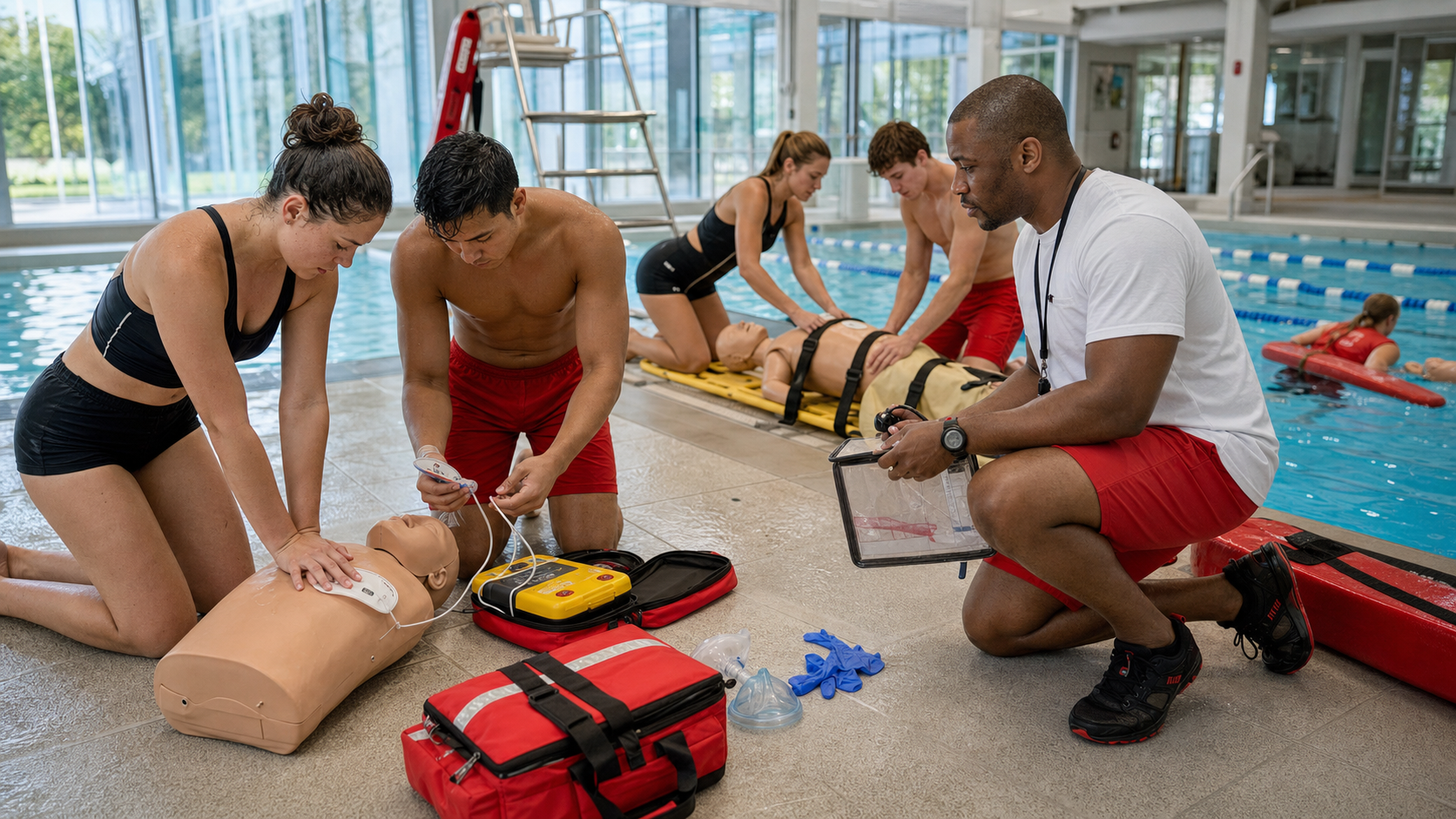
Lifeguard certification establishes that a candidate completed a defined course and demonstrated required rescue and emergency-care skills. It does not automatically establish readiness for every pool, waterpark, resort or waterfront.
Aspiring lifeguards and facility HR teams should evaluate the training provider, certification type, expiration date and aquatic environment covered. Employers involved in commercial pool operations and staffing must also consider state rules, local health-department requirements and facility-specific risks.
The American Red Cross, Ellis & Associates and StarGuard offer established lifeguard training systems, but their courses, renewal periods and operational models differ. A credential accepted at one facility may not satisfy another employer or authority having jurisdiction.
| Quick answer Lifeguard certification standards for 2026 generally require a current credential from a recognized training provider, demonstrated water-rescue ability, professional-level CPR/AED training and first aid competence. American Red Cross lifeguarding certification is generally valid for two years, while Ellis & Associates ILTP credentials require annual renewal. StarGuard requirements should be verified through the candidate’s current certificate and training center. Certification alone is insufficient: facilities should also conduct pre-service evaluations and documented in-service training. |
Standards for 2026
The United States does not have one universal lifeguard certificate accepted automatically at every aquatic facility. Training requirements can be affected by the state, local health authority, facility type, employer and water environment.
A municipal pool may accept a different list of providers from a camp, waterpark or oceanfront facility. HR teams should verify local acceptance before enrolling staff or recognizing a candidate’s credential.
The role of the MAHC
The CDC’s Model Aquatic Health Code, or MAHC, provides voluntary guidance that jurisdictions may adopt or adapt. It is not automatically federal law.
The 2024 fifth edition of the MAHC defines a qualified lifeguard as someone who has:
- Completed a lifeguard course recognized by the authority having jurisdiction
- Maintained a current certificate
- Met the facility’s pre-service requirements
- Participated in ongoing in-service training
The MAHC sets a maximum validity period of two years for lifeguarding and first aid credentials and one year for CPR/AED. A state or local authority may impose different or more restrictive rules.
The code also expects aquatic facilities to document training and keep relevant certification records available for inspection.
Certification is the starting point
A lifeguard card confirms successful completion of a course. It does not prove that the holder understands a specific facility’s blind spots, water depth, rescue equipment or emergency procedures.
Before assigning a guard to active surveillance, an employer should verify that the person can perform the required skills in the actual work environment.
Facility-specific preparation may include:
- Surveillance zones and rotation patterns
- Water depth and entry points
- Elevated stands and blind spots
- Rescue-tube placement
- Backboard and spinal-management procedures
- AED and first-aid equipment locations
- Emergency communication systems
- Procedures for summoning and meeting EMS
- Missing-person and severe-weather protocols
- Team response to an unresponsive victim
- Rules for attractions, slides and diving areas
A certification is therefore one part of a broader aquatic water-safety program, not a substitute for operational training.
Match training to the environment
The certification must correspond to the environment in which the guard will work.
Common course categories include:
- Shallow-water pools
- Traditional deep-water pools
- Waterparks and aquatic attractions
- Waterfronts
- Open-water environments
- Special facilities with waves or unusual features
A shallow-water credential may not cover rescues in a ten-foot diving well. A standard pool course may not prepare a guard for currents, limited visibility or long-distance waterfront rescues.
Facility HR should compare the exact certificate title with the job description rather than recording only “lifeguard certified.”
Major Certification Programs
The three programs below are widely encountered in commercial aquatics. Acceptance depends on the relevant authority and employer.
| Program | General model | Typical validity | Emergency-care component | Important consideration |
| American Red Cross | Public courses and authorized training providers | Two years for combined lifeguarding certification | CPR/AED for Professional Rescuers and first aid included | Review eligibility generally requires a current credential or one expired no more than 30 days |
| Ellis & Associates ILTP | Facility-centered aquatic risk-management model | One year | Professional-level CPR, AED, emergency oxygen and first aid within ILTP | Annual renewal and facility-specific accountability are central to the model |
| StarGuard | Training-center and facility-based certification model | Check the specific credential | Rescue and emergency-care content varies by course configuration | Verify expiration, facility type, local acceptance and any credential restrictions |
The table provides a general comparison. The candidate’s actual certificate, provider materials and local requirements control.
American Red Cross
The American Red Cross Lifeguarding course combines water rescue, first aid and CPR/AED for Professional Rescuers.
Candidates must be at least 15 years old by the final day of class and complete course-specific swimming prerequisites.
For the Red Cross deep-water lifeguarding course, the current prerequisites include:
- A continuous swim-tread-swim sequence
- A 150-yard swim using front crawl, breaststroke or both
- Two minutes of treading water using only the legs
- An additional 50-yard swim
- A timed 20-yard approach and object-retrieval event
- Retrieval of a ten-pound object from seven to ten feet
- Return transport and exit without a ladder or steps
The timed event must be completed within one minute and 40 seconds. Different prerequisites apply to shallow-water programs.
Successful participants receive a Lifeguarding with CPR/AED for Professional Rescuers and First Aid certificate that is generally valid for two years.
ARC renewal
The Red Cross offers abbreviated Lifeguarding Review courses for candidates with a current certification or one expired by no more than 30 days. Successful completion renews the certification for another two years.
Candidates outside the review eligibility period may need to complete the full course. Employers should check the credential before the expiration date rather than waiting until seasonal hiring begins.
Ellis & Associates
Ellis & Associates operates the International Lifeguard Training Program, commonly called ILTP. Its model is frequently associated with waterparks, resorts and facilities using an integrated risk-management system.
ILTP course categories include shallow water, pool and special-facility environments.
Published Ellis prerequisites include:
- Minimum age of 15 for shallow-water and pool courses
- Minimum age of 16 for certain special-facility courses
- A 50-yard swim for shallow-water candidates
- A 100-yard swim for pool candidates
- A 200-yard swim for certain wave-pool or open-water courses
- Retrieval of a ten-pound object
- Hands-free treading requirements for deeper-water programs
The exact swimming and rescue requirements depend on the course type.
Ellis & Associates ILTP credentials are valid for one year and require annual renewal.
ILTP renewal
Annual lifeguard renewal is important because it requires the candidate to revisit rescue and emergency-care skills more frequently than a two-year credential.
The Ellis continuing-education schedule lists a renewal ILTP Shallow Water Lifeguard course at approximately 9.5 hours. Course length can vary by program type and delivery arrangement.
Facilities operating under the Ellis system may have additional training, audit and accountability requirements. HR teams should confirm whether a candidate’s credential transfers to the particular facility or whether site-specific onboarding is necessary.
StarGuard
StarGuard provides internationally recognized lifeguard training through authorized training centers and aquatic facilities. Its programs can be delivered through traditional in-person or blended formats that combine online study with face-to-face instruction.
Because StarGuard credentials may vary by course and facility, employers should review the certificate itself rather than relying on the program name alone.
Verify:
- The exact certification title
- The issue and expiration dates
- The aquatic environment covered
- Whether the credential is restricted to one facility
- Whether CPR/AED and first aid are current
- Whether the local authority accepts the course
- Whether additional site-specific testing is required
Some state guidance specifically advises employers to check whether a StarGuard certificate is limited to a particular facility or aquatic environment.
Candidates can use StarGuard’s certification lookup system to confirm credential status. StarGuard states that certified individuals must possess a complete, current and unexpired certificate.
Which program is best?
There is no single best program for every lifeguard or employer.
The most appropriate option is the one that:
- Is accepted by the relevant jurisdiction
- Matches the facility’s water environment
- Includes required emergency-care training
- Provides hands-on skill evaluation
- Can be verified by the employer
- Supports timely renewal
- Aligns with the facility’s operational system
A candidate should ask prospective employers which programs they accept before paying for a course. An employer should document its accepted credentials instead of evaluating each applicant informally.
Required Lifeguard Skills
A complete course should address prevention, recognition, rescue and emergency care. Watching online lessons alone does not demonstrate the physical ability to perform a water rescue or provide effective CPR.
Blended learning can be appropriate when online instruction is combined with instructor-led, in-person skill practice and evaluation.
Surveillance and recognition
Lifeguards must recognize distress before a situation progresses.
Training should address:
- Active and passive drowning behavior
- Swimmers in distress
- Submerged victims
- High-risk activities
- Unsafe behavior
- Environmental hazards
- Zone coverage
- Scanning patterns
- Blind spots
- Distraction and fatigue
Surveillance skills must then be adapted to the actual facility. Crowd density, glare, water clarity, stand position and attraction design can change what the guard is able to see.
A written certificate cannot replace a facility’s responsibility to evaluate whether its surveillance plan works.
Water rescue skills
Course content may include:
- Entries from deck level or an elevated stand
- Approaches to conscious and unconscious victims
- Rescue-tube use
- Front and rear rescues
- Submerged-victim recovery
- Multiple-victim response
- Extrication from the water
- Spinal-motion restriction
- Team backboarding
- Rescue breathing in the water
- Response to shallow-water emergencies
The skills required for a flat-water community pool differ from those needed at a wave pool or open-water beach.
Facility HR and operations teams should ensure that each guard’s credential matches the assigned role. The lifeguard services overview provides context on how trained staffing fits into broader aquatic operations.
CPR and AED training
Lifeguards need professional-level CPR because they may respond to adults, children and infants and work as part of a multi-rescuer team.
Training should address:
- Recognition of cardiac arrest
- High-quality chest compressions
- Rescue breathing
- Two-rescuer CPR
- AED operation
- Care for adults, children and infants
- Airway obstruction
- Use of personal protective equipment
- Team communication
- Transfer of care to EMS
Certificate validity can be affected by jurisdiction. Although a combined lifeguarding credential may display a two-year expiration date, the MAHC recommends a maximum of one year for CPR/AED currency.
Some jurisdictions also impose separate annual CPR requirements. Employers must check local rules rather than assume every component remains valid for the same period.
First aid certification
First aid prepares lifeguards for emergencies that may not begin in the water.
Relevant topics include:
- Bleeding control
- Shock
- Head, neck and spinal injuries
- Heat-related illness
- Seizures
- Asthma emergencies
- Allergic reactions
- Burns
- Fractures and soft-tissue injuries
- Sudden medical illness
- Bloodborne-pathogen precautions
The first-aid component must remain current under the applicable course and local requirements.
Emergency action plans
A guard should know more than general rescue techniques. They must understand their role in the facility’s emergency action plan.
During a response, one guard may enter the water while another clears the pool, retrieves the AED, contacts EMS or directs emergency responders to the victim.
Documented drills can reveal communication failures before a real emergency. This is one reason pool-safety planning must extend beyond initial certification.
Recertification and Employment
Lifeguard renewal should be planned before the credential expires. Waiting until opening week can create staffing gaps, especially when review courses are full or a guard is no longer eligible for abbreviated renewal.
Renewal comparison
| Credential | Renewal timing | Common requirement |
| American Red Cross | Generally every two years | Review course for current credentials or those expired no more than 30 days |
| Ellis & Associates ILTP | Annually | Renewal course and required skill evaluation |
| StarGuard | According to the certificate and training-center requirements | Verify status, course type and renewal process |
| CPR/AED | Provider and jurisdiction dependent | May require annual currency even when lifeguarding is valid longer |
| First aid | Provider and jurisdiction dependent | Must remain current under local rules |
Candidates should retain digital and physical copies of every certificate and confirm that names and dates are correct.
Pre-service evaluation
Before a lifeguard begins active duty, the facility should complete a documented pre-service evaluation.
This may cover:
- Physical readiness
- Swimming ability
- Rescue entries and approaches
- Submerged-object retrieval
- Backboarding
- CPR/AED
- First aid
- Surveillance zones
- Rotation procedures
- Emergency communication
- Facility rules
- Emergency action plan responsibilities
The MAHC expects lifeguards to meet pre-service requirements before assuming on-duty responsibilities.
Facility inspections may also examine whether current staff credentials and safety documentation are maintained. A structured aquatic facility inspection can identify missing records or operational gaps before the pool opens.
In-service training
Rescue and CPR skills can deteriorate when they are not practiced. Certification should therefore be supported by continuing drills throughout employment.
In-service sessions may include:
- Timed victim recognition
- Active and passive rescues
- Deep-water retrievals
- Backboarding
- CPR and AED scenarios
- Missing-child drills
- Severe-weather response
- Team communication
- Zone adjustments
- Review of recent incidents
- Physical conditioning
The MAHC calls for periodic in-service training, documentation, maintenance of credentials and demonstration of test-ready skills.
Records should identify the date, attendees, instructor, content and skills evaluated.
HR verification checklist
Before scheduling a lifeguard, HR should verify:
- Candidate identity
- Minimum age
- Certification provider
- Exact certificate title
- Issue and expiration dates
- Water-depth or facility restrictions
- CPR/AED currency
- First-aid currency
- Acceptance by the relevant authority
- Completion of pre-service evaluation
- Attendance at required in-service training
- Documentation in the employee file
Organizations recruiting seasonal staff can provide these requirements before candidates apply. The lifeguard employment information offers applicants additional context about aquatic roles and hiring.
Maintaining Readiness
Lifeguard certification standards for 2026 require more than possession of a card. Candidates need a current credential that matches the aquatic environment, while employers must verify acceptance, emergency-care currency and facility-specific competence.
American Red Cross, Ellis & Associates and StarGuard each provide structured training pathways. Their renewal periods and operating models differ, so candidates and HR teams should verify the exact certificate rather than relying only on the provider’s name.
Current credentials, pre-service testing and documented in-service drills form the foundation of lifeguard readiness. Facilities reviewing staffing or training requirements can use the contact page to ask which certifications and operational standards apply to a specific aquatic environment.
Frequently Asked Questions
How old must someone be to become a lifeguard?
American Red Cross candidates must be at least 15 by the final day of class. Ellis & Associates generally requires candidates to be at least 15 for pool or shallow-water training and 16 for certain special-facility courses.
How long does lifeguard certification last?
Red Cross certification is generally valid for two years. Ellis ILTP credentials are valid for one year. StarGuard candidates should check the dates and conditions on their certificate.
Does lifeguard certification include CPR and first aid?
Many comprehensive lifeguard courses include professional-level CPR/AED and first aid. Employers should review the actual certificate and verify whether local rules require separate or more frequent renewal.
Can lifeguard certification be completed entirely online?
A complete certification requires physical skill demonstration and evaluation. Online coursework may form part of a blended course, but it cannot independently prove water-rescue or CPR competence.
Can an expired lifeguard certificate be renewed?
The answer depends on the provider. Red Cross review courses generally accept a current certificate or one expired by no more than 30 days. A longer lapse may require the full course.
Can a shallow-water lifeguard work at a deep pool?
Not automatically. The certification must match the facility environment and assigned duties. A shallow-water credential may not cover deep-water retrieval and rescue requirements.
Are all lifeguard certifications accepted nationwide?
No. Acceptance depends on the employer, state, local authority and facility type. Candidates should confirm acceptance before enrolling.
Does a current certificate guarantee employment?
No. Employers may also require interviews, physical testing, background checks, pre-service evaluation and facility-specific training.
Why is in-service training needed?
Regular practice helps maintain rescue, surveillance, CPR and teamwork skills. It also prepares lifeguards to use the specific equipment and emergency procedures at their workplace.
What records should a facility retain?
Facilities should retain copies of current credentials, pre-service evaluations, in-service attendance, skill assessments and other records required by the local authority.