
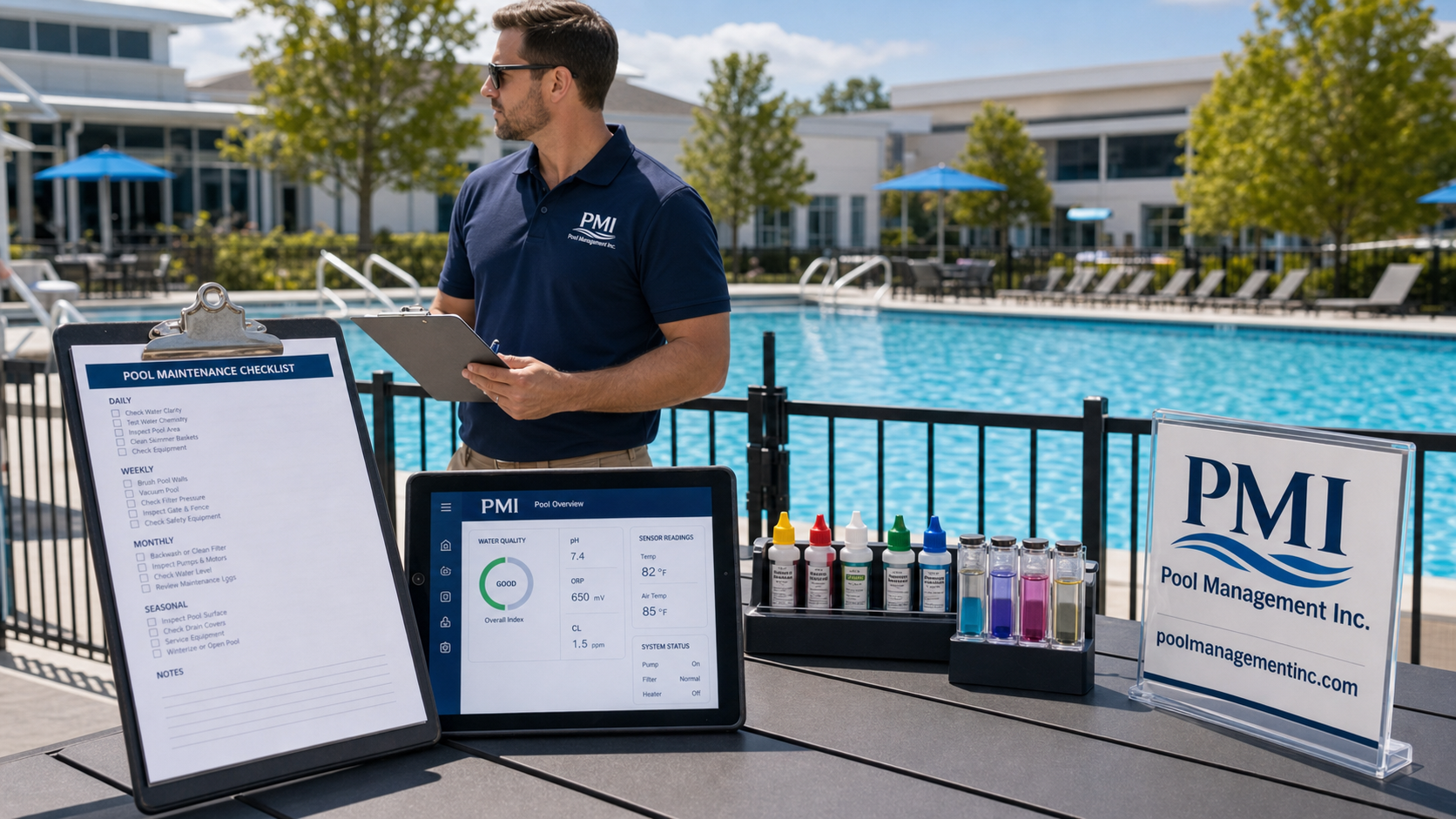
A broken gate, missing sign, unclear lifeguard policy, or failed pool inspection can quickly become more than a maintenance issue for an HOA board. It can turn into resident complaints, delayed opening, liability concerns, and emergency board decisions.
HOA pool safety is not only about clean water. It is about knowing which rules apply, who handles each responsibility, and how the board can show that the community prepared before residents started using the pool.
For communities that need help organizing pool operations, maintenance, staffing, repairs, and safety-focused service support, Pool Management Inc. can be a helpful operational partner for HOA and community aquatic facilities.
Quick Answer
HOA pool safety requirements usually include:
- Controlled pool access
- Posted pool rules and warning signs
- Fencing, gates, locks, and barriers
- Water testing and chemical management
- Maintenance and inspection records
- Emergency contacts and incident procedures
- Lifeguard, attendant, or no-lifeguard policies
- Local health department requirements
Boards should confirm requirements before every pool season because rules can vary by state, county, city, and pool classification.
What Boards Should Check First
Before opening day, the board should answer the questions that usually cause confusion later. Who controls access? Who checks the water? Who closes the pool when something is wrong?
These answers should be clear before residents receive opening dates. If the board waits until the pool is already in use, small issues can become larger complaints.
| Question | Why it matters | Where to document it |
| Who controls resident and guest access? | Prevents unauthorized use and guest disputes | Pool rules or access policy |
| Who handles water care? | Clarifies vendor responsibility | Pool service agreement |
| Who receives service reports? | Keeps the board informed | Vendor reporting process |
| Who decides when the pool closes? | Prevents confusion during safety issues | Closure procedure |
| Who communicates with residents? | Reduces rumors and complaints | Board or manager communication plan |
| Who approves repairs? | Prevents surprise spending | Repair approval policy |
Board Tip: If the board cannot answer these questions in one meeting, the pool plan is not ready yet.
Why Requirements Vary
HOA pool safety requirements are not the same everywhere. State law, county health departments, city ordinances, insurance rules, pool design, and HOA governing documents can all affect what the board must do.
Pool classification matters too. A community pool may be treated as public, semi-public, limited-use, or private depending on local rules.
The CDC’s Model Aquatic Health Code is a national guidance document that jurisdictions can use when creating or updating pool codes, but the CDC explains that it is not federal law unless adopted by a state, local, territorial, or tribal authority.
Key Compliance References
Some safety topics are local, but HOA boards should still know the major national references. These sources help boards understand common compliance areas before reviewing local rules.
| Topic | Why it matters | Reference |
| Aquatic health codes | Helps boards understand pool operation, maintenance, illness prevention, and safety planning | CDC Model Aquatic Health Code |
| Drain safety | Helps boards understand entrapment and drain-cover safety concerns | CPSC Virginia Graeme Baker Pool and Spa Safety Act materials |
| Accessibility | Helps boards review pool access obligations where ADA rules may apply | U.S. Access Board swimming pool guidance |
| Current code updates | Helps boards track recent aquatic code guidance | CDC MAHC current edition information. |
The U.S. Access Board provides accessibility guidance for swimming pools, wading pools, and spas, including accessible means of entry such as pool lifts or sloped entries.
Core Safety Areas
Most HOA boards should review the same safety categories before each pool season. The exact requirements may differ, but the planning areas are usually consistent.
| Safety area | What to review | Common gap |
| Access control | Gates, locks, fobs, keys, guest access | Old codes or inactive resident lists |
| Pool rules | Hours, guests, supervision, conduct, closures | Rules are vague or outdated |
| Fencing | Fence condition, gate latches, entry points | Gate does not close properly |
| Signage | Rules, warnings, emergency contacts | Signs are missing or hard to read |
| Water care | Testing, chemical levels, service logs | Records are incomplete |
| Equipment | Drains, pumps, filters, visible hazards | Problems found after opening |
| Staffing | Lifeguards, attendants, or no lifeguard | Roles are unclear |
| Incidents | Reporting, response, follow-up | No clear process |
For communities that want to strengthen safety planning, PMI’s pool safety page is the most natural internal resource here.
State-by-State Planning
This section should help boards know what to verify first. It should not replace local code review.
The goal is not to copy another state’s policy. The goal is to ask better questions before pool season starts.
| State or market | What to check first | Why it matters |
| Georgia | Public pool classification, local health authority expectations, safety equipment, signage, and inspection history | Georgia law authorizes public health rules for public pool construction, operation, permits, inspections, water quality, fencing, chemical storage, and safety equipment |
| Texas | Public pool and spa rules, pool yard enclosures, chemical levels, sanitation, and bather-load planning | Texas DSHS lists public pool and spa laws and rules, including Texas Administrative Code Chapter 265 and pool yard enclosure rules |
| Maryland | County-level pool review, public pool and spa rules, signage, site drainage, and local code compliance | Maryland public pool and spa rules are addressed under COMAR 10.17.01, and public pool or spa sites must comply with applicable state and local codes |
| Colorado | Seasonal opening, weather-related closures, equipment readiness, local inspection timing, and staffing availability | Shorter pool seasons often leave less time for repairs and opening preparation |
| Delaware | HOA access rules, guest policies, fencing, resident communication, and rule enforcement | Smaller community pools often depend heavily on clear access policies |
| Virginia | Pool classification, posted safety rules, maintenance records, vendor duties, and local code review | Classification can affect inspections, signage, and operating procedures |
| South Carolina | Seasonal use, guest traffic, resort-style communities, staffing expectations, and access control | High-use community pools may need stronger resident communication |
| Charlotte, North Carolina | City or county requirements, dense housing amenities, staffing decisions, access control, and inspection readiness | Local requirements may shape operating procedures before opening |
Georgia’s public pool safety rules include requirements related to safety features, markers, depth markers, and lifesaving equipment for public swimming pools. Texas Health and Safety Code Section 341.064 states that a public swimming pool, artificial swimming lagoon, or bathhouse must be maintained in a sanitary condition.
Compliance Note: Do not stop at state-level research. County and city requirements may be more specific than statewide guidance.
Fencing, Gates, and Access
Pool fencing laws vary, but every HOA should treat access control seriously. A pool should not be easy to enter after hours, during closures, or without authorization.
Boards should review fencing, gate latches, locks, fobs, key cards, entry codes, guest rules, and closure procedures. If access rules are unclear, residents may create their own version of what is allowed.
| Access item | What to check | Why it matters |
| Fence condition | Damage, gaps, weak sections, climbable areas | Helps control entry |
| Gate function | Self-closing, latching, locking | Reduces after-hours access |
| Resident access | Active fobs, cards, keys, or codes | Prevents outdated access |
| Guest policy | Number of guests and resident responsibility | Controls crowding |
| Closure access | How the pool is locked during closures | Prevents unsafe use |
| After-hours process | Posted hours and enforcement steps | Reduces misuse |
If access problems are part of a broader facility concern, a pre-season review through facility inspections can help boards identify visible readiness issues before opening.
Pool Rules and Signage
HOA pool rules should be written for residents, not just for board files. If a resident cannot understand the rule quickly, the rule will be harder to follow.
Keep the language specific. Avoid vague phrases like “reasonable guest use” when the board actually means a set number of guests.
| Rule category | What to include | Better wording |
| Pool hours | Opening and closing times | “Pool hours are 9 AM to 8 PM” |
| Guest limits | Number of guests per household | “Two guests per household” |
| Children | Adult supervision expectations | “Children under X age must be supervised by an adult” |
| Food and drinks | Allowed and restricted items | “No glass containers in the pool area” |
| Closures | Weather, maintenance, safety concerns | “Pool may close during storms or maintenance” |
| Violations | Warning and enforcement process | “Repeated violations may result in access suspension” |
Board Tip: If a rule is hard to enforce consistently, rewrite it before the season starts.
Water Quality and Maintenance
Safety planning is not only about fences and signs. Water testing, chemical balancing, cleaning, and equipment checks are also part of responsible community pool operations.
The board should confirm how service is documented. A written log is more useful than a verbal update.
| Maintenance item | Board question | Why it matters |
| Water testing | How are readings recorded? | Creates a usable record |
| Chemical balancing | Who is notified when adjustment is needed? | Prevents confusion |
| Cleaning schedule | How often is the pool cleaned? | Sets expectations |
| Equipment checks | What equipment is reviewed? | Finds issues earlier |
| Repair reporting | How are problems communicated? | Helps the board plan |
| Service logs | Who receives reports? | Improves oversight |
For boards reviewing water care and maintenance expectations, aquatic facility maintenance is the best internal fit.
Lifeguards and Attendants
Lifeguard requirements depend on location, pool classification, facility use, insurance guidance, and board preference. Some HOA pools operate without lifeguards where allowed, while others use lifeguards or attendants.
The board should not blur staffing roles. A lifeguard, pool attendant, maintenance technician, and property manager do different jobs.
| Role | Main purpose | Important clarification |
| Lifeguard | Supervision and emergency response while on duty | Requires clear schedule and duties |
| Pool attendant | Access support and rule reminders | Not the same as a lifeguard |
| Maintenance technician | Cleaning, water care, equipment checks | Not responsible for swimmer supervision |
| Property manager | Communication and coordination | Not a substitute for pool staff |
If the community is evaluating supervised operations, pool lifeguard services is the most natural internal resource.
Liability and Records
HOA liability planning should focus on consistency, clear responsibility, and organized records. Boards should avoid promising complete safety because no shared amenity can remove all risk.
This is the section where recordkeeping belongs. Keep it here instead of repeating the same point throughout the article.
| Liability step | What to do |
| Review insurance | Confirm coverage and vendor certificates |
| Define vendor scope | Put maintenance, staffing, and reporting duties in writing |
| Track incidents | Keep reports and follow-up actions organized |
| Update rules | Review pool rules before each season |
| Communicate closures | Notify residents clearly and quickly |
| Review complaints | Look for repeated patterns |
Highlight: A board does not need a complicated system. It needs one clear place for pool rules, service records, incident notes, vendor documents, and resident notices.
Seasonal Compliance File
Every HOA should keep a simple pool compliance file. It does not need to be complicated.
The goal is to keep important records in one place. That way, the board is not searching through old emails during a problem.
Include:
- Current pool rules
- Vendor contract
- Vendor insurance certificates
- Maintenance and service logs
- Incident reports
- Inspection notes
- Repair records
- Resident notices
- Lifeguard or attendant schedule, if applicable
- Opening and closing checklist
- Emergency contact list
Pre-Opening Checklist
Use this checklist before residents return to the pool.
- Confirm pool classification and local requirements.
- Review fencing, gates, locks, and access controls.
- Check signage and posted pool rules.
- Confirm maintenance schedule and reporting process.
- Review water testing documentation expectations.
- Confirm lifeguard, attendant, or no-lifeguard model.
- Review emergency contacts and incident process.
- Confirm vendor insurance documents.
- Walk the pool area before opening.
- Send pool rules and opening details to residents.
Before Opening Day: Walk the pool area with the vendor, check gates and signs, confirm emergency contacts, and make sure the board knows who receives service reports.
Common Mistakes
Copying Another HOA’s Pool Rules
Another HOA’s rules may not match your local requirements, facility design, insurance expectations, or resident behavior.
Use examples for inspiration. Do not copy them blindly.
Assuming the Vendor Handles Everything
The contract should define who handles repairs, inspections, closures, resident communication, and emergency escalation.
State-level research is not always enough. County and city requirements may be more specific.
A vendor may handle maintenance or staffing, but the board still needs oversight.
Skipping Local Review
Boards should verify local expectations before opening day.
Treating Lifeguards as a Simple Add-On
Lifeguard staffing is not just adding a person to the pool deck.
The board should define hours, duties, breaks, supervision, communication, weather procedures, and emergency response expectations.
Not Keeping Records
If the board cannot show what was done, it becomes harder to evaluate vendors or respond to concerns.
Keep service logs, incident reports, inspection notes, and resident notices in one place.
Final Recommendation
HOA pool safety requirements should be handled as a repeatable seasonal process. The board should confirm local rules, review access, update pool rules, clarify vendor responsibilities, organize records, and communicate clearly with residents.
The goal is not to make the pool harder to enjoy. The goal is to make it easier to manage responsibly.
If your HOA needs help reviewing pool operations, maintenance expectations, staffing needs, or seasonal readiness, request a bid from Pool Management Inc. and share your facility details.
Frequently Asked Questions?
What are HOA pool safety requirements?
HOA pool safety requirements usually include access control, fencing or barriers, posted pool rules, signage, water care, maintenance logs, emergency contacts, and local health department requirements.
Some communities may also need lifeguards, attendants, permits, inspections, or accessibility review depending on local rules and facility type.
Are HOA pools considered public pools?
Some HOA pools may be treated as public, semi-public, community, or private pools depending on state and local rules.
The classification matters because it can affect inspections, permits, water testing, signage, staffing, and operating requirements.
Do HOA pools need lifeguards?
Some HOA pools need lifeguards, while others may operate without them where allowed.
The answer depends on local rules, facility use, insurance guidance, resident expectations, and board preference.
What pool rules should an HOA post?
An HOA should usually post pool hours, guest limits, access requirements, child supervision rules, food and drink restrictions, glass restrictions, weather closure rules, emergency contacts, and violation procedures.
Rules should be clear enough for residents to understand without needing board explanation.
How can an HOA reduce pool liability?
An HOA can reduce pool liability by documenting maintenance, controlling access, posting clear rules, reviewing insurance, keeping incident records, using qualified vendors, communicating closures, and confirming local requirements.
Boards should avoid promising complete safety and focus on consistent, documented procedures.
Who is responsible for HOA pool compliance?
Responsibility depends on local rules, governing documents, vendor contracts, and management structure.
A board may delegate maintenance, staffing, or reporting tasks, but it should still understand oversight responsibilities.
How often should HOA pool safety rules be reviewed?
HOA pool safety rules should be reviewed before every pool season.
Boards should also review rules after incidents, repeated complaints, access changes, vendor changes, staffing changes, or updates from local authorities.
What should be in an HOA pool compliance file?
An HOA pool compliance file should include pool rules, vendor contracts, insurance documents, maintenance logs, inspection notes, incident reports, repair records, resident notices, staff schedules if applicable, emergency contacts, and opening or closing checklists.
Keeping these records organized makes board oversight easier.