
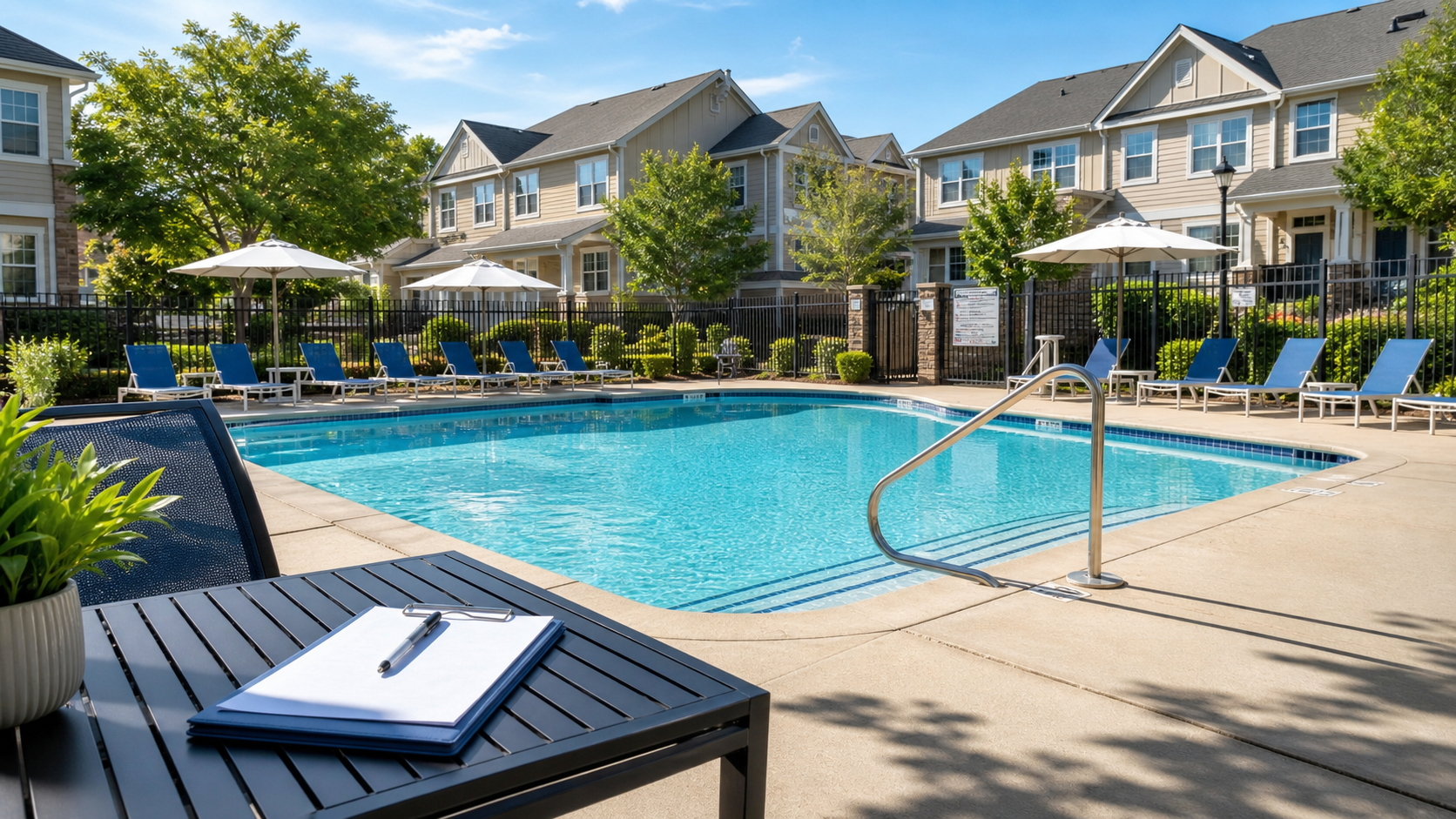
A successful HOA pool season starts long before the first resident walks through the gate. It depends on early planning, clear rules, realistic budgeting, vendor coordination, safety awareness, and steady communication.
For many communities, the pool is one of the most visible amenities the board manages. When it is clean, safe, open on schedule, and easy to use, residents feel the value of the community. When the pool is closed, unclear, understaffed, or poorly maintained, it quickly becomes one of the board’s biggest complaint sources.
These HOA pool management tips are written for board members, property managers, and amenity committees across the U.S. Use this as a practical playbook for smoother community pool operations, better pool season planning, stronger HOA pool rules, and improved resident satisfaction.
For boards that want to understand what professional support can include, commercial pool management services often cover seasonal planning, pool operations, maintenance coordination, staffing, safety support, and service documentation.
Quick Answer
The best HOA pool management tips are to plan early, define clear responsibilities, set practical pool rules, inspect the facility before opening, budget beyond basic cleaning, choose vendors carefully, communicate with residents, and review performance during the season.
A community pool should be managed like a shared asset, not a last-minute summer task. Every decision should support safety, resident satisfaction, cost control, and reliable pool access.
1. Start Planning Months Before Pool Season
The strongest HOA pool seasons usually begin months before opening day. Boards that wait until the final few weeks often run into rushed repairs, unclear vendor scope, limited staffing options, and frustrated residents.
Early planning gives the board enough time to review what went wrong last season, approve needed repairs, update rules, compare service proposals, and prepare resident communication. It also gives vendors time to schedule opening work, confirm staff, order supplies, and address equipment issues before the pool is expected to open.
| Planning window | Board priority | Why it matters |
| 6 months before opening | Review complaints, closures, repairs, and budget history | Helps avoid repeating the same issues |
| 4 months before opening | Review vendor scope and staffing needs | Gives time to compare options |
| 2 months before opening | Approve repairs and update pool rules | Reduces opening-week surprises |
| 1 month before opening | Confirm schedules, access, reports, and emergency contacts | Makes daily operations easier |
| During season | Review complaints, incidents, and vendor performance | Allows mid-season corrections |
| After closing | Document lessons and next-year budget needs | Builds a better plan for the following season |
Pool season planning should become a repeatable board process. If every year starts from scratch, the same problems usually return.
2. Define Who Owns Each Responsibility
One of the most common HOA pool management problems is unclear responsibility. The board may assume the community manager is handling a task, the manager may assume the pool vendor is handling it, and the vendor may see it as outside the contract.
Before the season begins, the board should decide who owns each recurring responsibility. This prevents small issues from getting ignored until they become resident complaints or emergency repairs.
| Responsibility | Board | Community manager | Pool vendor |
| Budget approval | Owns decision | Provides input | Provides pricing or recommendations |
| Vendor communication | Reviews major issues | Usually coordinates | Reports updates |
| Pool rules | Approves | Distributes and tracks concerns | May help enforce if included |
| Routine cleaning | Oversees through contract | Monitors reports | Performs contracted work |
| Chemical management | Reviews records if needed | Tracks concerns | Tests and documents if included |
| Repairs | Approves spending | Coordinates approval | Recommends or completes approved work |
| Resident complaints | Reviews patterns | Receives and tracks | Provides service notes |
| Emergency closures | Sets policy | Communicates updates | Advises when conditions require action |
| Seasonal review | Leads decisions | Organizes records | Shares performance notes |
This table can be adjusted based on the association’s management agreement and vendor contract. Boards in specific states may also want to compare how these responsibilities are typically structured locally. For example, communities in Colorado can review how these roles apply in practice through this overview of HOA pool management in Colorado. The important part is that no recurring task is left floating.
3. Create HOA Pool Rules Residents Can Follow
HOA pool rules should be clear, visible, practical, and enforceable. If the rules are too vague, residents may not understand them. If they are too complicated, they may be ignored.
Good rules explain how residents and guests should use the pool, when the pool is open, what behavior is not allowed, and what happens when rules are broken. Boards should avoid writing rules only after something goes wrong.
Useful HOA pool rules often cover:
- Pool hours
- Guest limits
- Adult supervision requirements
- Food and drink rules
- Glass restrictions
- Alcohol policy
- Music and noise expectations
- Diving or jumping restrictions
- Pool party rules
- Furniture use
- Access cards, fobs, or gate codes
- After-hours use
- Weather closures
- Lifeguard or no-lifeguard notices
- Rule violation process
Rules should protect safety and fairness without making the pool feel difficult to use. A good test is simple: can residents understand the rule, can the board explain it, and can it be enforced consistently? Boards working with associations in Texas may find it useful to see how these rule-setting decisions play out in practice for HOA pool management in Texas.
4. Budget for More Than Cleaning
HOA pool budgeting should include more than routine cleaning or basic chemical service. Many boards under-budget because they only think about weekly visits or opening costs.
A realistic pool budget should include routine maintenance, chemicals, inspections, repairs, staffing, safety supplies, access control, furniture, emergency service, and long-term facility improvements. If the pool has aging equipment, the board should also plan for capital repairs instead of treating every breakdown as unexpected.
| Budget category | Why boards should include it |
| Routine service | Covers regular cleaning, water checks, and vendor visits |
| Chemicals | Can change with weather, usage, and water balance |
| Repairs | Pumps, filters, feeders, gates, lights, and drains may need attention |
| Staffing | Lifeguards, attendants, or monitors may be needed |
| Safety supplies | Rescue equipment, first aid items, and signs need upkeep |
| Furniture and shade | Chairs, tables, umbrellas, and shade areas affect resident experience |
| Access control | Gates, locks, keypads, and fobs need maintenance |
| Emergency visits | After-hours issues and urgent closures can create added costs |
| Capital planning | Resurfacing, renovations, and major equipment replacement require long-term funding |
If the facility needs larger updates, pool renovation planning can help boards separate routine operating costs from bigger improvement projects.
5. Choose Vendors by Scope, Not Price Alone
A low-cost proposal can look attractive during budget season. But if the scope is thin, the board may pay more later through emergency visits, poor communication, resident complaints, or avoidable closures.
When evaluating a pool vendor, boards should compare what is included, what is excluded, how often service happens, how problems are reported, and how quickly urgent issues are handled. The best proposal is not always the longest or the cheapest. It is the one that makes responsibilities clear.
| Vendor question | What the answer reveals |
| What is included in routine service? | Whether the scope is specific or vague |
| How often will the pool be visited? | Whether service frequency matches pool use |
| How are chemical readings documented? | Whether water care is tracked |
| What happens when equipment problems are found? | Whether repairs will move quickly |
| What reports will the board receive? | Whether the board can verify work |
| Do you provide lifeguards or attendants? | Whether staffing can be coordinated |
| How are emergencies handled? | Whether response expectations are clear |
| What costs extra? | Whether the budget is realistic |
| Who is the main contact? | Whether communication will be organized |
For communities that need more than basic service, aquatic management services can help connect maintenance, staffing, safety procedures, and daily pool operations under a clearer structure.
6. Inspect the Facility Before Residents Arrive
A pre-season inspection helps the board catch problems before opening day. This is especially important because many pool issues are not obvious from the water’s surface.
Boards should look at the entire pool area, including gates, fences, deck surfaces, restrooms, lighting, rescue equipment, signs, furniture, chemical storage, pumps, filters, drains, and accessibility-related items. A pool can look ready from the outside but still have problems in the equipment room or around the deck.
A structured facility inspection checklist can help boards and managers organize what needs to be reviewed before opening, during the season, and after closing.
The inspection should also create a repair list. That list should separate urgent safety items, opening-day requirements, resident-experience improvements, and long-term capital projects.
7. Communicate Before Complaints Build
Resident satisfaction often depends on communication as much as pool condition. People are more patient when they know what is happening, why something changed, and when the board expects the issue to be resolved.
Boards should not wait until complaints pile up before sending updates. A simple communication plan can reduce confusion about pool hours, guest rules, access systems, weather closures, pool parties, staffing, and repairs.
Useful resident updates include:
- Opening date announcement
- Pool hours and access instructions
- Updated HOA pool rules
- Guest policy reminders
- Pool party reservation process
- Weather closure policy
- Safety reminders
- Repair or closure notices
- Lifeguard or no-lifeguard explanation
- End-of-season notice
The best updates are short and direct. Residents usually want to know what changed, why it matters, and what they need to do.
8. Track Complaints Like Operations Data
Every HOA pool gets complaints. The key is to use those complaints as information instead of treating each one as an isolated issue.
A single complaint may be a one-time concern. Repeated complaints about the same issue may reveal a service gap, rule problem, staffing issue, equipment concern, or communication failure.
| Complaint type | What it may indicate |
| Cloudy water | Chemical imbalance, filtration issue, heavy use, or service gap |
| Dirty deck | Cleaning frequency issue or resident behavior problem |
| Broken furniture | Replacement budget or inspection gap |
| Locked gate issues | Access-control problem |
| Rule violations | Enforcement problem or unclear rules |
| Noise complaints | Pool party, guest, or hours policy issue |
| Staffing confusion | Residents may not understand lifeguard coverage |
| Repeated closures | Equipment, staffing, water quality, or planning problem |
Boards should review complaint patterns during the season, not only after closing. This allows the board to make mid-season adjustments before frustration grows.
9. Treat Safety as an Ongoing Practice
Pool safety is not a one-time checklist. It should be part of daily community pool operations.
Boards should make sure safety equipment is visible, rules are posted, access points work properly, hazards are documented, and emergency contacts are clear. If the community uses lifeguards or attendants, their duties should be written into the service agreement.
Safety planning may include:
- Rescue equipment checks
- First aid supply review
- Gate and fence checks
- Depth marker visibility
- Pool rule signage
- Weather closure process
- Incident report process
- Lifeguard or attendant role clarity
- Slip and trip hazard review
- Emergency contact process
Communities that need help reviewing risk areas, signage, rules, and safety procedures can use pool safety services as part of their seasonal preparation.
10. Plan Staffing Before the Season Gets Busy
Not every HOA pool needs lifeguards, but every board should discuss staffing before opening. Some communities use certified lifeguards, some use attendants, and others operate without on-deck staff where allowed.
If staffing is part of the plan, the board should understand how recruitment, certification, scheduling, supervision, breaks, callouts, and incident reporting will work. These details matter most during weekends, holidays, pool parties, and high-use periods.
| Staffing model | Best fit | Watch point |
| No staff on deck | Small pools where allowed | Rules, signage, access control, and inspections become more important |
| Pool attendant | Communities needing access checks or rule reminders | Attendants are not lifeguards |
| Lifeguard coverage | Pools needing active water supervision | Certification and scheduling must be clear |
| Hybrid coverage | Pools with guards during peak times only | Residents must know when guards are present |
| Full-service staffing | Large or busy amenities | Costs more but provides stronger operating support |
For communities that need staffed pool operations, lifeguard services should be evaluated by recruitment process, certification tracking, scheduling, supervision, and backup coverage.
11. Protect the Pool as a Community Asset
A pool is not only a seasonal expense. It is a shared community amenity that affects resident satisfaction and property appeal.
Boards should protect that asset by planning for equipment life, deck condition, furniture, signs, access systems, lighting, landscaping impact, and resident use patterns. If the pool is always managed through emergency repairs, the community usually spends more and enjoys the amenity less.
An annual asset review can help the board identify:
- Equipment nearing replacement
- Deck or surface wear
- Furniture replacement needs
- Shade or umbrella concerns
- Lighting problems
- Gate and fence repairs
- Signage updates
- Restroom improvements
- Accessibility concerns
- Long-term renovation needs
This is where HOA amenity management becomes broader than pool cleaning. The board is protecting both the physical facility and the resident experience.
For communities that need ongoing maintenance support beyond basic cleaning, aquatic facility maintenance can help boards think through equipment, facility condition, and seasonal care.
12. Use a Season Scorecard
A season scorecard helps boards review pool performance objectively. Instead of relying only on complaints or memory, the board can look at what actually happened.
| Scorecard item | What to measure |
| Opening readiness | Did the pool open on time? |
| Closure days | How often was the pool unavailable? |
| Complaint volume | What did residents complain about most? |
| Water quality issues | Were there repeated clarity or chemical concerns? |
| Repair response | How quickly were issues handled? |
| Staffing reliability | Were scheduled shifts covered? |
| Rule enforcement | Were recurring behavior issues managed? |
| Vendor communication | Did the board receive useful updates? |
| Budget accuracy | Did actual costs match expectations? |
| Resident satisfaction | Did the pool feel well-managed overall? |
The scorecard should be reviewed at least twice: once during the season and once after closing. The mid-season review helps the board correct problems, while the post-season review helps plan next year’s budget.
Common Board Mistakes
Waiting Until Spring to Start Planning
Spring is often too late for major planning. Vendors may already be booked, staffing options may be limited, and repair timelines may be tight. Boards should begin reviewing the next pool season well before residents expect opening dates.
Writing Rules That No One Enforces
Rules only work when residents understand them and the board has a realistic enforcement process. A long rule list without follow-through can create frustration. Focus on rules that protect safety, fairness, and resident experience.
Budgeting for a Perfect Season
A perfect pool season is rare. Storms, equipment issues, staffing changes, chemical swings, and resident behavior can all affect operations. The budget should include room for unexpected needs.
Ignoring Small Resident Complaints
Small complaints can reveal early warning signs. If the same concern appears repeatedly, the board should investigate before it becomes a larger issue. Complaint tracking is an operational tool, not just a customer service task.
Choosing a Vendor Without Reporting
If the board does not receive service reports, it has limited visibility into pool operations. Reports help confirm work, document problems, and support better decisions. A vendor should make the board’s job easier, not less informed.
Board Playbook
| Play | Action |
| Define success | Decide what a well-run pool season should look like |
| Assign roles | Clarify board, manager, and vendor responsibilities |
| Inspect early | Review the facility before residents expect access |
| Update rules | Make pool rules clear, visible, and enforceable |
| Budget fully | Include service, repairs, staffing, safety, and emergencies |
| Communicate often | Keep residents informed before complaints grow |
| Track complaints | Look for patterns, not just individual comments |
| Review reports | Use vendor records to guide decisions |
| Plan staffing | Confirm lifeguard or attendant needs early |
| Score the season | Review performance before renewing or rebidding |
A playbook gives the board a repeatable operating model. It also helps future board members maintain the same standard instead of starting over every year.
Final Recommendation
The best HOA pool management tips all point to one idea: manage the pool proactively. A community pool should not be handled only when something breaks, residents complain, or the season is about to begin.
Boards should plan early, define responsibilities, write clear rules, budget realistically, inspect the facility, choose vendors carefully, communicate with residents, and review performance throughout the season. That approach improves community pool operations and gives residents a better experience with one of the association’s most visible amenities.
If your board is reviewing HOA pool services, seasonal planning, staffing, or vendor options, you can request a pool management bid with your community details and service goals.
Frequently Asked Question?
What are the most important HOA pool management tips?
The most important HOA pool management tips are to plan early, set clear rules, budget realistically, inspect before opening, hire the right vendor, communicate with residents, and track complaints during the season. These steps help boards reduce surprises and improve resident satisfaction.
How early should an HOA board start pool season planning?
An HOA board should start pool season planning several months before opening. Early planning gives the board time to inspect the facility, approve repairs, review vendors, update rules, and prepare resident communication. Waiting too long can create rushed decisions and limited vendor availability.
What should be included in HOA pool rules?
HOA pool rules should cover hours, guest limits, access, supervision, food and drink, glass restrictions, pool parties, noise, safety behavior, weather closures, and rule violations. Rules should be clear enough for residents to understand and practical enough for the board to enforce.
How can HOA boards improve resident satisfaction at the pool?
Boards can improve resident satisfaction by keeping the pool clean, opening on time, communicating clearly, responding to complaints, maintaining furniture and access systems, and reducing repeated closures. Residents notice both pool condition and board communication.
What should an HOA include in its pool budget?
An HOA pool budget should include routine service, chemicals, repairs, inspections, staffing, safety supplies, access control, furniture, emergency visits, and long-term capital needs. Budgeting only for basic cleaning can leave the board unprepared.
Should an HOA hire a professional pool management company?
An HOA should consider hiring a professional pool management company when the pool needs regular maintenance, chemical documentation, staffing, safety support, reporting, inspections, or seasonal coordination. A professional vendor can reduce board workload when the scope is clear.
How should HOA boards review pool performance after the season?
Boards should review opening readiness, closure days, complaints, repair response, water-quality issues, staffing reliability, vendor communication, and budget accuracy. This review helps the board improve next year’s pool season plan.