
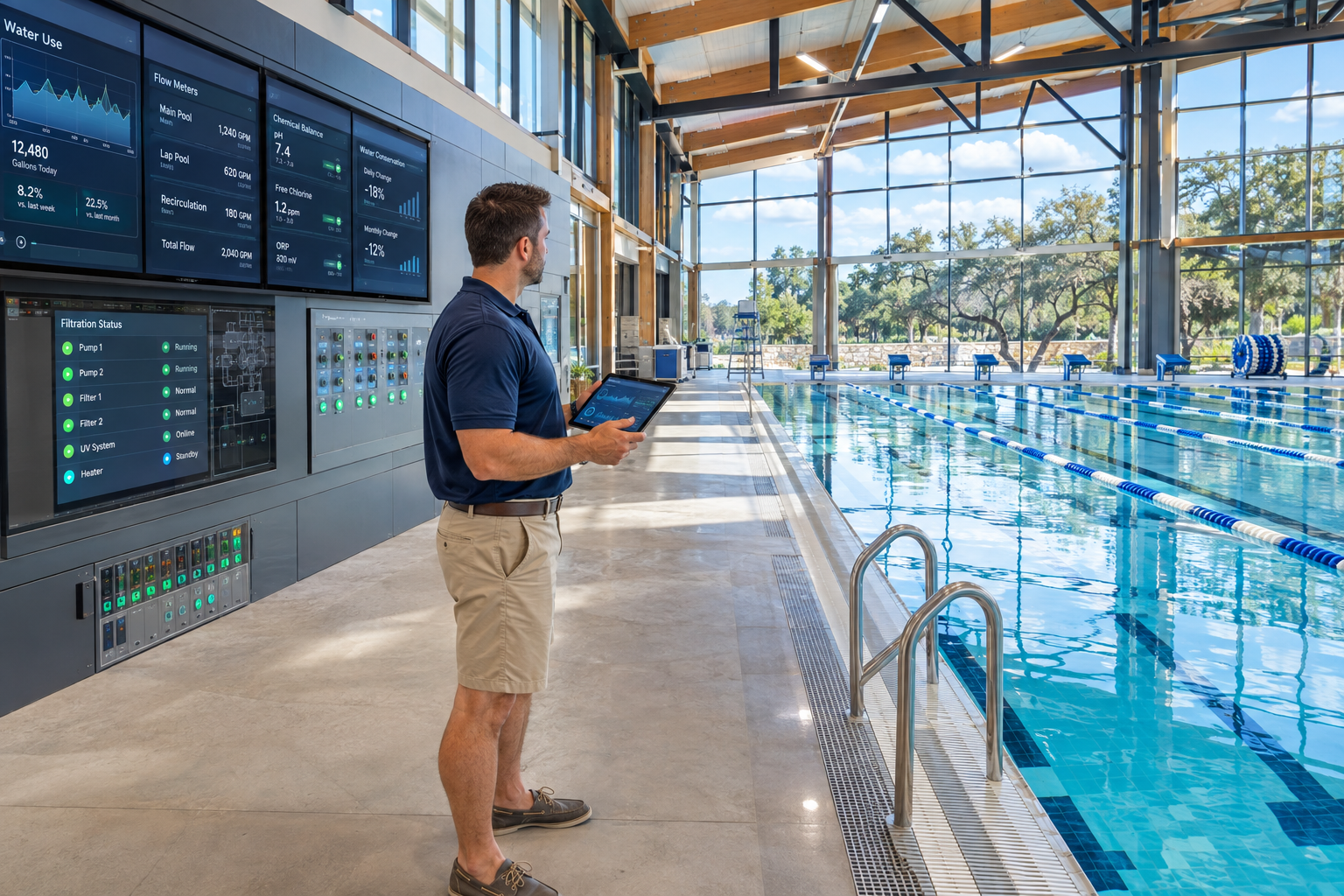
The future of pool management in Texas will be shaped by technology, workforce availability, water constraints and rising expectations for operational accountability. Facility operators will need to control costs while maintaining safe, reliable aquatic services in a state with long operating seasons and significant regional differences.
From Houston pool operations affected by humidity and storms to Dallas facilities managing rapid seasonal changes, successful commercial aquatic operations will increasingly depend on data, preventive planning and adaptable staffing.
The following outlook examines confirmed developments from 2026 and the trends likely to influence the Texas aquatic industry through 2027.
| Quick Answer Texas pool management trends for 2026–2027 include wider use of connected chemical controllers, remote equipment monitoring, digital compliance records and data-based staffing. Facilities will also focus more heavily on water conservation, energy efficiency, lifeguard recruitment and climate-resilient maintenance.Technology will not eliminate the need for trained operators, manual testing or on-site supervision. The most successful facilities will use smart systems to identify problems earlier while keeping qualified employees responsible for operational decisions. |
Texas Aquatic Trends
Smart pool technology
Smart pool technology is moving from individual equipment automation toward connected facility management. Chemical controllers, flow meters, variable-speed pumps, HVAC systems and maintenance platforms can now provide data through a shared dashboard.
The 2026 Aquatic Trends Report found that 93.7% of surveyed aquatic facilities used some form of pool automation. The report also found growing adoption of chemical, energy and water conservation measures.
For Texas operators, the next stage will involve connecting these systems rather than managing them independently.
Expected smart-pool applications include:
- Remote chemical-controller monitoring
- Automated equipment alarms
- Digital water-quality logs
- Pump and filter performance tracking
- Predictive maintenance alerts
- Energy-use dashboards
- Leak and abnormal water-loss detection
- Mobile opening and closing checklists
- Digital work orders
- Attendance-based staffing reports
- Programme and lane-utilisation analysis
- Central oversight of multiple facilities
These tools can help a regional operator monitor several pools without waiting for a weekly site visit. A sudden increase in chemical demand, loss of flow or unexplained water use can generate an alert before the condition results in a closure.
Remote monitoring should remain a decision-support tool. It does not replace manual water testing, physical inspections or qualified employees. Texas requires Class A, B and C pools and spas to operate under the supervision and direction of a properly trained and certified operator. That operator may oversee multiple facilities and does not always have to remain on-site, but contact information must be available to on-site staff and management.
AI-assisted safety
Artificial intelligence is beginning to influence aquatic safety through camera-based surveillance, occupancy analysis and unusual-motion detection. These systems may help identify activity that requires immediate staff attention.
During 2026–2027, larger municipal, university and private facilities may begin testing AI-assisted systems for:
- Potential submersion detection
- Restricted-area access
- Occupancy counting
- Queue and deck congestion
- Closed-pool intrusion
- Surveillance-zone analysis
- Incident review
- Lifeguard deployment planning
AI safety tools should supplement-not replace-lifeguards. Cameras may encounter limitations involving glare, surface turbulence, crowds, blind spots and equipment failure. Facility management must also address privacy, cybersecurity, data retention and employee-training requirements.
Every technology purchase should have a defined operational purpose. Operators should ask what condition the system detects, who receives the alert, how quickly they must respond and what happens when the system is unavailable.
Digital compliance
Paper records are likely to decline as Texas facilities adopt digital compliance platforms. Electronic systems can time-stamp inspections, prevent incomplete submissions and create searchable histories for managers and inspectors.
Useful digital records include:
- Water-quality readings
- Daily safety inspections
- Lifeguard assignments
- In-service training
- Equipment maintenance
- Chemical deliveries
- Incident reports
- Pool closures
- Corrective actions
- Reopening authorization
- Contractor visits
- Inspection findings
Texas public-pool requirements are established under Title 25, Chapter 265, Subchapter L of the Texas Administrative Code. The current DSHS rules took effect on April 26, 2024, and address pool operation, certified operators, lifeguards, water quality and safety.
Digital records can improve traceability, but operators should confirm that their systems retain the information required by state and local authorities. Facilities also need procedures for exporting records and continuing operations during internet or software outages.
Predictive maintenance
Traditional maintenance often follows one of two patterns: repair equipment after failure or replace components according to a fixed calendar. Predictive maintenance adds a third approach by using operating data to identify equipment deterioration.
Operators can monitor:
- Filter-pressure changes
- Pump vibration
- Motor temperature
- Flow-rate decline
- Chemical consumption
- Controller calibration drift
- Heater performance
- HVAC run time
- Water-level changes
- Electrical demand
A gradual change may indicate an emerging issue even when the equipment remains functional. Identifying that trend early allows managers to schedule repairs outside public hours.
A documented aquatic facility maintenance programme should combine real-time monitoring with physical inspections and manufacturer-recommended service.
Operational dashboards
By 2027, more aquatic directors will use dashboards that combine safety, staffing, programming and mechanical information.
A facility dashboard may display:
| Operating area | Suggested measurement |
| Water quality | Compliance rate and exceptions |
| Mechanical systems | Flow, pressure and active alarms |
| Staffing | Scheduled, present and required employees |
| Programming | Registration and pool utilisation |
| Maintenance | Open and overdue work orders |
| Safety | Incidents, rescues and inspection completion |
| Financial performance | Revenue and labour cost |
| Sustainability | Water, chemical and energy use |
Dashboards should focus attention rather than produce additional administrative work. Each measurement needs an owner, an acceptable range and a defined corrective action.
Workforce pressure
Lifeguard recruitment will remain one of the most important operational issues for the Texas aquatic industry. In June 2026, Houston had 25 of its 37 municipal pools open, with the open facilities fully staffed. The city had experienced more severe lifeguard shortages during earlier seasons.
Lufkin’s only public pool did not open for summer 2026 because the city could not recruit enough lifeguards to meet operational requirements.
These examples demonstrate that staffing shortages can determine whether a facility opens at all. Operators cannot treat seasonal recruitment as an activity that begins shortly before Memorial Day.
Future staffing plans will increasingly include:
- Year-round recruitment
- Certification support
- Paid pre-season training
- Referral incentives
- Returning-employee bonuses
- Flexible scheduling
- School and college partnerships
- Leadership pathways
- Cross-training
- Early supervisor selection
- Digital shift communication
- Attendance-based scheduling
Facilities should identify the minimum number of employees needed to operate each pool or feature. A reduced operating plan can then prioritize the most valuable programmes when full staffing is unavailable.
Employees providing lifeguard services still need facility-specific training. Certification alone does not prepare a lifeguard for every pool layout, programme or aquatic feature.
Programme flexibility
Texas aquatic programming will continue moving toward adaptable schedules based on attendance and community demand. Facilities may reserve permanent blocks for essential activities while adjusting other periods seasonally.
Programmes likely to remain important include:
- Learn-to-swim instruction
- Competitive swimming
- Water fitness
- Senior programmes
- Therapy and rehabilitation
- Lap swimming
- Youth camps
- Family recreation
- Drowning-prevention education
- Private rentals
- School partnerships
Operators should evaluate each activity using participation, cost, revenue, community benefit and pool utilisation.
A programme does not need to generate the highest revenue to justify its place on the schedule. Water-safety education may provide an important public benefit, while rentals and competitions may support cost recovery.
Sustainable operations
Sustainability in Texas pools will become an operational requirement rather than a branding initiative. Water supply, electricity use, chemical costs and extreme weather all affect facility reliability.
The 2027 Texas State Water Plan projects potential water shortages of 3.6 million acre-feet per year in 2030 under drought-of-record conditions. It identifies conservation and additional water-supply projects as part of the state’s response.
Aquatic facilities will need to demonstrate that they can provide public services while controlling avoidable consumption.
Practical water-saving measures include:
- Leak detection
- Automatic water-level controls
- Pool covers
- Optimized backwashing
- Filter-performance monitoring
- Splash-out reduction
- Metering by pool
- Prompt plumbing repairs
- Condensate recovery where practical
- Reviewing unnecessary draining practices
Operators should establish normal water use for each facility. Monthly utility bills alone may not reveal a slow leak or malfunctioning level-control system.
The best measurement is often water use per operating day, visitor or pool volume. Tracking these figures can help managers separate weather-related changes from equipment or maintenance problems.
Energy management
Pumps, heaters, lighting and indoor environmental systems create significant operating costs. Variable-speed pumps, optimized schedules, LED lighting and efficient heating systems will remain common upgrade priorities.
For indoor facilities, energy management must not compromise humidity control or air quality. Mechanical changes should be reviewed as part of the whole natatorium system rather than treated as isolated equipment replacements.
Energy-saving strategies include:
- Matching pump speed to required flow
- Reviewing operating schedules
- Maintaining heat exchangers
- Using covers during closed periods
- Monitoring HVAC set points
- Cleaning filters and strainers
- Reducing unnecessary lighting
- Comparing energy use with attendance
- Evaluating equipment life-cycle cost
Operators should avoid reducing circulation below code, design or treatment requirements. Energy efficiency must remain compatible with water quality and safe operation.
Regional Outlook
Texas does not have one aquatic operating environment. Climate, facility type, water availability and population patterns differ across the state.
Houston pool operations
Houston-area facilities face heat, humidity, heavy rainfall and tropical weather. Outdoor pools may operate for long seasons, while indoor facilities must manage moisture and air quality throughout the year.
Houston operators should prepare for:
- High seasonal attendance
- Storm debris
- Flood and drainage risks
- Extended humidity
- Lightning and severe-weather interruptions
- Power outages
- Chemical-storage concerns during heat
- Corrosion
- Large seasonal workforces
- Emergency closure communication
A hurricane-readiness plan should identify how equipment will be secured, which systems remain operating, when chemicals or portable items must be relocated and who can access the property after a storm.
Following heavy rainfall, operators should inspect water level, chemistry, clarity, deck conditions, drainage and electrical areas before reopening. Floodwater entering a pool requires a more extensive response than normal rain dilution.
Houston’s recent municipal-pool experience also shows that staffing remains a capacity issue. Operators should create tiered opening plans instead of waiting until late spring to decide which facilities can operate.
Dallas pool management trends
Dallas–Fort Worth facilities experience hot summers but also greater exposure to winter freezes than Gulf Coast pools. Management plans should cover both peak cooling-season demand and cold-weather equipment protection.
Dallas facilities should prioritize:
- Freeze-protection procedures
- Seasonal opening and closing plans
- Equipment insulation
- Emergency power planning
- Rapid temperature changes
- Summer water loss
- High-demand programme scheduling
- Severe thunderstorm response
- Hail and wind inspections
- Workforce planning across a large metropolitan area
Pools operating year-round need defined freeze thresholds and escalation procedures. Employees should know which pumps must continue operating, which pipes require protection and how to respond to loss of power during freezing conditions.
The construction market also shows regional differences. Permit data for the first quarter of 2026 indicated 512 new pool permits in the Dallas area, although this represented a 25% year-over-year decrease. Houston recorded 455 permits and 6% growth during the same period. These figures relate primarily to construction activity rather than public-facility operations, but they illustrate that local market conditions are not moving uniformly.
Central Texas
Austin and San Antonio operators must pay particular attention to drought restrictions and water-use expectations.
Regional considerations include:
- Local drought stages
- Refill and draining restrictions
- Water-loss monitoring
- Pool-cover requirements
- Heat exposure
- employee hydration
- Competition for seasonal workers
- Rapid population growth
San Antonio eased some drought measures in August 2026, but Stage 2 watering rules remained in effect. Conditions can change quickly, so facilities should monitor their water provider rather than rely on a permanent statewide assumption.
Aquatic facilities should document why draining, refilling or backwashing is operationally necessary. Local restrictions may contain different rules for public, commercial and residential pools.
Coastal Texas
Coastal facilities face salt exposure, windblown debris, humidity and tropical storms.
Inspection programmes should give additional attention to:
- Structural fasteners
- Electrical enclosures
- Metal stairs and rails
- Pump-room ventilation
- Surface coatings
- Sealants
- Outdoor controls
- Fencing and shade structures
- Sand entering drainage systems
- Emergency equipment storage
Maintenance frequencies should reflect observed site conditions rather than a generic calendar. A coastal facility may need more frequent corrosion inspections even when the same equipment performs normally at an inland pool.
Regional priorities
| Region | Primary operating pressure | Likely 2027 priority |
| Houston and Gulf Coast | Humidity, storms and staffing | Resilience and workforce planning |
| Dallas–Fort Worth | Heat, freezes and growth | Seasonal readiness and asset management |
| Austin and San Antonio | Drought and rapid demand growth | Water conservation |
| Coastal communities | Salt, wind and severe weather | Corrosion control and storm preparation |
| West Texas | Water scarcity and extreme heat | Water-loss and evaporation control |
| East Texas | Seasonal staffing and storms | Recruitment and emergency planning |
2026–2027 Action Plan
Trend forecasting becomes useful only when it influences budgets, procedures and staffing decisions.
Technology assessment
Before purchasing smart pool technology, operators should answer:
- What problem will the system solve?
- Which equipment can it monitor?
- Does it integrate with existing controllers?
- Who receives alarms?
- What response time is required?
- How will data be protected?
- What happens during an outage?
- Does the vendor provide training?
- Can records be exported?
- What is the total life-cycle cost?
Technology should reduce risk or workload in a measurable way. A platform that produces large amounts of data without improving decisions may create additional administrative pressure.
Facility baseline
Operators should establish 2026 baseline figures before setting 2027 targets.
A useful baseline includes:
- Water consumption
- Energy use
- Chemical consumption
- Operating hours
- Attendance
- Programme participation
- Labour hours
- Overtime
- Maintenance costs
- Equipment downtime
- Water-quality exceptions
- Pool closures
- Incidents and rescues
- Customer complaints
Facilities can then create realistic improvement targets. For example, a director might aim to reduce unplanned downtime, increase preventive maintenance completion or decrease water use per operating day.
Workforce plan
A 2027 workforce plan should begin before the end of the 2026 season.
The plan should address:
- Returning-employee commitments
- Supervisor candidates
- Certification dates
- Recruitment partners
- Training facilities
- Compensation
- Schedule preferences
- Minimum operating levels
- Substitute coverage
- Programme-specific qualifications
- Employee retention
- Late-summer availability
Exit interviews can identify why employees do not return. Scheduling conflicts, limited hours, weak supervision or a lack of advancement may affect retention as much as starting pay.
Water-management plan
Each facility should know where and why it uses water.
The plan should cover:
- Normal evaporation
- Backwashing
- Splash-out
- Cleaning
- Plumbing fixtures
- Irrigation
- Leaks
- Equipment maintenance
- Planned draining
- Emergency refilling
Meters should be installed at a level that allows management to identify abnormal use. A campus-wide bill may not show whether water loss originates from a pool, irrigation system or building fixture.
Capital priorities
Capital planning should rank projects by risk and operating impact.
| Priority | Example investment |
| Life safety | Barriers, electrical repairs and rescue equipment |
| Compliance | Filtration, accessibility and required safety upgrades |
| Reliability | Pumps, controllers and emergency power |
| Conservation | Covers, meters and leak detection |
| Efficiency | Variable-speed equipment and lighting |
| Service improvement | Programme equipment and customer amenities |
| Data management | Monitoring platforms and digital records |
Operators should calculate life-cycle costs rather than comparing purchase prices alone. Installation, maintenance, software subscriptions, employee training and expected equipment life all affect value.
Forecast indicators
Directors can monitor the following indicators to determine whether these trends are becoming more important:
- Local drought stage
- Water and electricity rates
- Lifeguard application volume
- Seasonal turnover
- Chemical prices
- Equipment lead times
- Local construction activity
- Facility attendance
- Programme wait lists
- Insurance requirements
- State and local code changes
- Technology-service costs
This article presents a forecast based on conditions available in September 2026. Regulations, drought conditions and local operating requirements may change during 2027. Facilities should confirm current requirements with Texas DSHS, local health authorities, water providers and applicable building or fire officials.
Frequently Asked Questions
What is the future of pool management in Texas?
The future of pool management in Texas will combine trained operators with connected equipment, digital records, preventive maintenance and data-based staffing. Water conservation and climate resilience will become more important as operating costs and regional water pressures increase.
Will smart pool technology replace certified operators?
No. Smart technology can provide alerts and operating data, but qualified employees must interpret conditions, verify readings and authorize corrective actions. Texas requires Class A, B and C pools and spas to remain under the supervision and direction of a trained and certified operator.
What smart pool technology will become more common?
Remote chemical monitoring, digital inspections, abnormal water-use alerts, predictive maintenance and centralized multi-facility dashboards are likely to become more common through 2027.
What is the largest staffing risk?
Seasonal lifeguard availability remains a major risk. A facility may have functional pools and strong programme demand but still be unable to open without enough qualified staff. Houston and Lufkin experienced different forms of this problem during 2026.
How will sustainability affect Texas pools?
Facilities will face more pressure to measure water, chemical and energy consumption. Leak detection, efficient filtration, optimized backwashing and pool covers can support conservation without reducing service quality.
Are Houston and Dallas pool trends the same?
No. Houston facilities generally place greater emphasis on humidity, tropical weather and flood readiness. Dallas facilities must plan for extreme summer demand as well as winter freezes and rapid seasonal changes.
What regulations apply to Texas public pools?
Texas public swimming pools and spas are regulated under Title 25, Chapter 265, Subchapter L of the Texas Administrative Code. Local health departments, building officials and other authorities may impose additional requirements.
What should facility operators do first?
Operators should establish accurate baselines for water, energy, staffing, maintenance, attendance and closures. Strong aquatic management starts with knowing how a facility currently performs before investing in technology or setting improvement targets.