
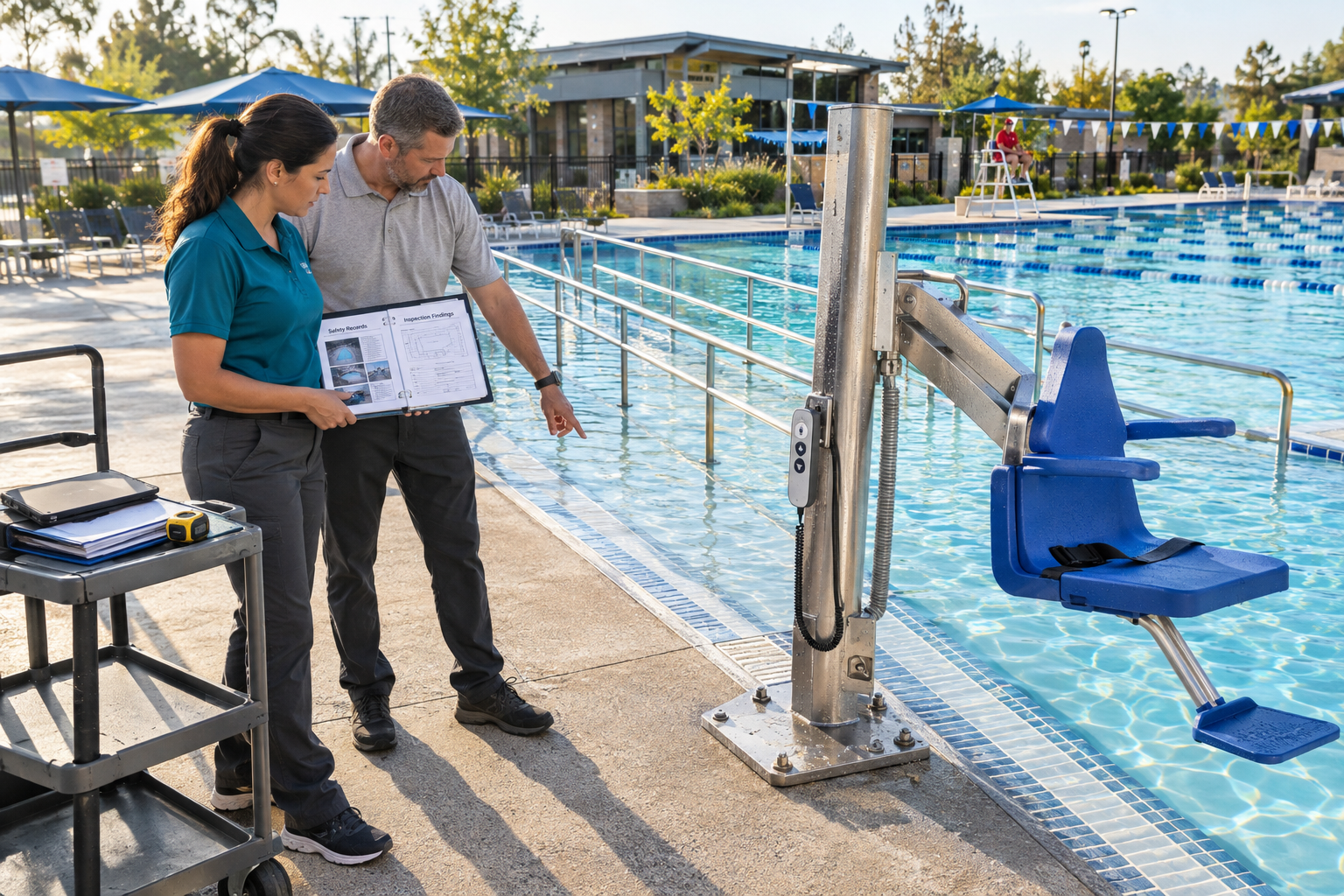
Commercial pool safety standards come from several sources, not one nationwide operating code. Effective commercial pool management starts with identifying applicable federal requirements, state and local rules, and facility-specific operating procedures.
The Virginia Graeme Baker Pool and Spa Safety Act addresses suction-entrapment protection. ADA requirements address accessibility, while local pool codes govern many daily operating conditions. CDC’s Model Aquatic Health Code provides guidance unless adopted into law.
This guide explains those distinctions and provides a framework for reviewing operations. It is a starting point for compliance planning, not a substitute for the requirements governing an individual facility.
| Quick Answer Commercial pool safety standards combine applicable federal requirements, state and local pool codes, and facility-specific procedures. Review VGB anti-entrapment protection, ADA accessibility, water quality, staffing, emergency response and records. CDC’s MAHC is guidance unless adopted by the relevant jurisdiction. Confirm applicable rules before treating any checklist as complete. |
Identify the Rules That Apply
Start with facility classification
Identify how the relevant authorities classify each aquatic venue. A swimming pool, spa, wading pool and interactive water feature may have different requirements.
Do not assume that private property falls outside public-pool regulation. CDC’s MAHC guidance includes venues operated by hotels, apartment complexes, homeowners’ associations and membership clubs.
However, different legal frameworks may use different definitions. Establish coverage separately for health codes, the VGB Act and accessibility requirements.
Record the responsible health department and other relevant authorities. Confirm which permits, adopted codes and inspection requirements apply.
Separate laws from guidance
A useful compliance register distinguishes mandatory requirements from recommended practices.
| Framework | Main subject | How to treat it |
| VGB Act and implementing regulations | Suction-entrapment protection at covered public pools and spas | Federal legal requirements |
| ADA and applicable regulations | Accessibility at covered facilities | Federal requirements that differ for construction, alterations and existing facilities |
| State and local pool codes | Facility design and operation | Enforceable requirements within the relevant jurisdiction |
| CDC MAHC | Design, operation, staffing and health protection | Guidance unless adopted, potentially with modifications |
| Manufacturer instructions | Equipment installation, operation and service | Review alongside applicable codes and approval conditions |
CPSC, DOJ and CDC describe different responsibilities within these frameworks. Compliance with one does not establish compliance with the others.
For example, a compliant drain cover does not resolve inadequate staffing or an inaccessible pool entrance.
Confirm the MAHC edition
As of October 7, 2026, CDC identifies the 2024 fifth edition as the current Model Aquatic Health Code. It was posted on December 16, 2024. The current-edition page does not identify a separate 2026 edition.
The MAHC is not a federal law. Jurisdictions may adopt all of it, adopt selected sections, modify it or use it only as a reference.
Ask which edition and amendments your jurisdiction has adopted. A newer CDC publication does not automatically replace the locally enforceable code.
Where the MAHC has not been adopted, it can still inform a safety review. Label its recommendations accurately rather than presenting them as local legal requirements.
Review relevant recent changes
CDC’s fifth-edition summary identifies changes involving chemical controls, access to chemical storage, lifeguard staffing and additional aquatic venue types.
For example, the model code adds closure provisions addressing specified malfunctioning flow-related controls and unauthorized access to chemical storage spaces.
These are useful audit prompts, but their legal status depends on local adoption. Review the full provisions rather than relying only on a summary.
Maintain a requirement register
Create one record connecting each obligation to its source, responsible person and supporting evidence.
| Register field | What to record |
| Requirement | The applicable drain-cover, accessibility or operating provision |
| Source | Regulation, adopted code section or permit condition |
| Facility scope | The specific pool, spa or supporting area |
| Responsible person | Named manager or qualified contractor |
| Verification | Inspection, document review or operational check |
| Frequency | Interval required by the relevant source |
| Corrective action | Response when the requirement is not met |
Use documented pool safety procedures to translate that register into staff instructions. General guidance should not replace the facility’s actual obligations.
Review Critical Safety Controls
Verify VGB anti-entrapment protection
The VGB Act requires covered public pools and spas to have compliant anti-entrapment drain covers. CPSC identifies the implementing requirements in 16 CFR part 1450.
CPSC states that additional anti-entrapment protection is required for specified configurations, including a single blockable drain or multiple drains on the same plane less than three feet apart.
Have a qualified professional evaluate the actual suction configuration. Do not infer compliance from the number of visible covers alone.
Retain product identification, installation records and manufacturer instructions. Ask the reviewer to verify compatibility with the installation and operating conditions.
A product described as VGB compliant does not establish that the entire installed system meets applicable requirements.
Respond to damaged drain covers
A missing, broken or insecure drain cover requires immediate attention. Keep swimmers out of the affected venue until qualified personnel have resolved the hazard.
CPSC cautions that secondary anti-entrapment systems should not be relied on to justify continued operation while noncompliant covers are being replaced.
Include drain-cover conditions in opening checks and scheduled technical inspections. Record defects and corrective work rather than relying on verbal handoffs.
Do not improvise replacement parts or fasteners. Follow the specified installation requirements.
Evaluate ADA coverage correctly
ADA pool compliance depends on the covered entity, facility and work involved. New construction, alterations and existing facilities have different obligations.
For existing state and local government facilities, Title II addresses program accessibility. For existing Title III public accommodations, the framework includes readily achievable barrier removal.
Do not assume that every residential or HOA pool has identical ADA obligations. Obtain a facility-specific assessment when coverage is unclear.
Likewise, an older pool is not automatically exempt. DOJ describes continuing accessibility obligations for covered existing facilities.
Check accessible entry requirements
For ordinary swimming pools covered by the applicable design requirements, Section 242.2 establishes the following general framework:
| Pool wall measurement | General accessible-entry requirement |
| Less than 300 linear feet | At least one means of entry, either a compliant lift or sloped entry |
| 300 linear feet or more | At least two means of entry, with at least one compliant lift or sloped entry |
The threshold concerns pool wall length, not surface area. Special provisions apply to certain venue types, including wading pools and spas.
Read these design requirements alongside the rules applicable to existing facilities. The table alone cannot determine a property’s obligations.
Keep accessible equipment operational
Installing a lift does not complete the accessibility review. DOJ states that accessible pool features must remain operable and available when the pool is open to others.
Check batteries, controls, access routes and staff familiarity with the equipment. A lift stored away or unavailable during operating hours may not provide the required access.
Include maintenance and operational training in the inspection schedule. DOJ identifies staff training as important to keeping accessible features available.
When planning pool renovations, evaluate accessibility before finalizing the scope. Alterations can trigger obligations that routine maintenance does not.
Follow applicable water-quality limits
Use the water-quality limits and testing intervals applicable to the specific venue. A general online chlorine range is not a complete commercial operating standard.
CDC directs operators to follow local, state, tribal or territorial pool codes. The MAHC can provide additional guidance.
Document disinfectant readings, pH, required operating measurements and corrective actions. Assign responsibility for reviewing results, not simply recording them.
Include these tasks in the aquatic facility maintenance schedule. Specify who may adjust equipment and who determines whether conditions require closure.
Control chemical and equipment hazards
CDC recommends restricting chemical handling to trained personnel, separating incompatible chemicals and maintaining access to safety data sheets and appropriate protective equipment.
Chemical storage and pump rooms need their own review. Check access control, ventilation, labeling and emergency arrangements.
CDC also recommends automatic deactivation of chemical feed pumps when recirculation flow is absent or too low. These controls help prevent hazardous chemical accumulation.
Do not bypass a failed safety interlock to keep the pool operating. Qualified personnel should investigate and restore the system safely.
Treat recirculation failures seriously
CDC advises closing the venue when the recirculation system is not running or before servicing chemical-feed or recirculation equipment.
Restarting the pump should not be treated as the only reopening criterion. The cause of the failure must be addressed, and applicable reopening conditions must be satisfied.
Keep maintenance instructions specific to the equipment. Record what happened, who performed the work and who authorized reopening.
Establish site-specific lifeguard coverage
A single staffing rule cannot establish compliance for every commercial pool. Review the applicable code, venue design and operating arrangements.
Where lifeguards are used, document surveillance zones, relief coverage and emergency roles. Evaluate whether glare, blind spots or activities affect the ability to observe swimmers.
The current MAHC summary includes a provision for two qualified lifeguards to be present and available to respond at facilities with a single surveillance zone. Review its scope and local adoption before treating it as an enforceable staffing rule.
When reviewing lifeguard staffing arrangements, request current qualifications and site-specific preparation. A certificate alone does not describe coverage throughout an operating day.
Review emergency and contamination procedures
Create written procedures for rescue, medical emergencies, chemical incidents and loss of essential equipment. Assign responsibility for closing the venue, contacting responders and controlling access.
CDC recommends developing, training and testing emergency action plans for public aquatic venues. Chemical emergencies require specific preparation.
Contamination response also needs a defined protocol. CDC distinguishes formed-stool incidents from diarrheal incidents because the required response can differ substantially.
Do not improvise disinfectant dosing or reopening times. Use the applicable current protocol and trained personnel.
Conduct an Aquatic Safety Audit
Separate inspection from certification
An aquatic safety audit identifies gaps and tracks corrective action. It does not automatically certify compliance with every applicable law.
A regulatory inspection, maintenance walkthrough and specialist accessibility review answer different questions. Record the purpose and limits of each.
Use a facility inspection checklist to organize checks of gates, drain grates, flow meters, chemical equipment and accessible lift equipment. Supplement it with requirements specific to the facility and jurisdiction.
The checklist should support professional judgment. It does not replace specialist evaluation of electrical, structural or suction-system issues.
Inspect conditions and records
Review the facility as it operates, not only when it is empty. Observe access routes, barriers, gates, deck conditions, equipment and staff practices.
Compare those observations with written records. A procedure has limited value if actual operations do not follow it.
| Audit area | Physical review | Supporting records |
| Entrapment protection | Drain-cover condition and installed configuration | Product and installation documentation |
| Accessibility | Entry equipment, routes and availability | Assessments and maintenance records |
| Water quality | Required measurements and equipment condition | Testing and corrective-action logs |
| Staffing | Coverage and role assignments | Qualifications, schedules and training |
| Chemical safety | Storage, labeling, access and controls | Safety data sheets and training records |
| Emergency readiness | Communication and response equipment | Plans, drills and incident reports |
| General site condition | Gates, decks, markers and handrails | Inspections and completed repairs |
Treat the table as an audit framework. Add requirements for the venue type and applicable jurisdiction.
Prioritize corrective actions
Separate immediate hazards from work that can be scheduled safely. Follow mandatory closure requirements and the facility’s emergency procedures.
Do not leave a safety-critical defect unresolved simply because a contractor has been contacted. Record the interim control, including closure when appropriate.
Assign each action an owner, deadline and verification method. A repair request is not evidence that the work has been completed and checked.
For example, a malfunctioning accessible lift needs more than a purchase order for a replacement battery. The completed action should include verification of operation and availability.
Make closure authority clear
Identify who can close a venue and who can authorize reopening. Staff should not need to negotiate responsibility during an incident.
Record applicable closure triggers and notification requirements. Keep them accessible to supervisors and staff.
The current MAHC includes immediate-closure provisions, but local legal requirements depend on adoption and other governing rules. CDC separately recommends closure for certain equipment and chemical-maintenance conditions.
A manager’s approval does not override a regulatory closure order.
Review contractor responsibilities
Document who handles chemistry, inspections, staffing, repairs and incident reporting. Avoid gaps between the facility owner and service providers.
Ask which tasks require specialist qualifications and which records will be supplied. Specify how urgent findings are communicated.
Use the facility management contact page to clarify service scope and documentation before arranging work. Confirm regulatory interpretations with the relevant authority or qualified adviser.
Keep evidence current
Maintain records showing what was checked, when it was checked and what happened next.
The facility file should include:
- Current permits and applicable code references.
- Inspection reports and corrective-action records.
- Drain-cover and suction-system documentation.
- Accessibility assessments and equipment maintenance.
- Water-quality and equipment operating logs.
- Staff qualifications and training records.
- Emergency plans, drills and incident documentation.
- Required notifications and reopening approvals.
Apply the retention periods required by governing rules and organizational policy. Do not assume one national retention period applies to every document.
Frequently asked questions
Are CDC MAHC guidelines mandatory?
Not automatically. The MAHC becomes enforceable where a jurisdiction adopts it, potentially with modifications. Confirm the locally adopted edition and provisions.
What is the current MAHC edition in 2026?
As of October 7, 2026, CDC identifies the 2024 fifth edition as current. It was published on December 16, 2024.
Does every public pool need a secondary anti-entrapment system?
Not every configuration does. CPSC identifies specific configurations requiring additional protection, including a single blockable drain. Have a qualified professional evaluate the installed system.
Does installing a pool lift establish ADA compliance?
No. Coverage, design, installation, accessible routes, operation and availability all matter. Existing-facility obligations also depend on the applicable ADA framework.
Is there one national lifeguard requirement?
Do not assume a universal staffing rule. Check applicable jurisdictional requirements and site conditions, including any adopted MAHC provisions.
How often should a facility conduct an aquatic safety audit?
Follow required inspection intervals and maintain routine operating checks. Schedule additional reviews around reopening, renovations, significant equipment changes and incidents, based on facility risks and governing requirements.
Does passing an inspection guarantee continued compliance?
No. Conditions can change after an inspection. Maintenance, operating checks, staff readiness and corrective-action follow-through remain ongoing responsibilities.