
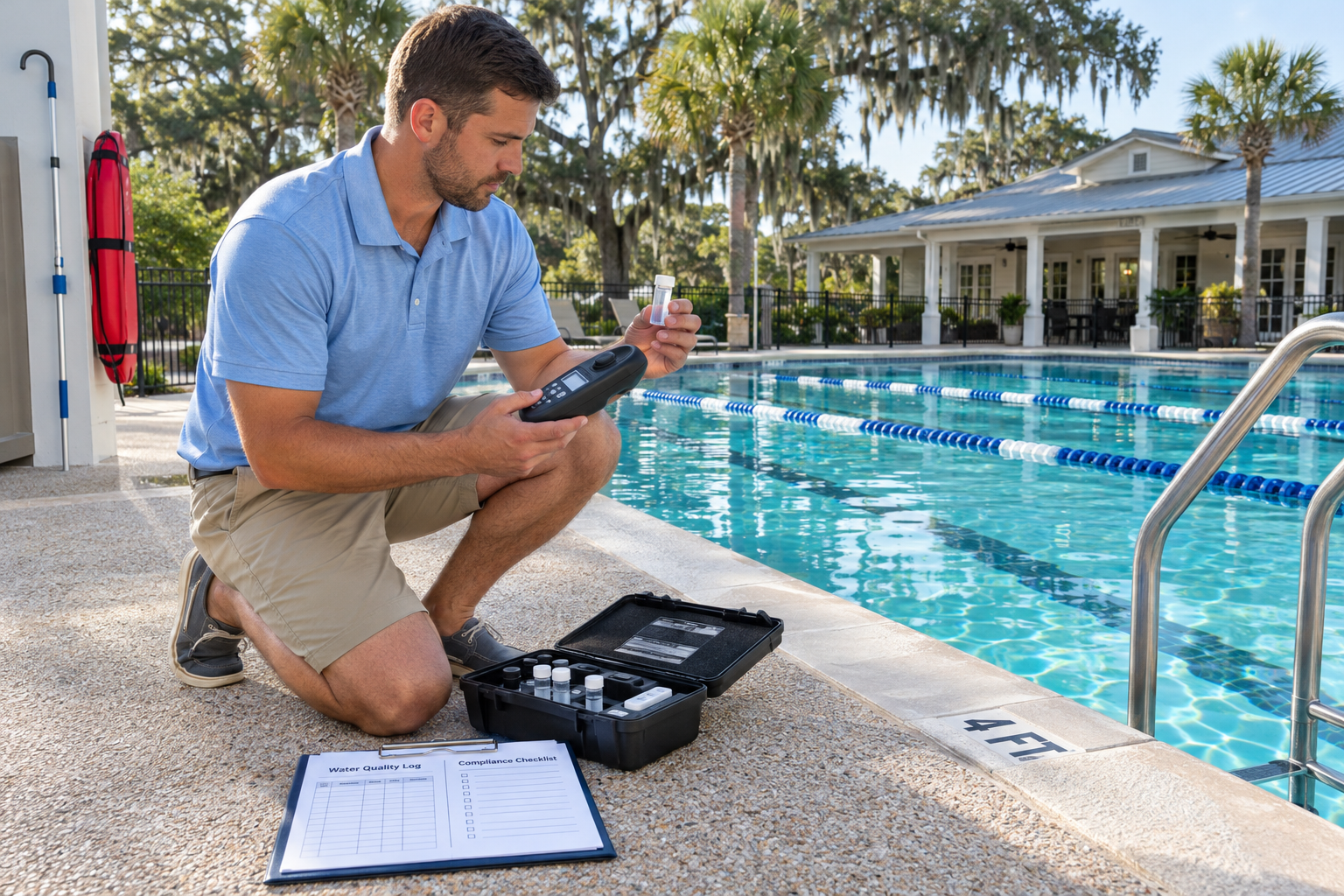
Commercial pool management requirements in South Carolina involve several separate responsibilities: facility permits, certified operation, appropriate staffing, documented maintenance and approval for construction or alterations. Before taking on a commercial pool management contract, identify which duties belong to the owner, management company and certified operator.
An operating permit does not replace an operator’s certification. Likewise, pool operator certification does not establish the contractor licensing needed for regulated construction work.
For operators entering the market, the first step is to separate those requirements before quoting services or accepting responsibility for opening a facility.
| Quick Answer To manage a commercial pool in South Carolina, verify its classification and operating permit, designate a qualified South Carolina-certified operator and establish compliant staffing, testing and recordkeeping. Construction and alterations require separate review and appropriate contractor qualifications. Document who handles permits, corrective work, inspections and emergency closure decisions. |
Establish Your Authority to Operate
Start With the Current Regulator
The South Carolina Department of Environmental Services, or SCDES, oversees public swimming pools through its Recreational Waters Program. The principal state regulation is R.61-51, Public Swimming Pools.
References to “DHEC pool standards” remain common because older documents name the Department of Health and Environmental Control. DHEC was dissolved into two agencies on July 1, 2024, and public-pool oversight now sits with SCDES.
Use current agency guidance when reviewing applications, training options and inspection procedures. Keep the facility’s approved plans and permit conditions alongside the regulation.
Separate Permits From Professional Credentials
The phrase “SC commercial pool license” can refer to different approvals. Clarify what the person requesting it actually needs.
| Approval or credential | What it addresses | What it does not replace |
| Pool construction permit | Approval to construct the facility under accepted plans | Final approval to open |
| Pool operating permit | Authorization for the facility to operate | Operator certification |
| South Carolina Pool Operator certification | Qualifications of the person directing pool operation | Construction contractor licensing |
| Contractor license | Authority to perform applicable regulated contracting work | Pool construction and operating approvals |
| Local permits | Building, electrical and other applicable local requirements | SCDES public-pool requirements |
These distinctions follow the separate permitting, operator and contracting provisions in the state requirements.
Do not represent an employee’s training certificate as proof that every aspect of the business or facility is licensed.
Confirm the Facility Classification
Classification affects supervision, equipment and operating requirements.
Hotels, apartments, condominium developments, subdivisions and clubs generally fall within the regulation’s Type B definition. A pool does not become exempt simply because access is limited to residents or guests.
| Classification | Examples |
| Type A | Pools open to the general public, subject to the regulation’s exclusions |
| Type B | Hotel, apartment, condominium, subdivision and club pools |
| Type C | Wading pools, kiddie pools and certain recirculating spray features |
| Type D | Spas and hot tubs |
| Type E | Waterpark attractions and certain subdivision pools with slides |
| Type F | Special-purpose pools used exclusively for limited activities |
| Type G | Hybrid pools with multiple intended-use zones |
Confirm the category against the full definition and approved plans. Exceptions and feature-specific conditions can affect the result.
For example, a subdivision pool with a slide may fall under Type E while the slide is operating. The regulation allows Type B operation when qualifying slide access is secured and the slide is not in use.
Do not base staffing or pricing solely on the property’s description of itself as an HOA or hotel.
Verify Operator Certification
All public pools covered by the regulation must operate under the direction of a qualified operator holding valid South Carolina Pool Operator certification from an approved issuing party.
SCDES lists recognized certification providers and separately identifies organizations offering preparation courses for the state examination. Its guidance warns that the preparation courses listed in the latter group do not include the examination.
Before enrolling or assigning an operator, confirm:
- Whether the provider is recognized by SCDES.
- Which credential the course awards.
- Whether the South Carolina examination is included.
- Whether separate examination registration is required.
- The credential’s validity and expiration.
- Whether the individual can meet the facility’s inspection obligations.
Do not assume that every national pool course, attendance certificate or out-of-state credential satisfies South Carolina’s requirement. Verify the actual qualification against current SCDES guidance.
Assign the Operator of Record
Certification alone is not the complete operating arrangement.
The operator of record must inspect each public pool at least three times per week during operation. Findings must be recorded and initialed in the facility’s bound logbook.
When planning South Carolina pool management services, account for travel time, the number of separate pools and realistic inspection coverage.
A single visit to a property should not be treated as documentation for every body of water without inspecting each one.
Identify who performs daily testing, who reviews abnormal readings and who responds when the operator of record is unavailable. The three-times-weekly inspection requirement does not replace daily water-quality checks.
Check Construction and Renovation Qualifications
Routine pool operation and construction contracting are separate areas of responsibility.
R.61-51 requires appropriate South Carolina contractor licensing for new construction and alterations in accordance with the state contracting law. The Contractor’s Licensing Board states that regulated commercial construction over $10,000 requires the applicable general or mechanical contractor license.
Confirm the exact classification, project scope and applicable requirements with the licensing authority. Do not assume that operator certification qualifies someone to perform structural, electrical or other regulated work.
Before proposing commercial pool renovations, also identify the SCDES approval process. Change-order approval authorizes the specified changes; it is not a substitute for contractor qualifications.
Complete Opening and Renewal Requirements
New public pools require construction approval before building begins. Newly constructed or altered facilities cannot open until the required final inspection has occurred and written approval has been issued.
For final inspection, the regulation calls for certification letters from the pool contractor, the owner or general contractor or designated agent, and the project architect or engineer. It also requires the completed departmental final inspection checklist.
Existing facilities must maintain a valid operating permit. The permit period runs from April 1 through March 31, and the current permit must be displayed on or near the pool rules sign.
A management agreement or scheduled opening date does not override these conditions.
Budget for Permit Fees
SCDES publishes separate fees for construction review and annual operation.
| Fee category | Published fee |
| Construction, Types A, B, C, D and F | $400 plus $0.50 per square foot of surface area |
| Annual operation, Types A, B, C, D and F | $125 for the first pool on a property, plus $100 for each additional pool |
| Annual operation, Type E | $125 per flume or water course |
| Type E construction | A separate schedule applies to flumes, water courses and additional areas |
These figures are from SCDES’s fee guidance. Confirm the current fee schedule and the facility’s classification before preparing an application or budget.
Annual operating fees are due February 15 and become delinquent if not received by March 15. SCDES lists a 10% late fee on March 15 and an additional 25% on April 15 for delinquent fees.
State fees are only one budget item. Define responsibility for training, staffing, maintenance, corrective work and any applicable local permits separately.
Build a Compliant Management Operation
Audit the Facility Before Takeover
Review the facility before accepting an opening commitment.
Request the current permit, approved plans, change orders, recent inspection reports, operator records and any unresolved closure or enforcement documents.
Use a documented facility inspection process to compare the actual equipment and layout with the approved configuration.
This matters because pools must be operated and maintained according to permitted plans and specifications or approved changes. The owner or designated agent is responsible for correcting noncompliant conditions.
Create a written list of deficiencies, assigned responsibilities and required completion dates. Do not treat inherited problems as resolved merely because the management company changes.
Document Ownership and Management Changes
The owner must notify SCDES in writing of address or ownership changes.
A change in management company is not necessarily an ownership change. Confirm with the agency which facility, contact or operator records need updating for the specific transition.
Collect keys, access credentials, emergency contacts and documentation before the outgoing team leaves.
Record who receives inspection reports and who can approve repairs. Missing communication responsibilities can leave deficiencies unaddressed even when the technical work is straightforward.
Establish Testing and Maintenance Procedures
A compliant operating schedule must cover water quality, equipment and housekeeping.
R.61-51 requires chlorine or bromine and pH checks daily, or more frequently during operating hours as needed to maintain the required standards. Cyanuric acid must be tested and recorded weekly where applicable.
| Parameter | Requirement in R.61-51.J |
| Free chlorine | 1–8 parts per million |
| Bromine | 2.3–17.6 parts per million |
| pH | 7.0–7.8 |
| Cyanuric acid, where used | No more than 100 parts per million |
| Pool water temperature | Must not exceed 104°F |
These are regulatory limits, not recommended operating targets for every facility. The qualified operator should establish appropriate procedures for the particular pool.
Build testing, calibration, filtration checks and housekeeping into the aquatic facility maintenance schedule.
The regulation prohibits hand-feeding chemicals while the pool is open for swimming. It also requires the recirculation system to operate during posted pool hours, with additional provisions governing operation throughout the swimming season.
Maintain Inspectable Operating Records
Daily operation reports must be recorded in a bound log with consecutively numbered pages acceptable to the Department.
Entries must include the date, time and actual numerical reading, with the required initials and signature. Reports for the previous 18 months must remain available at the facility.
Automatic instrument monitoring does not replace physical poolside sampling. Do not assume that a remote dashboard alone satisfies the sampling or recordkeeping requirements.
During a takeover, obtain the existing records rather than beginning a new file without the required history. Identify missing information and address it with the owner and regulator as appropriate.
Staff According to Pool Type
Type A and Type E pools require lifeguards during operating hours. Type A minimum staffing depends on both surface area and patron numbers. Type E pools must follow the applicable requirements and approved coverage arrangements.
For example, a Type A pool of 3,000 square feet or fewer with 26–50 patrons requires at least two lifeguards under the state schedule. That example does not establish staffing for larger pools or other attendance levels.
When arranging South Carolina lifeguard services, use the approved classification, dimensions, expected attendance and attraction layout.
Where only one lifeguard is required, an additional pool staff employee must be present and available to make an emergency call. Lifeguards must have current certifications available and must not perform unrelated duties while supervising swimmers.
An attendant is not interchangeable with a lifeguard under the regulation’s definitions.
Verify Emergency Readiness
Confirm that barriers, signs and emergency equipment match the facility’s requirements before opening.
The state requires an approved, permanently mounted emergency notification device within a 200-foot walking distance of the pool. The pool’s physical address must be displayed, and a mobile phone is not an acceptable substitute under the regulation.
Test whether staff can locate the device, provide the correct address and secure the pool when necessary.
Separately review applicable federal requirements, including anti-entrapment protections and accessibility obligations. State operating approval should not be treated as a complete review of every federal requirement.
Define Closure and Incident Responsibilities
Give staff clear instructions about who can close the pool and how the owner is notified.
Biological or chemical contamination requires immediate closure and the applicable response procedures. For an SCDES-ordered closure, follow the agency’s correction, follow-up inspection and reopening process.
Deaths, injuries or accidents requiring an EMS response, emergency room visit or hospitalization must be reported in writing on the approved form within 72 hours.
Define who prepares and submits the report. Keep the deadline separate from internal notifications and insurance reporting.
Put Responsibilities in the Contract
A management contract should identify the party responsible for each compliance task.
| Responsibility | What the agreement should establish |
| Permits and fees | Who tracks deadlines, pays and stores approvals |
| Certified operation | Who serves as operator of record and provides coverage |
| Routine testing | Who performs, records and reviews readings |
| Lifeguard staffing | Required coverage, credentials and replacement arrangements |
| Repairs | Approval authority, budget limits and escalation procedures |
| Inspection findings | Who receives reports and verifies correction |
| Closures | Authority to suspend operation and reopening coordination |
| Incident reports | Who prepares and submits required notifications |
| Records | Custody, retention and transfer when the contract ends |
These are recommended contract provisions, not a replacement for the legal duties assigned by regulation.
Avoid broad wording such as “all compliance included” without defining staffing, capital repairs, permit administration and emergency response.
Contact Us
Before requesting a proposal, gather the pool classification, current permit, recent inspection reports, operating schedule, operator credentials and planned repair work.
Use the Contact Us page to discuss your facility’s requirements with Pool Management Inc. and establish a management scope with clear responsibilities.
Frequently Asked Questions
Is There One Commercial Pool License?
No single document replaces every requirement. Facility operating permits, operator certification, contractor licensing and local approvals address different responsibilities.
What Operator Certification Is Required?
Public pools must operate under a qualified operator holding valid South Carolina Pool Operator certification from an approved issuing party. Check SCDES’s current provider and examination guidance before enrolling.
Does Every Course Include the Exam?
No. SCDES distinguishes recognized certification providers from separately listed examination-preparation courses. Its guidance states that the latter courses do not include the state examination.
How Often Must the Operator Inspect?
The operator of record must inspect each public pool at least three times per week during operation and document the findings in the bound logbook. Daily water testing remains a separate requirement.
Are HOA and Hotel Pools Regulated?
Yes, those facilities generally fall within the Type B definition, although features and operating arrangements can affect classification. Residents-only or guest-only access does not automatically create an exemption.
Can Operators Perform Construction Work?
Operator certification does not replace contractor licensing. Review the work against the applicable SCDES permitting and South Carolina contracting requirements before accepting it.
What Happens After a Management Change?
Review permits, approved plans, records and unresolved deficiencies before takeover. Owners must report address or ownership changes in writing; confirm any additional contact or operator updates with SCDES.