
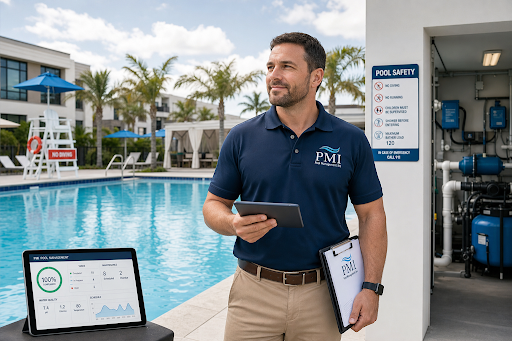
Commercial pool management in 2026 is no longer just about keeping the water clear.
A modern commercial pool needs documented procedures, trained staff, consistent water-quality control, reliable equipment, safety oversight, inspection records, smart monitoring, and clear reporting to ownership. For HOAs, apartments, resorts, hotels, clubs, and waterparks, the real standard is not “the pool looks clean today.” The real standard is whether the facility is safe, efficient, compliant, documented, and ready for heavy use.
That is where commercial pool management best practices matter.
The facilities that run well do not depend on guesswork. They operate with repeatable systems: pool SOPs, daily checks, escalation procedures, maintenance schedules, lifeguard accountability, technology-supported monitoring, and owner-facing reports. Facilities that skip those systems usually end up with the same pattern: chemical swings, staffing gaps, equipment surprises, resident complaints, and expensive last-minute decisions.
For properties that need broader operational support rather than one-off service visits, aquatic management services provide the larger framework behind safe and consistent pool operations.
Quick Answer
Commercial pool management best practices in 2026 include documented pool SOPs, trained staff, consistent chemical control, preventive maintenance, regular inspections, lifeguard readiness, smart pool technology, sustainability planning, and clear reporting to owners or boards.
The best-run facilities use management systems, not memory. They know who checks the water, who inspects equipment, who handles incidents, who escalates repairs, and who reports trends to ownership.
What Changed in Commercial Pool Management
The old model was reactive. A vendor visited, cleaned the pool, tested chemicals, handled obvious issues, and waited for something to break.
The 2026 standard is different.
| Old Operating Model | 2026 Industry Standard |
| Manual notes and scattered logs | Digital records and trend visibility |
| Reactive repairs | Preventive maintenance and early escalation |
| Basic cleaning focus | Full aquatic operations management |
| Staffing as scheduling | Staffing as risk and safety control |
| Chemical checks only | Chemistry management tied to safety and equipment life |
| Seasonal opening and closing | Year-round planning and asset protection |
| Owner updates only when problems happen | Routine reporting and accountability |
The shift is simple: commercial pools are being managed more like business assets. That means decisions should be based on records, procedures, risk, cost, and performance — not just whether the water looks fine during a visit.
Core Best Practices
Every commercial pool should have a baseline operating system. Without that, technology and staffing will not fix the underlying problems.
| Best Practice Area | What It Should Include | Why It Matters |
| Water quality control | Testing schedule, corrective actions, retesting, logs | Keeps water safe and protects equipment |
| Facility inspections | Deck, signage, gates, drains, equipment, hazards | Reduces safety and liability risk |
| Equipment checks | Pumps, filters, heaters, feeders, controllers | Prevents avoidable failures |
| Staff accountability | Assigned duties, shift checks, escalation rules | Reduces confusion and missed tasks |
| Incident response | Injury, contamination, weather, closure procedures | Helps staff respond quickly and consistently |
| Seasonal planning | Opening, closing, repair planning, budget notes | Prevents rushed decisions |
| Owner reporting | Logs, summaries, issues, recommendations | Gives boards and managers visibility |
The best facilities do not separate these items. They connect them into one operating rhythm. That is why aquatic facility maintenance should be treated as part of the broader management system, not just a cleaning checklist.
Pool SOPs
A commercial pool SOP is the operating manual for the facility.
It should tell staff and vendors exactly what needs to happen, when it happens, who owns it, how it gets recorded, and when an issue gets escalated. If the procedure only exists in one person’s head, it is not a procedure.
| SOP Area | What It Should Define |
| Chemical testing | Frequency, acceptable ranges, corrective action, retesting |
| Cleaning | Daily, weekly, and periodic cleaning duties |
| Equipment checks | Pumps, filters, heaters, feeders, valves, controllers |
| Lifeguard duties | Opening checks, surveillance expectations, rotation rules |
| Incident response | Injury, contamination, weather, closure, emergency procedures |
| Facility inspections | Gates, signage, deck hazards, drains, safety equipment |
| Communication | Who reports issues, who approves repairs, who updates ownership |
| Documentation | What gets logged, where it is stored, and who reviews it |
Good SOPs reduce dependence on individual memory. They also make it easier to train staff, evaluate vendors, and hold people accountable when something is missed.
Safety and Risk Control
Safety is not one section of commercial pool management. It touches everything.
Chemical levels, drain covers, gates, signage, lifeguard readiness, deck hazards, weather policies, emergency plans, and incident documentation all affect risk. A clean pool can still be poorly managed if the safety system is weak.
A strong pool safety program should include:
- Daily safety checks before opening
- Clear pool rules and visible signage
- Emergency action plans
- Incident and near-miss documentation
- Lifeguard readiness standards
- Weather and closure procedures
- Drain and entrapment awareness
- Chemical handling and storage controls
- Regular review of inspection findings
Facilities that want to strengthen safety procedures should align operations with a defined pool safety program instead of treating safety as a side responsibility.
Staffing Standards
Staffing is one of the most underestimated parts of commercial pool management.
A facility can have good equipment and clean water, but if staff are poorly trained, late, unclear on duties, or unsupported during peak periods, risk increases fast. Lifeguard staffing is not just about placing someone in a chair. It is about supervision, readiness, communication, and consistency.
| Staffing Area | Best Practice |
| Scheduling | Match coverage to peak usage, facility rules, and risk level |
| Training | Confirm certifications, emergency procedures, and facility-specific rules |
| Rotation | Reduce fatigue and maintain attention |
| Supervision | Assign leads or supervisors for larger facilities |
| Communication | Give staff clear escalation paths |
| Documentation | Record incidents, closures, shift notes, and concerns |
| Backup planning | Prepare for absences, weather, and high-use periods |
For facilities where guard coverage is part of the operating model, professional pool lifeguard support should be integrated with maintenance, inspections, and reporting rather than handled as a separate staffing problem.
Facility Inspections
Inspections turn observations into accountability.
A proper inspection should not be a quick walk around the pool deck. It should review safety, maintenance, equipment, signage, access control, documentation, and visible facility conditions.
| Inspection Area | What to Check |
| Pool deck | Trip hazards, drainage, cleanliness, furniture placement |
| Access control | Gates, latches, locks, entry points |
| Safety equipment | Rescue equipment, signage, emergency phone or communication |
| Water condition | Clarity, readings, visible contamination issues |
| Equipment room | Pumps, filters, leaks, feeders, storage, ventilation |
| Documentation | Logs, incidents, corrective actions, prior recommendations |
| Structural condition | Surface wear, coping, drains, tiles, visible damage |
Routine facility inspection help owners catch small issues before they become complaints, compliance problems, or emergency repairs.
Smart Pool Technology
Smart pool technology is becoming part of modern aquatic operations, but it is not a replacement for management.
IoT pool monitoring, remote alerts, digital logs, automated chemical readings, and equipment performance tracking can improve visibility. But technology only helps when someone reviews the data, understands the risk, and acts on the warning signs.
| Technology | Use Case | Limitation |
| IoT pool monitoring | Tracks chemistry or system changes in near real time | Still needs human review and response |
| Digital logs | Improves documentation and trend visibility | Bad entries still create bad records |
| Remote alerts | Flags abnormal readings or system issues | Alerts must be assigned and acted on |
| Equipment monitoring | Helps identify pump, flow, or runtime problems | Does not replace physical inspection |
| Reporting dashboards | Gives ownership visibility | Data must be translated into decisions |
The right mindset is simple: smart technology supports good operators. It does not rescue bad operations.
Pool Efficiency
Efficiency is not only about cutting cost. It is about reducing waste without compromising safety, clarity, or guest experience.
| Efficiency Area | Best Practice | Business Impact |
| Pump scheduling | Match runtime to demand and turnover needs | Reduces unnecessary energy use |
| Filter care | Clean based on pressure, flow, and usage | Improves clarity and reduces strain |
| Chemical control | Avoid overcorrection and repeated swings | Reduces chemical waste |
| Staffing | Schedule around actual usage and risk | Improves labor control |
| Repairs | Plan before peak season | Reduces emergency spending |
| Reporting | Track repeated issues | Improves budgeting and decisions |
Efficiency improves when the facility has stable routines. If staff are constantly reacting to cloudy water, equipment warnings, late repairs, or staffing gaps, the facility is not efficient- even if the monthly service fee looks low.
Sustainability in Pool Operations
Sustainability in pool operations should be practical, not performative.
Commercial pool sustainability comes from reducing wasted energy, water, chemicals, labor, and equipment life. The most sustainable pool is usually the one that is well-managed, documented, and maintained before problems escalate.
Practical sustainability measures include:
- Energy-aware pump scheduling
- Leak detection and water-loss tracking
- Proper filter cleaning intervals
- Chemical storage and handling discipline
- Preventive maintenance to extend equipment life
- Smart monitoring where it improves response time
- Seasonal planning that prevents avoidable damage
When facility infrastructure is outdated, sustainability may also require physical improvements. That is where pool renovations and upgrades can support better efficiency, safety, and long-term facility performance.
Best Practices by Facility Type
Different facilities need different operating emphasis. A resort pool, HOA pool, and waterpark should not be managed with the exact same assumptions.
| Facility Type | Main Operating Challenge | Best Practice Focus |
| HOA pools | Board oversight, resident satisfaction, seasonal planning | Clear reporting, safety rules, consistent maintenance |
| Apartment pools | Heavy resident use, fast complaint cycles | Daily readiness, clean documentation, responsive repairs |
| Resort pools | Guest experience, reviews, high expectations | Water quality, lifeguard readiness, appearance standards |
| Waterparks | High bather load, complex operations, staffing needs | SOPs, supervision, inspections, incident response |
| Clubs and community pools | Member expectations, programming, events | Staffing, scheduling, communication, maintenance planning |
A community board evaluating HOA pool management has different priorities than a hotel operator reviewing resort pool management or a high-volume facility considering waterpark management. The best practice is to match the operating model to the risk profile of the facility.
Regional Operating Standards
Commercial pool management also changes by region.
Weather, season length, bather load, local rules, staffing availability, and facility type all affect how a pool should be managed. A year-round outdoor pool in a warm market has different pressure points than a seasonal community pool in a colder climate.
| Regional Factor | Why It Matters |
| Climate | Affects opening, closing, water temperature, and chemical demand |
| Storm patterns | Influence debris load, closures, inspections, and water balance |
| Season length | Changes staffing, maintenance, and budgeting needs |
| Local regulations | Affect safety, signage, staffing, and inspection expectations |
| Facility density | Impacts vendor response time and staffing availability |
That is why commercial pool owners should avoid generic service scopes. A facility looking for pool management in Texas may need a different operational plan than one evaluating pool management in Georgia.
Reporting and Accountability
A best-practice pool management program should produce records that owners can actually use.
If a board, CFO, or property manager only hears from the vendor when something breaks, the reporting system is weak. Good reporting should explain what happened, what was corrected, what is recurring, and what needs attention next.
| Report Type | Why Ownership Needs It |
| Chemical logs | Shows water quality control |
| Maintenance logs | Confirms recurring tasks were completed |
| Equipment notes | Tracks developing issues |
| Incident reports | Supports risk documentation |
| Inspection reports | Identifies safety and compliance gaps |
| Seasonal reports | Supports planning and budgeting |
| Repair recommendations | Creates accountability and next steps |
| Staffing notes | Shows coverage issues, incidents, and operational patterns |
Strong reporting protects both operations and decision-making. It helps ownership see whether the facility is improving, drifting, or being held together by last-minute fixes.
Best Practices Checklist
Use this checklist to evaluate whether a commercial pool is being managed to a modern 2026 standard.
Operations
- Written pool SOPs are in place
- Daily, weekly, monthly, and seasonal tasks are assigned
- Chemical readings are logged and reviewed
- Equipment checks are documented
- Maintenance issues are escalated clearly
- Opening and closing procedures are standardized
Safety
- Pool rules and signage are current
- Safety equipment is visible and accessible
- Emergency procedures are documented
- Incident reports are completed and stored
- Weather and closure procedures are defined
- Access control is reviewed regularly
Staffing
- Lifeguard schedules match usage and risk
- Staff certifications are current
- Shift duties are clearly assigned
- Supervisors or leads are identified
- Incident communication is clear
- Backup coverage is planned
Maintenance
- Pumps, filters, heaters, and feeders are checked on schedule
- Filter pressure and flow issues are tracked
- Equipment rooms are inspected
- Repairs are prioritized before peak season
- Seasonal reports feed into budget planning
Technology
- Digital logs are used where helpful
- Smart monitoring alerts are assigned to responsible staff
- Technology does not replace physical inspections
- Trends are reviewed, not just collected
Sustainability
- Pump schedules are reviewed for efficiency
- Leaks and water loss are tracked
- Chemicals are stored and used responsibly
- Equipment life is protected through preventive maintenance
- Upgrades are considered when old systems create waste
Reporting
- Ownership receives regular updates
- Inspection findings are summarized
- Recurring issues are flagged
- Repair recommendations include priority and timing
- Seasonal notes support budgeting
Common Mistakes to Avoid
Many facilities do not fail because one major decision was wrong. They fail because small management gaps stack up over time.
| Mistake | Why It Creates Problems |
| Treating pool care as cleaning only | Misses safety, staffing, equipment, and reporting needs |
| Relying on memory instead of SOPs | Creates inconsistency when staff or vendors change |
| Ignoring inspection records | Allows small risks to become expensive problems |
| Overtrusting technology | Alerts are useless if no one acts on them |
| Underplanning staffing | Creates safety gaps during peak usage |
| Waiting until peak season for repairs | Increases cost and downtime risk |
| Sending vague owner reports | Leaves boards and managers blind to recurring issues |
The fix is not more complexity. The fix is clearer ownership, better documentation, and a management system that turns daily operations into usable decisions.
When to Upgrade Your Pool Management Model
A facility should reconsider its current pool management model when the same issues keep repeating.
Warning signs include:
- Chemical logs are inconsistent
- Equipment failures are increasing
- Lifeguard staffing is reactive
- Facility inspections are undocumented
- Seasonal openings feel rushed
- Owners only hear about problems after they become expensive
- Vendor reports are vague or incomplete
- No one reviews recurring issues
- Safety procedures are not updated
- Technology exists but no one owns the response
At that point, the problem is not just pool maintenance. It is operational risk.
If your facility needs a clearer scope for commercial pool operations, staffing, inspections, maintenance, safety, or reporting, you can submit a bid request to compare options. If you want to discuss the right direction first, contact Pool Management Inc. and outline the current operational gaps.
Frequently Asked Questions?
What are commercial pool management best practices?
Commercial pool management best practices are the operating standards used to keep a commercial pool safe, clean, efficient, documented, and ready for use. They include pool SOPs, chemical control, maintenance schedules, equipment checks, safety procedures, staffing standards, inspections, reporting, and seasonal planning.
What should be included in pool SOPs?
Pool SOPs should define chemical testing, cleaning duties, equipment checks, lifeguard responsibilities, incident response, weather procedures, opening and closing steps, documentation requirements, and escalation rules.
How does smart pool technology improve aquatic operations?
Smart pool technology improves aquatic operations by giving operators faster visibility into chemistry changes, equipment behavior, alarms, and recurring trends. It can support better decisions, but it still requires trained staff and clear accountability.
Can IoT pool monitoring replace on-site inspections?
No. IoT pool monitoring can support faster alerts and better trend tracking, but it cannot replace physical inspections of the pool deck, equipment room, signage, gates, drains, safety equipment, and staff performance.
How can commercial pools improve efficiency?
Commercial pools can improve efficiency by optimizing pump schedules, cleaning filters based on pressure and flow, reducing chemical overcorrection, planning repairs before peak season, using staff more strategically, and reviewing recurring issues through reports.
What role does sustainability play in pool operations?
Sustainability in pool operations means reducing waste while protecting safety and performance. That includes energy-efficient pump use, leak detection, better chemical control, responsible storage, preventive maintenance, and longer equipment life.
How often should commercial pool operations be reviewed?
Commercial pool operations should be reviewed daily for readiness, weekly for maintenance and staffing patterns, monthly for performance trends, and seasonally for repairs, budget planning, and operating improvements.
When should a facility change pool management providers?
A facility should consider changing providers when documentation is poor, safety checks are inconsistent, staffing is unreliable, equipment issues repeat, reports are vague, seasonal planning is weak, or the vendor only reacts after problems become expensive.