
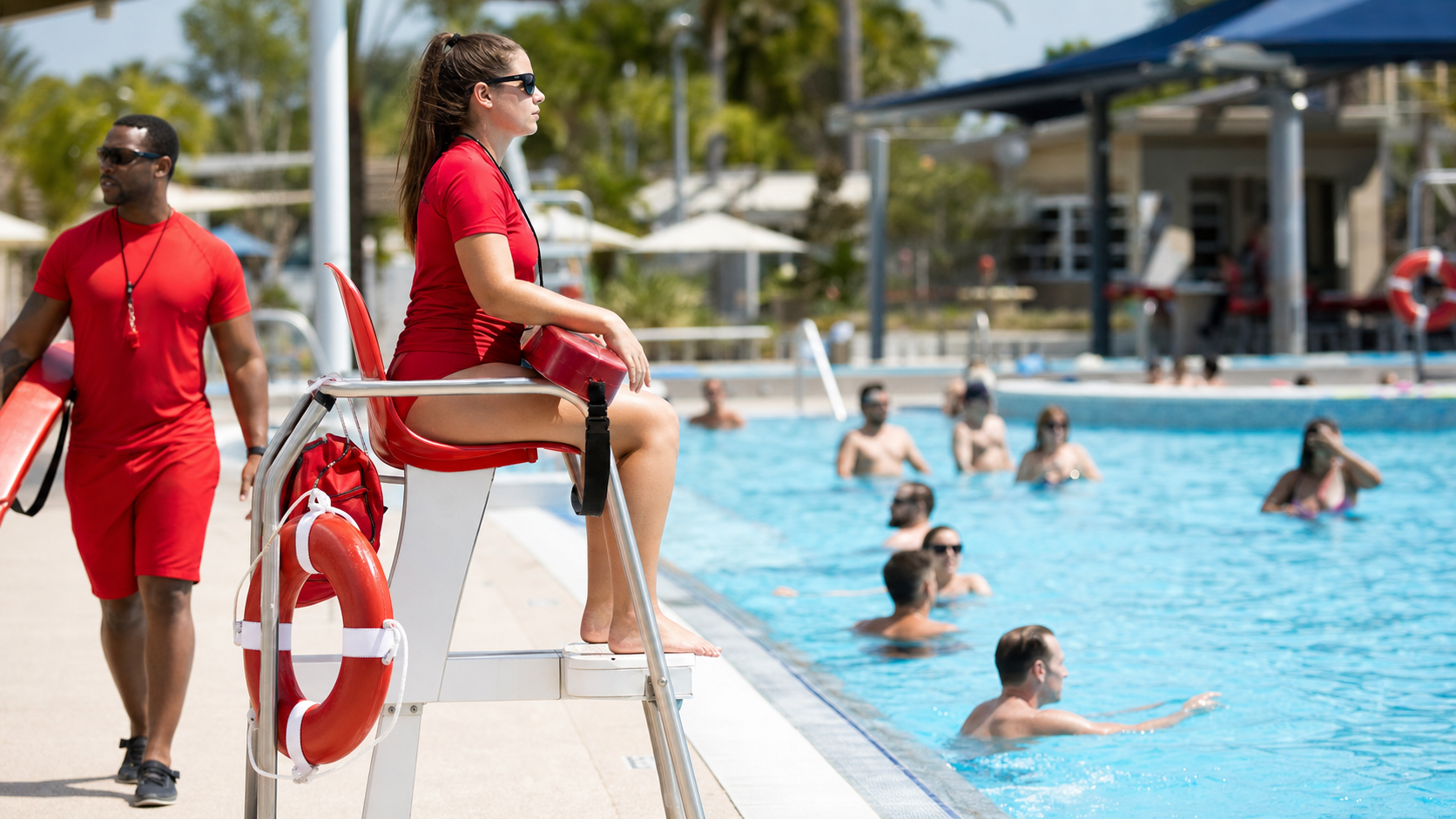
Commercial lifeguard requirements are not set by a single nationwide rule. The number of lifeguards your facility legally needs can depend on the state, county or city code, facility classification, bather load, pool size, water features, sightlines, activity level, and the ages and swimming abilities of your guests.
Most operators start with a lifeguard-to-swimmer ratio, but a ratio alone does not satisfy commercial lifeguard requirements or create a defensible staffing plan. A pool with blind spots, multiple bodies of water, a diving area, slides, a zero-depth entry, or a high proportion of children may need more supervision than a simple swimmer count suggests. Some jurisdictions publish explicit bather-load tables instead of ratios, scaling the required number of guards upward in fixed increments as permitted occupancy rises.
Before opening for the season or scheduling a high-attendance event, confirm the commercial lifeguard requirements that apply in your jurisdiction, assess site-specific risk, and document a coverage plan. Professional lifeguard staffing services can help you build coverage around your pool layout, operating hours, attendance patterns, and legal obligations.
Quick Answer
Commercial lifeguard requirements vary by jurisdiction, so a pool may need one lifeguard, several lifeguards, or no legally mandated lifeguard depending on local code and operating conditions. A common planning benchmark is one lifeguard for every 25 swimmers, but it is not a universal legal standard and should never replace a review of state and local code.
| Question | Short Answer |
| Is there one national lifeguard rule? | No. Requirements are usually set by state or local authorities |
| Is 1 lifeguard per 25 swimmers always required? | No. It is a common benchmark, not a universal legal requirement |
| Does bather load determine staffing? | It is an important factor, but layout, features, visibility, and risk also matter |
| Can a pool operate with one lifeguard? | Sometimes, depending on code, pool design, attendance, and operating conditions |
| Do slides or multiple pools require more guards? | Often, yes. Separate attractions and limited sightlines can increase staffing needs |
| Can an HOA or hotel rely on a “swim at your own risk” sign? | Signs do not remove the need to follow applicable laws, safety rules, and property obligations |
| Who should verify legal requirements? | The relevant state and local health, building, or aquatic regulatory authority |
Why Commercial Lifeguard Requirements Vary by State
Commercial lifeguard requirements differ substantially across jurisdictions. Some codes set specific lifeguard-to-bather ratios, while others focus on bather load, water surface area, facility classification, safety equipment, or whether a pool is classified as public, semi-public, hotel, HOA, waterpark, municipal, or recreational.
| Factor | Why It Affects Staffing |
| State and local code | Legal requirements may differ by jurisdiction |
| Pool classification | Public, HOA, hotel, resort, waterpark, and municipal pools may have different standards |
| Bather load | More swimmers and deck users can increase supervision needs |
| Pool size and shape | Large, irregular, or divided pools can create blind spots |
| Water depth | Deep water, diving zones, and drop-offs can increase risk |
| Water features | Slides, lazy rivers, splash areas, and play structures may need dedicated supervision |
| Guest age and ability | Young children and weak swimmers may require closer supervision |
| Sightlines | Lifeguards must be able to see assigned areas effectively |
| Operating hours | Shift length, fatigue, breaks, and rotations affect coverage |
| Special events | Pool parties, lessons, competitions, and high-attendance days may require additional staff |
The lesson is simple: do not select staffing only by counting people. Start with the legal requirement, then build coverage around the actual risk and visibility conditions at your facility.
For facilities that need help coordinating operations, staffing, safety, and maintenance, full-service aquatic management can provide a more integrated approach than treating lifeguard scheduling as a separate task.
Lifeguard-to-Swimmer Ratio Guidelines
Many operators refer to a 1:25 ratio as a starting point for planning. The American Camp Association identifies one lifeguard for every 25 swimmers as a suggested standard for group swimming, while noting that local codes and the specific user group can require a different ratio — for preschool-age swimmers without additional adult supervision in the water, a tighter ratio is appropriate.
That does not mean every commercial pool is compliant at 1:25. Some jurisdictions require more coverage, while others use bather load or water surface area instead of a swimmer ratio.
| Planning Scenario | Example Ratio or Approach | Important Limitation |
| General group-swim benchmark | 1 lifeguard per 25 swimmers | Not a universal legal requirement |
| Preschool or weak swimmers | A tighter ratio may be appropriate | Age and ability increase supervision needs |
| Large pool with multiple zones | Multiple guards assigned by zone | Guard count may depend on sightlines, not only swimmer count |
| Waterpark attraction | Dedicated coverage may be needed | Slides, wave pools, and play features create separate risks |
| High-attendance event | Additional guards and a supervisor may be needed | Event activity can exceed normal staffing assumptions |
| Multiple pools on one property | Separate or overlapping coverage zones | One guard may not be able to safely observe both pools |
When reviewing ratios, distinguish carefully between these terms:
| Term | Meaning |
| Swimmer count | Number of people currently in the water |
| Bather load | Maximum number of permitted users, often including pool and deck capacity |
| Lifeguard ratio | Number of guards relative to swimmers or bathers |
| Coverage zone | The specific area a guard is assigned to supervise |
| Active surveillance | Focused observation of swimmers and water areas |
| Rotation | Planned movement of guards between stations to reduce fatigue |
| Backup coverage | Staff available for breaks, emergencies, or attendance spikes |
Bather Load vs Swimmer Count
A pool’s bather load is not the same as its current number of swimmers. Bather load may be established through local code, pool design, square footage, deck capacity, or permit conditions, and it is typically posted in a prominent location at the facility.
| Measurement | What It Means | Why It Matters |
| Current swimmer count | Number of people in the water right now | Helps determine real-time surveillance demand |
| Deck occupancy | Number of people on the pool deck | May affect crowd control and emergency response |
| Posted bather load | Maximum number of permitted users | May be part of code compliance and operational planning |
| Facility capacity | Total practical occupancy based on design and use | Helps guide event and staffing planning |
| Lifeguard coverage | Number of qualified guards actively assigned | Must be adequate for actual conditions, not only capacity |
For example, a commercial pool may have a legally posted bather load of 150, but that number alone does not tell the operator how many guards are needed. The facility might include a lap pool, shallow play area, deep end, slide, and separate spa — all of which affect how lifeguards must be positioned.
A professional aquatic facility inspection can help operators identify visibility limitations, safety concerns, operational gaps, and site conditions that affect a staffing plan.
How Pool Layout Changes Staffing Needs
A rectangular pool with clear sightlines is very different from a resort-style pool with curved edges, landscaping, shallow play areas, bridges, swim-up zones, or separate attractions. The number of lifeguards needed should reflect what one guard can actually see and supervise.
| Pool Feature | Potential Staffing Impact |
| Deep end | May require focused supervision, especially during active recreation |
| Diving board | Can require dedicated rules, exclusion zones, and closer monitoring |
| Water slide | May require separate slide-attendant or lifeguard coverage |
| Lazy river | Creates continuous movement and limited visibility |
| Zero-depth entry | Can attract younger children and require close surveillance |
| Splash pad or play structure | May require separate supervision depending on local rules and use |
| Multiple bodies of water | Often requires more than one guard or clearly structured coverage |
| Irregular pool shape | Can create blind spots |
| Heavy landscaping | May obstruct sightlines |
| Indoor or outdoor glare | Can reduce visibility from a lifeguard station |
A guard should not be assigned to an area they cannot observe effectively. If a lifeguard must turn away from one water zone to supervise another, the coverage plan may not be adequate even when the swimmer count appears low.
How Facility Type Affects Requirements
Commercial lifeguard requirements often differ by pool classification, so an HOA pool, hotel pool, and waterpark may face different standards within the same county. Classification can affect staffing expectations, operational procedures, inspections, and compliance obligations.
| Facility Type | Common Staffing Considerations |
| HOA or community pool | Seasonal attendance, family use, peak weekend demand, local health-code requirements |
| Apartment pool | Resident access, after-hours policies, occupancy patterns, property-management responsibilities |
| Hotel or resort pool | Guest turnover, alcohol service, families, water features, resort activities |
| Waterpark | Slides, wave pools, lazy rivers, multiple attractions, zone coverage, high bather load |
| Municipal pool | Public access, programming, lessons, lap swim, open recreation, large attendance swings |
| Country club pool | Family swim, lessons, events, diving areas, food-and-beverage activity |
| School or university pool | Athletic use, classes, swim teams, public hours, changing activity levels |
| Fitness-club pool | Lap swimmers, classes, therapy use, locker-room proximity, different user groups |
For HOA boards and property managers, staffing decisions should be part of broader pool-operations planning. Location-specific HOA pool management services can help communities evaluate staffing, operations, maintenance, safety, and seasonal readiness.
Lifeguards, Supervisors, and Non-Guard Staff
Not every person on the pool deck performs the same safety function. A front-desk employee, pool attendant, maintenance technician, or event worker should not automatically be counted as lifeguard coverage.
| Role | Primary Function | Can It Replace a Lifeguard? |
| Certified lifeguard | Active water surveillance and emergency response | Yes, if properly assigned and qualified |
| Lifeguard supervisor | Oversees operations, rotations, readiness, and staff performance | May support coverage, depending on active assignment |
| Pool attendant | May monitor entry, rules, towels, or general deck conditions | Not automatically |
| Maintenance technician | Handles equipment, water quality, and repairs | No |
| Front-desk staff | Guest services, admissions, communication | No |
| Swim instructor | Provides instruction | May not replace independent lifeguard coverage |
| Event staff | Supports event operations | No, unless separately qualified and actively assigned as a guard |
A staffing plan should identify who is actively scanning water, who covers breaks, who responds to emergencies, and who manages non-water duties. Lifeguards should not be loaded with tasks that pull attention away from active surveillance.
For facilities seeking trained seasonal staff, review available commercial pool lifeguard staffing options. Job seekers interested in joining an aquatic team can visit lifeguard job opportunities.
Build a Commercial Pool Staffing Plan
A strong staffing plan is more than a schedule. It should combine legal review, operational planning, site assessment, attendance data, emergency response procedures, and clear guard assignments.
| Staffing-Plan Step | What to Review |
| 1. Confirm jurisdiction | The commercial lifeguard requirements set by your state, county, city, and health department |
| 2. Confirm pool classification | HOA, public, hotel, resort, waterpark, municipal, or other category |
| 3. Review permits and posted limits | Bather load, operating conditions, signage, and inspection history |
| 4. Map the pool | Deep water, shallow water, blind spots, attractions, entrances, and exits |
| 5. Define coverage zones | Which guard supervises each area |
| 6. Plan for peak demand | Weekends, holidays, pool parties, lessons, and special events |
| 7. Schedule breaks and rotations | Avoid leaving gaps in active surveillance |
| 8. Create backup coverage | Handle absences, emergencies, high attendance, and relief |
| 9. Train the team | Emergency action plans, communication, rescues, documentation, and facility rules |
| 10. Review regularly | Update the plan as attendance, operations, or regulations change |
A documented staffing plan helps operators make consistent decisions when attendance changes. It also supports communication among management, guards, maintenance teams, vendors, and property stakeholders.
Common Staffing Mistakes
| Mistake | Why It Creates Risk | Better Approach |
| Using one universal ratio for every pool | Ignores jurisdiction, pool layout, and guest risk | Start with code, then assess site-specific coverage needs |
| Scheduling only for average attendance | Peak periods can exceed normal staffing | Plan for weekends, holidays, events, and sudden spikes |
| Counting non-lifeguard employees as coverage | Non-guard staff may not be scanning water or trained for rescue | Clearly identify active guards and relief coverage |
| Ignoring blind spots | Guards cannot supervise what they cannot see | Complete a visibility and zone assessment |
| Failing to plan breaks | Guard fatigue can affect surveillance quality | Use documented rotations and relief staff |
| Treating signs as a substitute for staffing | Signage does not replace legal or operational responsibilities | Follow applicable regulations and documented procedures |
| Delaying inspection follow-up | Unresolved issues can affect compliance and safety | Address deficiencies promptly and document corrective action |
| Using outdated staffing plans | Facility use, code, or features may change | Review the plan before each season and after major changes |
When to Increase Lifeguard Coverage
Even when a facility meets its baseline legal requirement, operating conditions may call for additional coverage.
| Situation | Why Additional Coverage May Be Needed |
| High attendance | More swimmers make active surveillance more difficult |
| Pool party or special event | Guests may be unfamiliar with the facility or safety rules |
| Large number of children | Younger or weaker swimmers require closer observation |
| Swim lessons | Different activities may occur at the same time |
| Alcohol service nearby | Behaviour, judgement, and supervision needs may change |
| Severe glare or poor weather | Visibility may be reduced |
| Multiple water features in use | Separate zones can require dedicated staff |
| Lifeguard training or onboarding | New staff may need supervision and support |
| Rescue or medical response | Remaining swimmers still need coverage during an emergency |
Water safety planning should account for operational reality, not only minimum staffing. A well-designed plan helps facilities respond to changing conditions without sacrificing supervision.
For broader risk planning, see aquatic water-safety resources and the company’s pool-safety guidance.
Final Recommendation
Commercial lifeguard requirements depend on your jurisdiction and facility conditions. Do not rely on a generic 1:25 ratio, a neighbouring property’s practice, or a “swim at your own risk” sign as the basis for compliance.
Start by confirming state and local rules. Then assess bather load, pool layout, sightlines, water features, user age groups, operating hours, events, and emergency coverage. Document how guards will be positioned, rotated, relieved, and supported during both ordinary operations and peak attendance.
If your facility needs help reviewing coverage zones, staffing requirements, inspections, maintenance responsibilities, or seasonal readiness, you can request an aquatic management consultation.
Frequently Asked Questions
What are commercial lifeguard requirements?
Commercial lifeguard requirements are the state and local rules that determine whether a pool must provide lifeguards, how many are needed, what certifications they must hold, and what supervision and equipment standards apply. They vary by jurisdiction and by how the pool is classified.
Is there a legal lifeguard-to-swimmer ratio for commercial pools?
There is no single nationwide legal ratio. State and local rules may specify different ratios, bather-load thresholds, pool classifications, or operating conditions. A 1:25 ratio is commonly used as a planning benchmark in some settings, but it is not universally binding.
Can one lifeguard supervise a commercial pool?
Sometimes, but only if applicable law, pool layout, attendance, visibility, and risk conditions allow it. One guard may not be enough for a pool with blind spots, multiple water zones, deep water, slides, high attendance, or many young swimmers.
Does pool bather load determine how many lifeguards are needed?
Bather load is an important factor, and some codes tie required guard counts directly to it. Even so, operators should also consider swimmer count, pool layout, sightlines, water features, depth, and activities.
Do lifeguards need to be present at HOA pools?
It depends on the jurisdiction and how the HOA pool is classified and operated. Boards should review applicable state and local rules along with their insurance, operating policies, and safety obligations.
Do water slides require dedicated lifeguards?
They may. Slides, wave pools, lazy rivers, and similar attractions can create separate supervision needs. Review local code, manufacturer guidance, facility procedures, and the actual visibility of the attraction.
Can a pool attendant replace a lifeguard?
Not automatically. An attendant may manage admissions, rules, towels, or deck activity, but that does not mean they are trained, certified, assigned, or legally qualified for active water surveillance and emergency response.
How often should lifeguards rotate stations?
Rotation schedules should reflect facility operations, visibility, fatigue management, local requirements, and the safety plan. The goal is sustained focused surveillance with planned relief and no coverage gaps.
How can a commercial pool prepare for a staffing inspection?
Keep current certifications, staffing schedules, coverage-zone plans, emergency-action procedures, incident documentation, maintenance records, and corrective-action records organised. A commercial pool facility inspection can help identify gaps before they become compliance problems.