
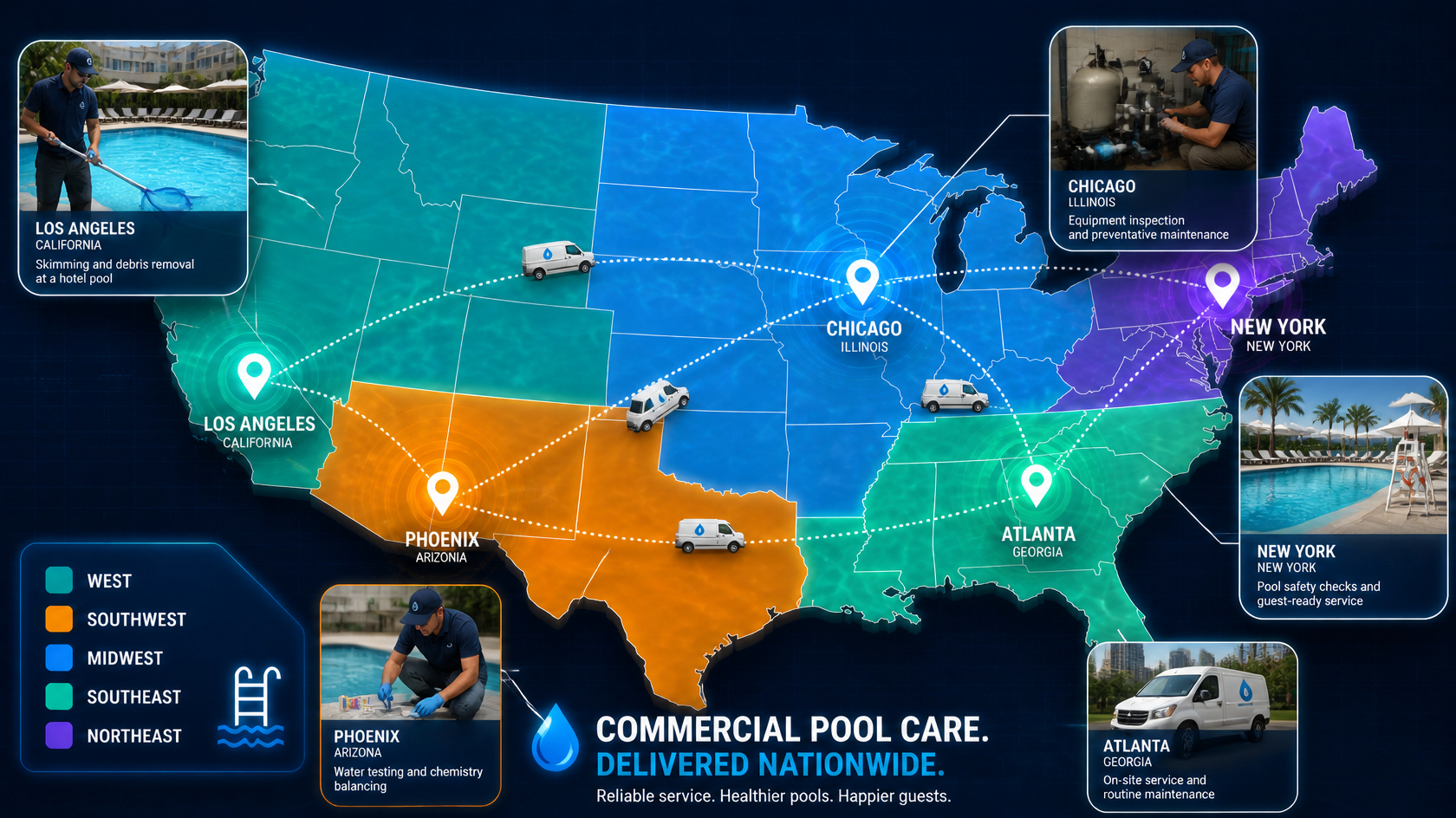
Managing one pool is a full-time responsibility. Managing dozens across several states, each with its own health codes, staffing markets and seasons, is a different challenge altogether. For national accounts and multi-site owners, choosing the right commercial pool management partner shapes safety, compliance and budget across the entire portfolio.
This guide explains what “best” really means for multi-state operators, how nationwide coverage works in practice, and how to evaluate providers before signing a portfolio-wide contract.
| Quick Answer The best pool management company in the United States for your portfolio is the one that can deliver consistent standards in every market you operate in. Look for a provider that offers:Proven coverage in the states and cities where your properties are locatedLocal knowledge of each state’s and county’s pool codesCertified operators and lifeguards recruited and trained locallyOne set of standards, reporting and account management across all sitesClear escalation paths for emergencies, closures and inspectionsTransparent pricing that compares easily across propertiesNational reach only matters if service quality holds up at the local level. |
What “Best” Means for National Accounts
There is no official ranking of pool management companies. “Best” depends on your properties, locations and goals. For multi-site owners, these criteria matter most:
| Criterion | What to Look For | Why It Matters |
| Coverage | Active operations in your states and metro areas | Avoids gaps, delays and unvetted subcontractors |
| Compliance knowledge | Familiarity with each state and local health code | Codes vary widely between jurisdictions |
| Staffing depth | Local recruiting, certification and backup staff | Prevents closures caused by missed shifts |
| Consistency | One operating standard across all sites | Makes performance comparable and auditable |
| Reporting | Centralized logs, inspection results and incident reports | Gives you portfolio-wide visibility |
| Responsiveness | Defined response times and escalation contacts | Limits downtime and liability |
| Commercial terms | Clear scope, pricing and renewal terms | Simplifies budgeting across properties |
A provider that scores well on all seven is usually a stronger choice than one that simply claims the largest footprint.
What Multi-State Pool Management Includes
Multi-state pool management brings operations at many locations under one coordinated program. Depending on the contract, services often include:
- Routine water testing, chemical balancing and equipment checks
- Certified pool operator oversight
- Lifeguard staffing, training and scheduling
- Opening and closing services for seasonal pools
- Safety equipment and signage checks
- Health department inspection preparation
- Repairs, upgrades and capital project coordination
- Centralized reporting for owners and asset managers
The best programs tie these services together with consistent standards, so a pool in one state is managed the same way as a pool in another. A coordinated approach to aquatic management services is what makes that consistency possible.
Nationwide Coverage Explained: Three Common Models
“Nationwide” can mean very different things. Before comparing providers, understand which model each one uses.
| Coverage Model | How It Works | Strengths | Watch Out For |
| Single national provider | One company operates directly in every market | Consistent standards, one contract, one point of contact | Coverage may be thin in some regions |
| Regional network | Several regional teams or partners cover different areas | Strong local knowledge and staffing | Standards and reporting can vary by region |
| Hybrid model | A lead provider self-performs in core markets and manages vetted partners elsewhere | Balances reach with local expertise | Subcontractor quality must be closely managed |
Why Local Teams Still Matter
Even with a national contract, pools are managed locally. Lifeguards are hired from local labor markets, inspectors come from local health departments, and weather patterns differ from region to region.
A Southeast portfolio, for example, needs teams that understand long outdoor seasons, heat and storm planning. Local operations like pool management in Georgia show how regional teams handle those conditions day to day.
Ask every provider which markets they self-perform in and which rely on partners.
How a Pool Management Coverage Map Works
A coverage map shows where a provider has active teams, not just where it is willing to work. When a provider shares a map, check:
- Which states and metro areas have dedicated local staff
- Which service lines are available in each area, such as lifeguards, maintenance or waterpark operations
- Typical response times for each region
- Where services depend on subcontractors
Example: Organizing Coverage by Region
Many multi-state programs group properties into regions to simplify staffing and oversight:
| Region | Example States | Common Considerations |
| Mid-Atlantic | Maryland, Delaware, Virginia | Seasonal community pools, HOA-heavy portfolios, short peak seasons |
| Southeast | Georgia, South Carolina, North Carolina | Long outdoor seasons, resort and coastal properties, storm planning |
| Southwest | Texas | Large multifamily portfolios, heat, detailed state and city codes |
| Mountain West | Colorado | Shorter outdoor seasons, altitude and sun exposure, resort pools |
Regional grouping helps national accounts compare performance between similar markets rather than across very different climates.
Compliance Across Multiple States
Compliance is often the biggest challenge in multi-state pool management. Each state sets its own public pool rules, and many counties and cities add their own permits, inspections and requirements.
Differences can include:
- How pools are classified, such as public, semi-public or community pools
- Operator certification requirements
- Water testing frequency and recordkeeping rules
- Lifeguard requirements and exemptions
- Required signs and safety equipment
- Local permit and inspection schedules
For example, Texas has detailed state rules plus separate city programs in places like Houston and Dallas. Teams that specialize in pool management in Texas need to track both levels.
A strong national provider maintains a requirements register for each jurisdiction and updates it when codes change. General best practices help, but they never replace the specific rules where each pool is located.
Staffing and Lifeguards at Scale
Staffing is where many multi-site programs struggle. A missed lifeguard shift can force a closure, and a closure at a busy property quickly becomes a resident or guest complaint.
Strong providers manage staffing with:
- Local recruiting pipelines in every market
- Verified lifeguard, CPR and first aid certifications
- Pre-season training and ongoing in-service sessions
- Backup staff and float pools for last-minute gaps
- Clear supervision and performance audits
Ask how a provider covers call-outs during peak weekends, and how quickly a replacement reaches each site. Reliable pool lifeguard staffing is one of the clearest signs of operational strength.
Consistent Maintenance and Water Quality Standards
Water quality must meet local requirements at every site, every day. Across a portfolio, that means:
- A standard testing schedule that meets or exceeds each local code
- Consistent chemical logs, digital or paper, at every property
- Preventive maintenance plans for pumps, filters and feeders
- Clear thresholds for when a pool must close
- Documented corrective actions
Standardized aquatic facility maintenance reduces surprises, extends equipment life and makes budgeting more predictable across properties.
Inspections and Portfolio Reporting
National accounts need visibility without visiting every site. A good provider offers centralized reporting that covers:
| Report | What It Shows |
| Water quality logs | Daily chemistry and corrective actions by site |
| Inspection results | Health department findings and follow-up status |
| Incident reports | Injuries, rescues, closures and contamination events |
| Staffing reports | Shift coverage, certifications and training status |
| Maintenance logs | Repairs, equipment issues and open work orders |
| Capital planning | Upcoming replacements, upgrades and estimated timing |
Internal facility inspections before official visits help catch problems early and give owners a consistent view of risk across the portfolio.
Matching Services to Facility Types
Multi-site portfolios rarely include just one kind of pool. A national provider should adapt its approach to each facility type:
- HOA and community pools: Seasonal staffing, resident communication and board reporting
- Apartments and condos: Year-round maintenance, access control and resident safety
- Hotels and resorts: Guest experience, extended hours and spa operations
- Waterparks and aquatic centers: Larger lifeguard teams, attraction safety and high bather loads
- Clubs and fitness centers: Lap swimming, programming and member services
HOA portfolios, for example, often need board-friendly reporting and strict season timelines, as seen in HOA pool management in Maryland.
Planning Capital Projects Across a Portfolio
Pools age at different rates. Over time, every portfolio faces resurfacing, equipment replacement and safety upgrades.
A national provider should help you:
- Track the age and condition of key equipment at each site
- Prioritize projects by safety, compliance and cost
- Schedule work outside peak seasons
- Coordinate permits and contractors in each jurisdiction
- Budget several years ahead
Coordinated planning for pool renovations prevents emergency spending and keeps properties open when residents and guests expect them to be.
How to Evaluate U.S. Pool Management Providers
Use a structured process when comparing commercial pool providers in the USA.
Request for Proposal Checklist
Ask each provider to supply:
- A list of states and cities where they self-perform services
- Where they use subcontractors, and how those partners are vetted
- Operator certification and lifeguard training standards
- Sample water logs, inspection reports and incident reports
- Staffing plans and backup coverage procedures
- Emergency response and escalation contacts
- Insurance coverage details
- A pricing structure that compares easily across sites
- An onboarding timeline for your portfolio
Questions to Ask
- How do you track code differences between states and cities?
- What happens if a site fails a health inspection?
- How fast can you replace a lifeguard who calls out?
- Who is our single point of contact, and who backs them up?
- How do you report performance across all our properties?
Red Flags
- Vague answers about who actually performs the work
- No documented training or certification tracking
- Inconsistent reporting formats between regions
- Promises of “guaranteed compliance”
- Pricing that hides key services or extra fees
No provider can guarantee a pool will pass every inspection. The right partner reduces risk through strong processes, trained people and clear documentation.
Onboarding a Multi-Site Portfolio
Moving several properties to a new provider works best in phases:
- Site audit: Review each pool’s condition, equipment, permits and records.
- Requirements mapping: Document state and local rules for every location.
- Staffing plan: Confirm operator coverage and lifeguard needs by site.
- Standard setup: Introduce consistent logs, reporting and procedures.
- Phased launch: Start with one region, then expand.
- Review: Hold regular performance reviews and adjust where needed.
Allow extra time before peak season, when hiring and inspections are busiest.
Contact Us
Managing pools across multiple states takes local expertise backed by consistent standards. Pool Management Inc. supports multi-site owners and national accounts with pool management, lifeguard staffing, maintenance and inspection support across its service areas. Contact us to discuss coverage for your portfolio.
Frequently Asked Questions
What is the best pool management company in the United States?
There is no official ranking. The best company for you is the one that covers your locations, understands local codes, staffs reliably and delivers consistent reporting across every property.
What does multi-state pool management mean?
It means one provider coordinates pool operations, staffing, maintenance and compliance for properties in several states, usually under one contract and one set of standards.
Do national pool management companies use subcontractors?
Some do. Many providers self-perform in core markets and use vetted partners elsewhere. Ask which model each provider uses and how partners are trained and monitored.
How do pool rules differ between states?
States set their own rules for pool classification, operator certification, water testing, lifeguards and signage. Many cities and counties add local permits and inspections.
What should a pool management coverage map show?
It should show where a provider has active local teams, which services are offered in each area, typical response times and where subcontractors are used.
How long does it take to onboard multiple properties?
It depends on portfolio size, locations and season. A phased rollout with site audits and requirements mapping is usually smoother than switching everything at once.
Can one provider manage HOA, resort and waterpark pools?
Yes, if it has experience with each facility type. Each needs different staffing levels, reporting and safety procedures, so confirm experience for every type in your portfolio.