
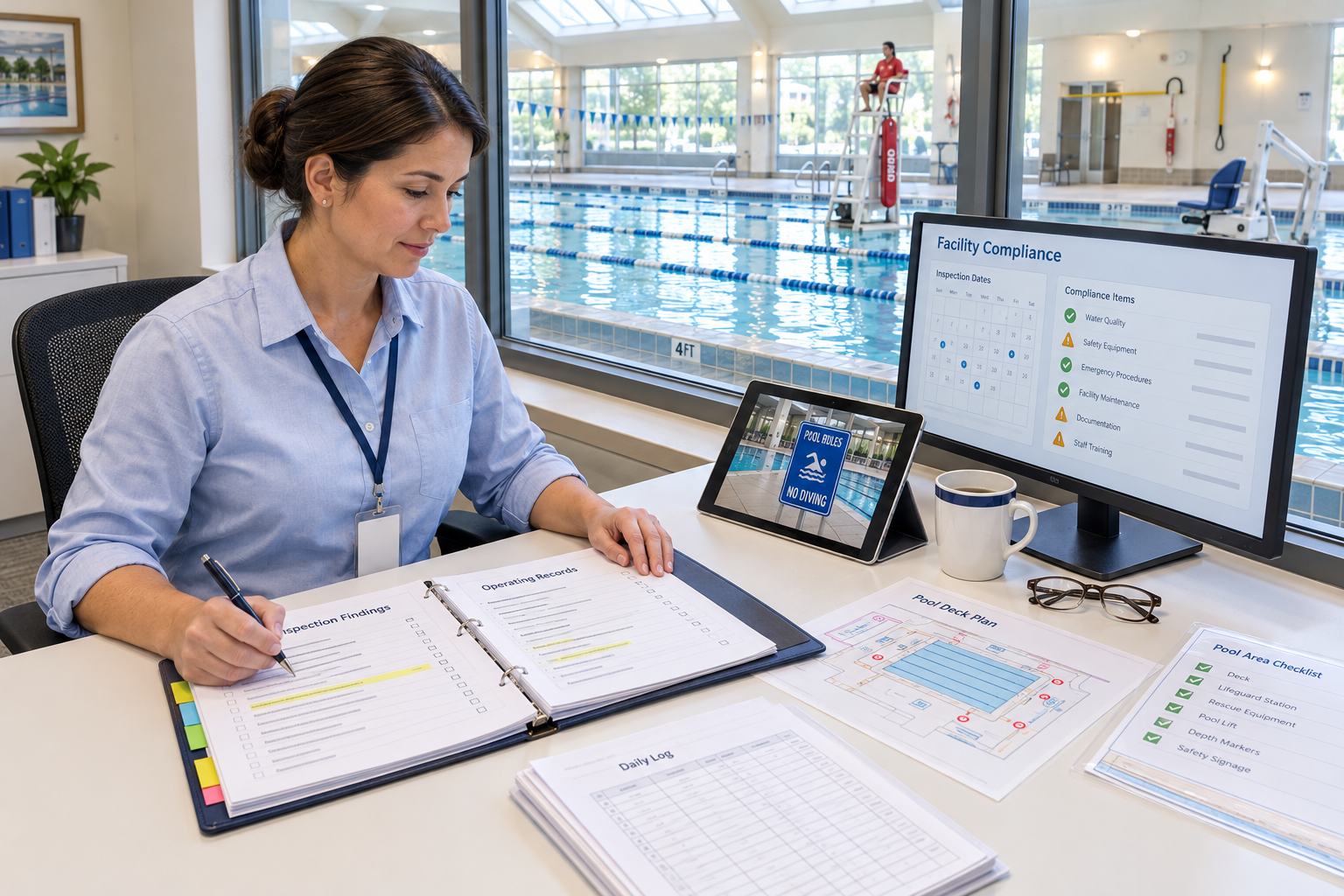
Aquatic facility compliance requires more than a current permit and a completed checklist. It needs a repeatable process that connects applicable requirements, daily operations, documented findings and verified corrective action.
Within an aquatic facility management program, that process should make responsibility visible. Staff need to know what to check, which records to maintain and when a problem requires escalation.
For compliance officers, the goal is not simply to prepare for an inspection. It is to demonstrate that the facility consistently identifies problems and follows through on them.
| Quick Answer Manage aquatic facility compliance by identifying applicable requirements, assigning responsible staff and maintaining reliable operating records. Use internal audits to test whether procedures work, prepare for official inspections and track each finding through correction and verification. Follow the relevant authority’s rules for reporting, record retention, closures and reopening rather than applying one universal checklist. |
Establish the Compliance Framework
Identify the Applicable Requirements
Start with the facility’s location, approved classification and operating activities.
A property with a swimming pool, spa and splash feature may need separate requirements mapped to each. Do not assume that shared ownership means identical operating conditions.
Identify the authorities responsible for public health, construction, fire safety and other applicable obligations. Include permit conditions, approved plans and written agency instructions in the review.
The CDC’s Model Aquatic Health Code can support policy development and internal reviews. However, it is not a federal pool law and becomes enforceable only to the extent adopted by the relevant jurisdiction.
Build a Requirements Register
A requirements register connects each obligation to an operating task and evidence of completion.
Use exact references where possible. “Maintain safe water” is less useful than identifying the applicable parameter, testing frequency, acceptable limits and response procedure.
| Register field | What to document |
| Facility or feature | The specific pool, spa or other aquatic area |
| Requirement source | Applicable code, permit condition or agency instruction |
| Operating obligation | What must be done and when |
| Responsible person | The role accountable for completion |
| Evidence | The record that demonstrates completion |
| Escalation trigger | When management or an authority must be notified |
| Review date | When the requirement was last checked |
Keep internal best practices separate from legal requirements. Both may belong in the operating plan, but staff should understand which is which.
Distinguish Audits From Inspections
An aquatic audit and an official inspection serve related but different purposes.
| Activity | Main purpose | Typical output |
| Routine operational check | Confirm current conditions and identify immediate problems | Readings, observations and corrective actions |
| Internal aquatic audit | Test whether procedures, records and responsibilities work consistently | Findings, evidence gaps and improvement actions |
| Independent operational review | Evaluate selected systems or practices against an agreed scope | Recommendations and documented observations |
| Regulatory inspection | Assess compliance with applicable requirements | Official findings, deadlines and possible enforcement action |
An internal pool inspection checklist can support preparation and routine checks. It does not establish regulatory approval or replace the authority’s inspection criteria.
Define the scope before starting an audit. A review of water-quality records is not equivalent to a complete assessment of construction, electrical safety, accessibility and operations.
Assign Responsibilities Before Problems Occur
Give every recurring task an owner and a backup.
The compliance officer may coordinate documentation and follow-up, while a qualified operator handles technical monitoring. Managers may control budgets, staffing and contractor approvals.
Make those boundaries explicit:
- Who performs and reviews operating checks.
- Who verifies credentials and permit status.
- Who receives official inspection reports.
- Who assigns corrective work.
- Who can restrict access or initiate a closure.
- Who communicates with the regulatory authority.
- Who verifies that an issue is resolved.
Include these arrangements in the facility’s pool safety procedures. A policy that names only “management” can leave staff uncertain when an immediate decision is needed.
Run the Compliance Workflow
Step 1: Organize the Evidence File
Create a central index of compliance documentation rather than relying on individual inboxes.
The records themselves may be stored in different approved locations, but the index should show where to find them and who maintains them.
| Record group | Examples to organize |
| Approvals | Permits, approved plans, conditions and authorized changes |
| Personnel | Required certifications, training records and coverage assignments |
| Operations | Water readings, equipment checks and opening records |
| Maintenance | Service reports, work orders and equipment documentation |
| Inspections | Official reports, internal audits and agency correspondence |
| Incidents | Event records, notifications and response documentation |
| Corrective actions | Assigned tasks, completion evidence and verification |
Confirm the required format, accessibility and retention period for each category. Some jurisdictions specify particular logs or on-site availability.
Do not assume a shared drive alone satisfies every recordkeeping requirement.
Step 2: Build a Facility-Specific Checklist
A useful checklist reflects the actual facility, not just a generic list of pool equipment.
Include the applicable requirement or internal procedure, the observed condition and any action needed.
| Review area | Example check | Evidence to capture |
| Permits | Current approval and applicable conditions | Permit details and renewal status |
| Water quality | Required measurements and testing intervals | Actual readings, time and staff identification |
| Circulation and filtration | Equipment operation and relevant readings | Operating log and service findings |
| Barriers and access | Gate function and restricted areas | Observations and follow-up actions |
| Emergency readiness | Required equipment and communication arrangements | Functional checks and availability |
| Staffing | Applicable qualifications and assigned coverage | Credential records and schedules |
| Chemical management | Storage, labeling and relevant procedures | Inspection observations and training records |
| Prior findings | Completion of previously required work | Corrective-action evidence |
Mark an item “not applicable” only when the reason is established. An unchecked item should not quietly become a passing result.
Specialist assessments, such as electrical testing, should remain with appropriately qualified personnel.
Step 3: Record Conditions Accurately
Good pool recordkeeping shows what was observed and what happened next.
For measurements, record the actual result rather than “good” or “normal.” Include the date, time, facility or feature, and the person completing the task.
When a result falls outside the applicable limit, document the response and the follow-up verification.
Do not backfill missed readings from memory or copy previous entries to complete a log. Identify the gap honestly and address the process failure.
For corrected entries, preserve a traceable correction rather than silently replacing the original information.
Step 4: Audit the Process
An aquatic audit should test whether the records reflect real operational control.
Select a sample of operating days, shifts or recent incidents. Follow the evidence from the initial observation through the response.
Useful audit questions include:
- Do readings appear at the required intervals?
- Are unusual results followed by documented action?
- Can staff explain the procedures they are expected to use?
- Do service reports match the issues recorded in operating logs?
- Are expired credentials or missing approvals identified promptly?
- Were repeated problems escalated rather than repeatedly marked complete?
Use a risk-based review schedule. Increase attention after significant incidents, recurring findings, equipment changes or staffing turnover.
The audit schedule is an internal management decision unless a specific requirement establishes its frequency.
Step 5: Prepare for Official Inspections
Maintain inspection readiness throughout operation rather than assembling documents only when a visit is expected.
Designate a primary contact and backup who can retrieve records, explain operating arrangements and provide authorized access to equipment areas.
During an inspection, record observations accurately and ask for clarification when a finding or required action is unclear.
Do not argue from a generic checklist when the inspector is applying a specific local requirement. Request the relevant reference and document the explanation.
Afterward, preserve the complete report and any attachments or instructions.
Step 6: Review Health Department Reports
Treat health department pool reports as action documents, not filing tasks.
For each finding, identify the cited requirement, affected area, required correction and deadline. Distinguish the official classification from any internal priority label.
Confirm whether the report requires:
- Immediate operating restrictions.
- Submission of corrective evidence.
- A follow-up inspection.
- Additional technical assessment.
- Formal authorization before reopening.
Do not assume every finding requires closure. Equally, do not downgrade an official closure requirement because staff believe the issue is minor.
Record the date the report was received and the person responsible for responding.
Step 7: Assign and Track Corrective Actions
Move each finding into a corrective-action register with a unique reference.
At minimum, include the issue, responsible person, due date, interim controls, work required and verification method.
A suggested internal status sequence is:
- Open.
- Assigned.
- Interim controls in place.
- Correction completed.
- Verification pending.
- Verified closed.
This is a management workflow, not an official regulatory classification.
Connect technical work to the aquatic facility maintenance process so work orders and compliance findings remain linked.
A contractor’s invoice may confirm that work was billed. It does not necessarily demonstrate that the underlying problem was resolved.
Step 8: Verify Before Closing
Verification should answer whether the corrective action met the applicable requirement.
Depending on the issue, evidence might include a repeat measurement, a functional check, revised documentation, specialist sign-off or an official reinspection.
For significant findings, consider having someone other than the person completing the repair review the evidence.
A completed work order, closed internal finding and permission to reopen are three different decisions. Where regulatory authorization is required, internal verification cannot substitute for it.
Record who verified the action, when it was checked and what evidence supported closure.
Step 9: Investigate Repeat Findings
Repeated deficiencies may indicate a process problem rather than isolated mistakes.
Suppose an audit finds missing water-test entries during the same weekend shift on several occasions. Simply reminding staff to complete the log may not resolve inadequate coverage or unclear assignments.
A stronger response examines scheduling, training, access to test equipment and supervisory review.
Use that information to revise the process and then check whether the same issue returns. This is an illustrative workflow, not a completed facility case study.
Step 10: Keep Staffing Evidence Current
Maintain a roster of roles, required qualifications, expiration dates and backup arrangements.
Review both credentials and actual assignments. A valid certificate does not show that the required person was available during the relevant operating period.
Where lifeguard staffing forms part of the facility’s operating requirements, connect schedules, certifications and training records to the compliance file.
Keep operator duties and surveillance duties distinct. Documentation should reflect how responsibilities are covered, not just which qualifications exist somewhere within the organization.
Step 11: Control Records and Changes
Define who can create, edit, approve and delete compliance records.
For digital systems, assess timestamps, change history, backup arrangements, export capability and access during an outage. Confirm that electronic records are accepted where a prescribed format applies.
Restrict access to sensitive incident information according to role and applicable obligations. Do not place medical details in a widely shared maintenance tracker.
Set retention periods by record category. Preserve records subject to an investigation, claim or legal hold rather than deleting them under the ordinary schedule.
Step 12: Review Operational Changes
Compliance review should happen before significant changes, not only after installation.
Equipment replacement, altered operating hours, new attractions and changes in facility use can affect procedures, staffing or approvals.
Before starting pool renovation work, determine which plans, permits, inspections and operating instructions need review.
After approved changes, update equipment records, staff training, checklists and emergency arrangements. Keep superseded documents identifiable so staff do not continue following outdated instructions.
Measure Follow-Through
Use a small dashboard to identify gaps in the workflow.
Useful internal measures include overdue corrective actions, missing required entries, repeat findings, approaching credential expirations and findings awaiting verification.
Define each measure before comparing facilities. For example, count a finding as closed only when the required verification is complete.
A high checklist-completion rate does not prove compliance if unacceptable results remain unresolved. Review the quality of the response as well as the number of completed forms.
Contact Us
Gather the latest inspection report, permit information, operating logs and unresolved findings before reviewing your compliance process.
To discuss operational support with Pool Management Inc., contact our aquatic management team. Establish responsibility for inspections, documentation, maintenance and corrective-action follow-up before services begin.
Frequently Asked Questions
What Is Aquatic Facility Compliance?
It is the ongoing work of meeting the requirements applicable to an aquatic facility and maintaining evidence that those obligations are being addressed. It includes operations, documentation, approvals and corrective action.
What Should a Pool Inspection Checklist Include?
Include the requirements relevant to the facility’s permits, water quality, equipment, barriers, emergency readiness, staffing and records. Add fields for findings, assigned actions and verification rather than relying only on pass-or-fail boxes.
How Often Should an Aquatic Audit Occur?
Set an internal schedule based on facility risk, operating complexity and previous findings. Additional reviews may be appropriate after incidents, major changes or repeated deficiencies. Follow any separately mandated inspection or audit frequency.
How Long Should Pool Records Be Kept?
Retention requirements vary by jurisdiction and record type. Confirm the applicable periods and preserve records subject to investigations, claims or legal holds. Do not apply one universal retention period to every document.
Can Compliance Records Be Digital?
Potentially, but acceptance depends on applicable requirements. Confirm prescribed formats, signatures, accessibility and retention rules before replacing required paper records.
Does Passing an Inspection Prove Ongoing Compliance?
No. An inspection assesses conditions and evidence at a particular time. Daily monitoring, maintenance and documented follow-up remain necessary afterward.
Who Can Close a Finding?
An internal reviewer can close a management finding after the required verification. Official findings, closures and reopening conditions must be handled according to the responsible authority’s instructions.
What If an Inspection Report Is Unclear?
Contact the issuing authority for clarification. Confirm the cited requirement, correction deadline, evidence needed and any operating restrictions, then preserve that communication with the report.