
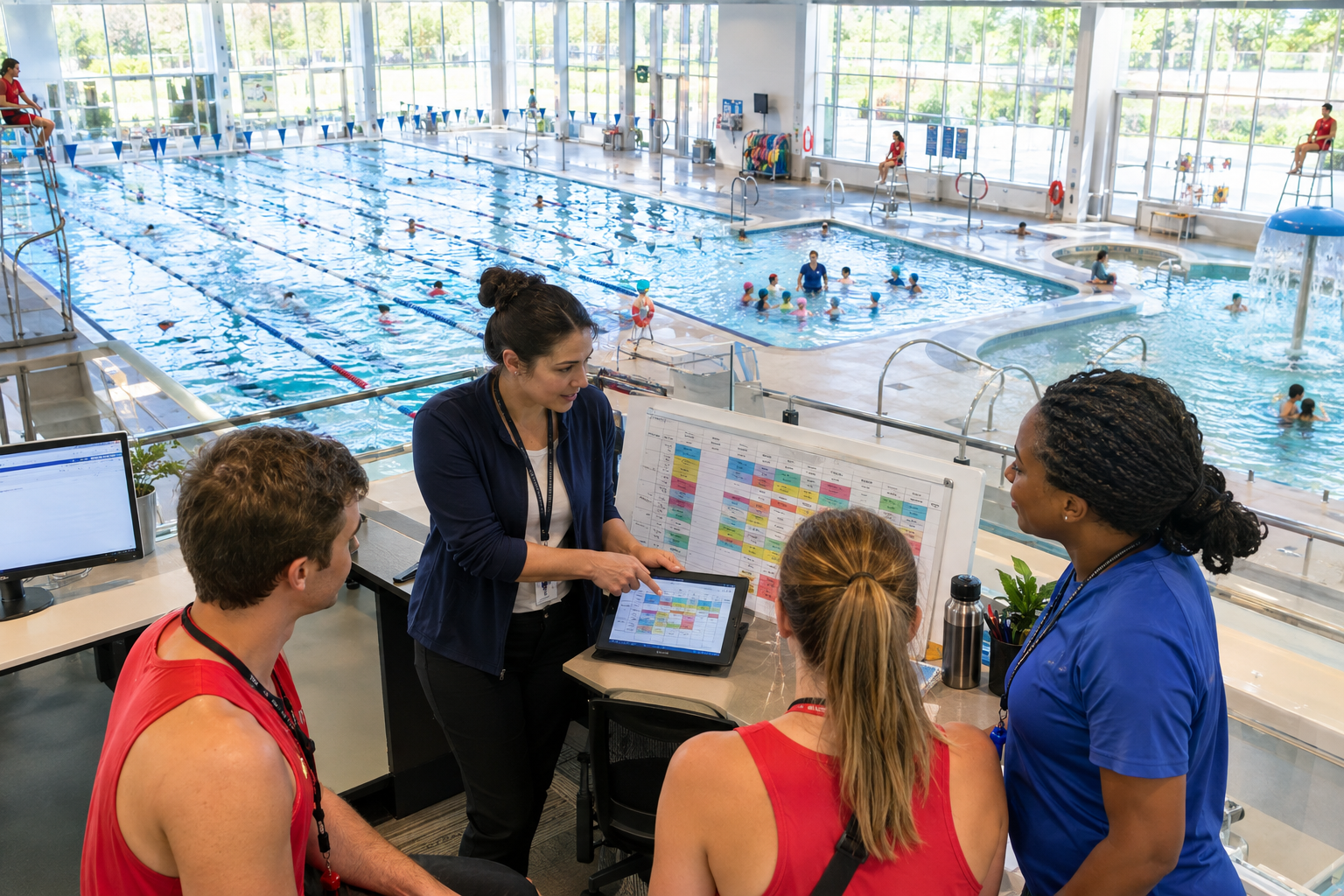
Aquatic center management becomes more complex when one facility contains competition, instructional, recreational, therapy and diving pools. Each venue may have different temperatures, staffing needs, maintenance demands and programming priorities.
Efficient commercial aquatic operations require directors to manage these spaces as one coordinated facility. Scheduling, water quality, staffing, safety and mechanical systems must work together rather than operate as separate departments.
The following framework helps aquatic center directors improve operational control while supporting a diverse programme schedule.
| Quick Answer Efficient aquatic center management requires a unified operating plan for every pool, supported by pool-specific staffing, water-quality targets, preventive maintenance and programming schedules. Directors should coordinate daily operations through shared dashboards, standard procedures and measurable performance indicators while preserving the requirements of competition, instruction, therapy and recreation programmes. |
Multi-Pool Operations
A large aquatic facility cannot apply the same operating model to every body of water. A competition pool may prioritize lane availability and event preparation, while an instructional pool requires warmer water, accessible entry and frequent programme transitions.
Management should create an operational profile for each aquatic venue.
The profile should identify:
- Primary and secondary uses
- Operating hours
- Water temperature requirements
- Maximum capacity
- Lifeguard and instructor coverage
- Required qualifications
- Mechanical systems serving the pool
- Accessibility features
- Setup and breakdown requirements
- Inspection and testing schedules
- Conditions requiring closure
- Responsible supervisors
The operational profile allows directors to understand how changes in one pool affect the rest of the facility. Closing an instructional pool, for example, may require moving lessons into the competition pool, reducing lap lanes and adjusting lifeguard assignments.
Pool operating profiles
| Aquatic venue | Primary uses | Main operating considerations |
| Competition pool | Training, lap swimming and meets | Lane allocation, water temperature, timing systems and event setup |
| Instructional pool | Swim lessons and beginner programmes | Warmer water, shallow access and instructor availability |
| Therapy pool | Rehabilitation and low-impact exercise | Accessibility, controlled capacity and specialised temperature |
| Recreation pool | Open swimming and family programmes | Changing attendance, play features and guest supervision |
| Diving well | Diving and deep-water training | Restricted access and specialised supervision |
| Spa or whirlpool | Relaxation and therapeutic use | Higher temperature, lower capacity and frequent monitoring |
Separate operating profiles should still connect to one facility-wide plan. Directors need a central view of staffing, closures, programme changes and maintenance activity.
Daily Operating Controls
Consistent swim center operations depend on repeatable opening, operating and closing procedures. Each checklist should identify who completes the task, who verifies it and what conditions prevent a pool from opening.
Pre-opening checks
The opening team should begin early enough to correct problems before programmes or public swimming start.
Pre-opening procedures should cover:
- Disinfectant and pH testing
- Water clarity
- Pool and air temperatures
- Flow and filtration readings
- Drain and suction-outlet condition
- Deck, ladder and handrail inspections
- Starting blocks and lane equipment
- Accessible lifts and entry systems
- Rescue and first-aid equipment
- Communication systems
- Doors, gates and controlled-access points
- Locker rooms and changing areas
- Programme equipment
- HVAC and humidity readings
CDC guidance recommends testing disinfectant and pH before opening and maintaining accurate records of water measurements and maintenance activity. Testing should occur more frequently during heavy use or when required by the applicable health code.
A pool should remain closed when water quality, visibility, mechanical performance or safety equipment falls outside approved operating conditions. The problem, corrective action and reopening authorization should be documented.
A structured facility inspection programme can bring pool, deck, building and mechanical checks into one traceable process.
Operating checks
Conditions can change quickly after opening. Bather load, programme activity and water temperature can influence disinfectant demand and filtration performance.
Supervisors should monitor:
- Attendance by pool
- Lifeguard coverage
- Programme transitions
- Water-quality trends
- Equipment alarms
- Deck conditions
- Locker-room activity
- Indoor air complaints
- Schedule delays
- Customer concerns
- Staff fatigue and break coverage
The operating plan should identify clear escalation steps. Frontline employees need to know when to notify a supervisor, suspend a programme or close an aquatic venue.
Closing procedures
Closing duties should include:
- Clearing each pool and deck
- Completing locker-room sweeps
- Recording final water readings
- Removing or securing programme equipment
- Inspecting rescue equipment
- Documenting incidents and defects
- Securing chemical and mechanical areas
- Locking controlled-access points
- Preparing maintenance requests
- Confirming the following day’s schedule
Incomplete work should appear in the next shift’s briefing rather than remain in an informal message or verbal handoff.
Staffing and Supervision
Multi-pool facilities need staffing plans based on activity and risk, not only total building attendance. Two pools with the same number of users may require different supervision because of depth, age, programme type or aquatic features.
A staffing model should account for:
- Lifeguard surveillance zones
- Pool dimensions and visibility
- Water depth
- Participant age and ability
- Diving and play features
- Lessons and group activities
- Spectator attendance
- Competition requirements
- Break and rotation coverage
- Emergency-response roles
- Opening and closing responsibilities
- Employee absences
Each shift should have an on-site supervisor capable of coordinating water quality, safety and operational decisions. The CDC’s Model Aquatic Health Code states that facilities without a full-time on-site qualified operator should designate an on-site responsible supervisor who can test and record water-quality parameters, make necessary adjustments and perform general operational checks.
Cross-training
Cross-training improves flexibility, but it should not replace role-specific competence. Employees should perform only the duties for which they are trained and authorized.
Useful cross-training areas include:
- Water-quality testing
- Emergency communication
- Admissions support
- Programme setup
- Accessible lift operation
- Basic equipment inspection
- Incident documentation
- Facility evacuation
Employees providing lifeguard services should also receive site-specific orientation. A lifeguard familiar with a conventional lap pool may still require additional training for diving areas, movable bulkheads, therapy programmes or recreation features.
Shift communication
Short shift briefings should review:
- Pool and lane closures
- Staff assignments
- Programme changes
- Expected attendance
- Maintenance restrictions
- Special accommodations
- Competition preparations
- Emergency information
- Unresolved incidents
Supervisors should use documented handovers whenever responsibility transfers between shifts.
Aquatic Programming
Aquatic programming should balance community access, programme quality, revenue and operational capacity. Filling every available hour does not necessarily produce an efficient schedule.
Directors must consider the time required to change from one activity to another. Moving from public swimming to a competition setup may involve lane changes, starting equipment, timing systems, spectator controls and additional staffing.
Scheduling priorities
A scheduling policy should define how the facility handles competing requests.
Possible priorities include:
- Emergency maintenance and safety closures
- Contracted competitions or major events
- Learn-to-swim and community programmes
- School or club training
- Lap and recreational swimming
- Private rentals and special events
The order should reflect the organization’s mission and contractual commitments. Once established, it should be applied consistently.
Stable programme blocks can make schedules easier for customers and employees to understand. They can also reduce equipment changes, staffing adjustments and operational downtime.
Programme evaluation
Directors should evaluate each activity using more than enrollment alone.
Useful programme measures include:
- Registration and attendance
- Wait-list demand
- Revenue per programme hour
- Direct labour cost
- Cost per participant
- Pool or lane utilisation
- Cancellation rate
- Instructor availability
- Participant progression
- Community benefit
- Accessibility
- Effect on other users
A low-revenue water-safety programme may still deliver substantial community value. In contrast, a popular programme may create excessive staffing costs or displace several other activities.
Programme decisions should combine financial results with mission-based outcomes.
Programming matrix
| Programme | Preferred venue | Scheduling concern | Performance measure |
| Competitive training | Competition pool | Lane demand and training blocks | Lane utilisation |
| Swim lessons | Instructional pool | Instructor ratios and transitions | Completion and progression |
| Water fitness | Instructional or therapy pool | Temperature and equipment setup | Attendance per class |
| Lap swimming | Competition pool | Lane sharing and peak demand | Swimmers per lane-hour |
| Open recreation | Recreation pool | Variable attendance | Visits and incident rate |
| Therapy sessions | Therapy pool | Accessibility and privacy | Appointment utilisation |
| Meets | Competition pool | Setup, staffing and spectators | Event cost and revenue |
| Private rentals | Appropriate designated pool | After-hours labour and cleanup | Net revenue per rental |
Competition Pool Management
Competition pool management requires coordination among facility staff, meet directors, officials, coaches, volunteers and timing personnel.
Event planning should begin with a written requirements sheet covering:
- Competition dates and session times
- Warm-up and cool-down arrangements
- Lane configuration
- Starting blocks
- Timing and scoring systems
- Officials’ areas
- Team seating
- Spectator capacity
- Admissions and credentials
- Locker-room assignments
- First aid and emergency response
- Cleaning and waste removal
- Security and access control
- Parking and deliveries
USA Swimming’s 2026 rules specify competition water temperatures between 25°C and 28°C, or 77°F and 82.4°F. Indoor competition conditions also include requirements for air temperature and recommended humidity.
Facility staff should confirm the governing body’s current requirements before each event rather than relying on specifications from a previous meet.
Event conversion
A detailed conversion schedule should identify when normal programming ends and competition setup begins.
Tasks may include:
- Reconfiguring lane lines
- Installing timing equipment
- Inspecting starting blocks
- Setting backstroke flags
- Testing scoreboards
- Arranging team and spectator seating
- Establishing controlled-access areas
- Protecting floors and deck surfaces
- Assigning emergency routes
- Preparing hospitality and officials’ rooms
The schedule should also cover post-event restoration. A competition should not disrupt the next day’s programmes because cleanup or equipment removal was not assigned.
Cost recovery
Directors should calculate the full cost of hosting an event, including:
- Regular and overtime labour
- Additional lifeguards
- Security and custodial services
- Utilities
- Timing equipment
- Setup and breakdown
- Consumable supplies
- Administrative support
- Lost programme revenue
- Equipment wear
Rental fees should reflect the actual operational impact rather than only the hours the pool is occupied.
Natatorium Management
Indoor aquatic centers require coordinated control of water chemistry, humidity, ventilation and building systems. Problems in one area frequently appear as symptoms in another.
For example, persistent odour or eye irritation may indicate chloramine accumulation, insufficient airflow, high bather contamination or a combination of these conditions.
CDC guidance explains that chloramines can irritate the skin, eyes and respiratory system. Inadequate ventilation allows them to accumulate in the air above indoor pools. Operators should move fresh air across the water surface toward exhaust points and monitor combined chlorine levels.
Indoor air controls
Natatorium management should include daily review of:
- Air temperature
- Relative humidity
- HVAC operating status
- Airflow and pressure alarms
- Condensation
- Odour complaints
- Eye or respiratory irritation
- Equipment corrosion
- Window and wall moisture
- Occupancy and spectator load
The 2024 Model Aquatic Health Code recommends maintaining records of air-handling system set points, actual daily readings and maintenance such as filter changes, cleaning and repairs.
A strong chlorine smell should not be treated as evidence that the pool contains too much effective disinfectant. It can indicate chloramines formed when chlorine reacts with contaminants introduced by bathers.
Operators should review water chemistry, combined chlorine, ventilation and bather hygiene before deciding on corrective action.
Bather hygiene
Facilities can reduce contaminant loading by encouraging patrons to:
- Shower before swimming
- Use the toilet before entering the water
- Avoid swimming when ill with diarrhea
- Follow swim-diaper policies
- Keep food away from wet areas
- Report contamination incidents promptly
These controls support water and air quality but do not replace proper treatment and ventilation.
Water and Mechanical Systems
Each pool should have a defined normal operating range based on local code, design specifications and manufacturer instructions.
Operators should record:
- Free or available disinfectant
- Combined chlorine where applicable
- pH
- Water temperature
- Clarity
- Flow rate
- Filter pressure
- Pump vacuum
- Controller readings
- Chemical additions
- Backwashing or filter cleaning
- Equipment alarms
- Corrective actions
Remote monitoring can help identify trends, but it does not eliminate manual testing. The 2024 MAHC states that qualified-operator remote water-quality monitoring is not a substitute for manual testing.
Preventive maintenance
Preventive aquatic facility maintenance should cover:
- Pumps and motors
- Filters and strainers
- Chemical feeders
- Controller probes
- Flow meters
- Valves and actuators
- Water-level systems
- Heaters and heat exchangers
- Ultraviolet or ozone systems
- HVAC and dehumidification equipment
- Accessible pool lifts
- Timing systems
- Movable floors or bulkheads
- Diving and starting equipment
Maintenance teams should compare current readings with established normal ranges. A gradual increase in filter pressure, change in chemical demand or decline in flow may provide warning before a complete failure occurs.
Maintenance priorities
| Priority | Example condition | Management response |
| Immediate | Unsafe water quality or failed rescue equipment | Close the affected venue |
| Urgent | Declining flow or unstable controller readings | Restrict use and repair promptly |
| Scheduled | Worn lane equipment or minor corrosion | Add to the maintenance calendar |
| Capital | Aging filtration, HVAC or structural systems | Include in long-term planning |
Work orders should document the problem, responsible employee, corrective action, parts used, completion date and authorization to return equipment to service.
Emergency Planning
Written pool safety procedures should address incidents affecting one pool as well as emergencies requiring a building-wide response.
Plans should cover:
- Water rescue
- Cardiac emergency
- Missing child
- Spinal injury
- Biological contamination
- Chemical exposure or release
- Power failure
- HVAC failure
- Severe weather
- Fire
- Mechanical failure
- Evacuation
- Shelter-in-place situations
Each procedure should define who:
- Stops the programme or attraction
- Initiates rescue or first aid
- Contacts emergency services
- Clears the affected pool
- Controls other facility areas
- Meets emergency responders
- Communicates with guests
- Documents the incident
- Authorizes reopening
Drills should test communication between separate pool areas. A response plan may work well on the competition deck but fail when employees in therapy rooms, locker rooms or spectator areas cannot hear instructions.
Directors should document drill performance, communication gaps and corrective actions.
Performance Management
Aquatic center directors need performance measures that connect daily operations to safety, service and financial objectives.
A balanced scorecard can include:
| Performance area | Suggested measures |
| Safety | Rescues, first-aid cases, incidents and drill performance |
| Water quality | Compliance rate, exceptions and closure time |
| Staffing | Vacancy rate, overtime, absences and certification status |
| Programming | Enrollment, attendance, wait lists and progression |
| Utilisation | Pool, lane and programme occupancy |
| Maintenance | Work orders, preventive completion and downtime |
| Financial | Revenue, labour cost and cost per operating hour |
| Customer service | Complaints, satisfaction and response time |
| Sustainability | Water, chemical and energy consumption |
| Competition events | Attendance, operating cost and net revenue |
Metrics should be reviewed by pool and programme. Facility-wide totals can hide an underused instructional pool, an inefficient competition schedule or recurring mechanical issues in one system.
Reporting schedule
| Frequency | Primary review |
| Each shift | Staffing, water quality, closures and incidents |
| Daily | Attendance, maintenance and programme changes |
| Weekly | Scheduling, work orders and staffing coverage |
| Monthly | Financial performance and operational trends |
| Quarterly | Programme mix, customer feedback and training |
| Annually | Capital planning, pricing and strategic priorities |
Directors should focus on trends rather than isolated numbers. One unexpected closure may be unavoidable, but repeated closures involving the same equipment indicate a broader maintenance or capital-planning problem.
Management Framework
A practical multi-pool management system should connect five areas:
- Safety: Maintain effective supervision, emergency readiness and documented inspections.
- Water quality: Establish pool-specific targets, testing schedules and corrective actions.
- Programming: Match activities to the right pool, time and staffing level.
- Maintenance: Use preventive schedules and operating trends to reduce unexpected downtime.
- Performance: Measure utilisation, cost, service quality and operational reliability.
Broader aquatic management should bring these responsibilities into one documented operating structure. Separate departments can perform individual tasks, but accountability must remain clear.
Frequently Asked Questions
What is aquatic center management?
Aquatic center management is the coordination of staffing, safety, programming, water quality, mechanical maintenance, customer service and financial performance across one or more aquatic venues.
How should multi-pool facilities be scheduled?
Each pool should have a primary purpose, defined programme blocks and a documented priority system. The schedule should also include setup time, maintenance windows and flexibility for unexpected closures.
How frequently should pool water be tested?
Testing frequency depends on local health codes, facility type, controller systems and bather load. CDC guidance recommends testing disinfectant and pH at least twice daily and more frequently during heavy use, while the 2024 MAHC requires measurements before opening and establishes additional operational requirements.
What makes competition pool management different?
Competition pools require lane planning, event conversion, timing equipment, spectator management, governing-body compliance and coordination among officials, coaches and facility personnel.
What causes poor indoor pool air quality?
Chloramines, inadequate ventilation, high contaminant loading and improper air distribution can contribute to poor indoor air quality. Operators should evaluate water chemistry and HVAC performance together.
Should every pool use the same temperature?
No. Competition, instructional, therapy and recreation programmes may need different temperatures. Operating ranges should follow local requirements, facility design, programme needs and applicable governing-body rules.
What should aquatic center directors measure?
Directors should measure safety incidents, water-quality compliance, staffing, programme participation, pool utilisation, maintenance completion, downtime, revenue, operating cost and customer satisfaction.
What is the most important management practice?
The most important practice is integrating staffing, programming, maintenance and safety into one facility-wide operating system. Strong aquatic safety management depends on clear responsibilities, documented controls and prompt action when operating conditions move outside approved limits.