
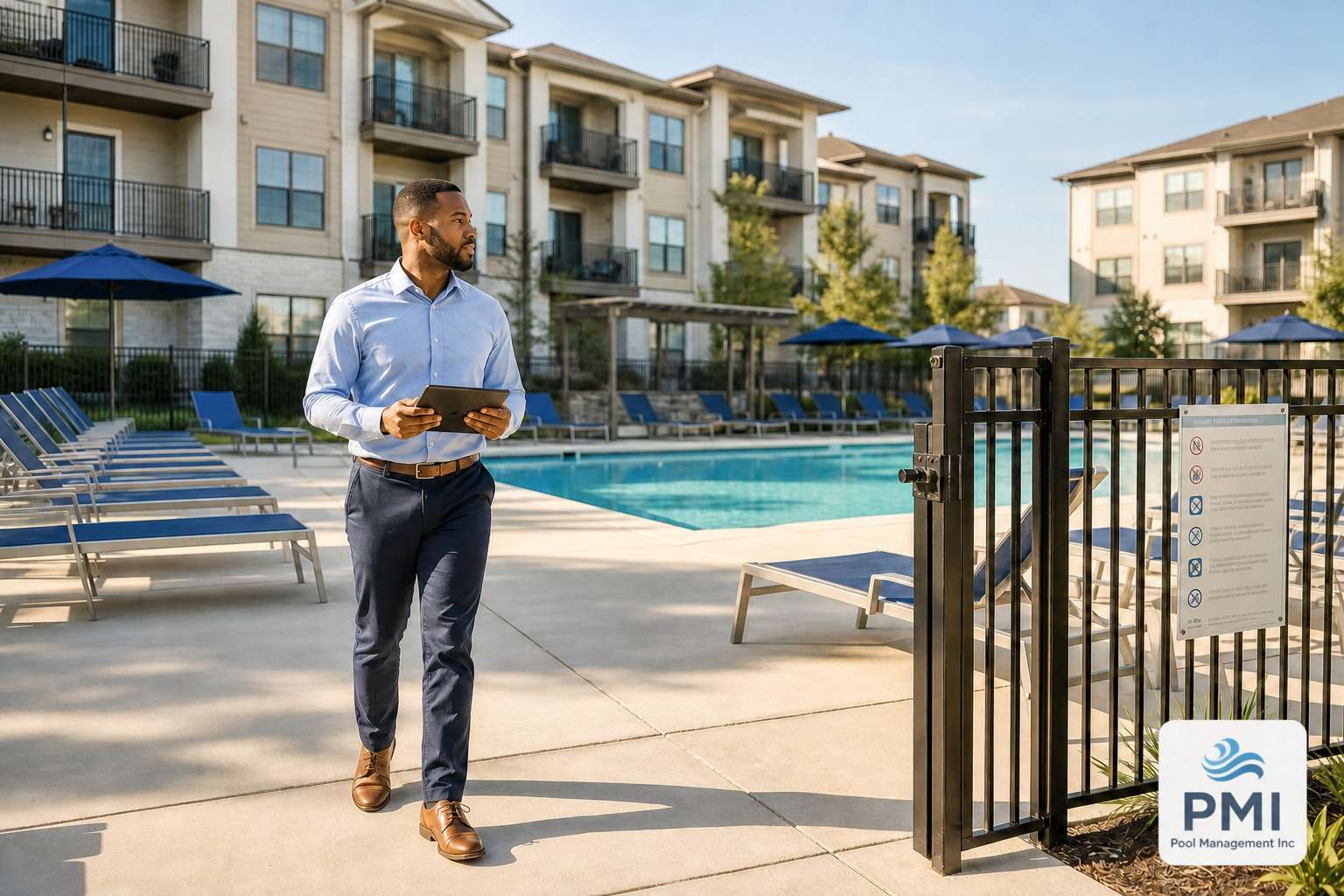
An apartment pool can make a rental community feel more attractive, more active, and more valuable. Clean water, organized furniture, smooth access, and clear rules all tell residents and prospects that the property is well managed.
But when the pool is cloudy, overcrowded, closed without notice, or poorly maintained, it quickly becomes more than a maintenance issue. It can affect resident satisfaction, leasing impressions, online reviews, staff workload, and the overall reputation of the property.
This apartment pool management playbook gives property managers a practical way to keep rental community pools cleaner, safer, and easier to operate. For communities that need outside help, commercial pool management services can support pool cleaning, maintenance, lifeguard staffing, chemical management, facility upgrades and repairs, consultation, compliance, and safety-focused pool operations.
Quick Answer
Apartment pool management works best when property managers control pool access, document pool service, budget for pool costs, communicate quickly, and review pool vendors regularly.
For rental communities, the goal is simple: keep the pool clean, safe, resident-ready, and operational without creating constant office complaints.
Why Apartment Pools Need Structure
Apartment pools operate under daily visibility. Residents may use them often, prospects may see them on tours, and onsite teams may hear complaints as soon as something goes wrong.
That makes the pool different from many behind-the-scenes maintenance items. A pool issue can become a leasing issue, resident experience issue, safety concern, or reputation problem at the same time.
Property Manager Reality: A pool closure is not just about the pool. It can affect resident trust, leasing confidence, office workload, and maintenance priorities.
The best apartment pool management systems focus on uptime, accountability, communication, and fast escalation. When those pieces are clear, the pool becomes easier to manage across the season.
1. Create a Pool Operations Plan
Every apartment community with a pool should have a simple pool operations plan. This plan should explain how the pool is opened, checked, serviced, closed, and escalated when problems appear.
The plan does not need to be complicated. It just needs to be clear enough for leasing staff, maintenance teams, managers, and pool vendors to follow the same process.
| Pool operations area | What to define |
| Daily pool check | Who checks gates, signs, furniture, and visible issues |
| Pool vendor visits | Service days, reporting method, and main contact |
| Resident pool access | Fobs, cards, gate codes, wristbands, or app access |
| Pool closures | Who can close the pool and how residents are notified |
| Pool repairs | Approval limits and emergency process |
| Pool incidents | Documentation and escalation steps |
Playbook Tip: If your onsite team cannot explain the pool process quickly, residents probably cannot understand it either.
For larger communities or portfolios, full-service pool operations can include staffing, maintenance, project management, construction services, chemicals and supplies, consulting, safety audits, programming, and total pool facility management.
2. Build a Pool Calendar
A pool calendar helps property managers stay ahead of the season instead of reacting to problems. It should include contract reviews, pre-season walkthroughs, access updates, staffing decisions, resident notices, vendor schedules, and closing dates.
This is especially helpful for regional managers overseeing multiple rental community pools. A shared calendar makes it easier to compare readiness across properties.
| Timeline | Property manager action |
| 5 to 6 months before opening | Review pool contracts, renewal dates, and last season’s issues |
| 3 to 4 months before opening | Walk the pool area and list repair needs |
| 2 to 3 months before opening | Confirm pool service scope, staffing, and chemical plan |
| 1 month before opening | Finalize pool rules, signage, access, and resident notices |
| During pool season | Track closures, complaints, service logs, and repairs |
| After pool season | Review pool performance, costs, and vendor results |
A calendar keeps important pool tasks from being left to memory. It also gives ownership and regional teams a clearer view of how the amenity is being managed.
3. Control Pool Access
Resident pool access is one of the biggest operational issues in apartment communities. Weak access control can lead to overcrowding, guest disputes, after-hours use, noise complaints, and unauthorized entry.
Property managers should review access before opening day and after major resident turnover. This includes move-ins, move-outs, roommate changes, lease transfers, expired credentials, and shared gate codes.
| Pool access area | What to check |
| Move-ins | How residents receive pool access |
| Move-outs | How pool access is removed |
| Guest policy | Guest limits and resident responsibility |
| Gate codes | Whether codes are shared or outdated |
| Fobs or cards | Active and inactive credentials |
| After-hours use | Locking method and enforcement process |
Pool Access Tip: If the same gate code has been used for multiple seasons, assume it has been shared.
Good pool access control protects the resident experience. It also reduces pressure on leasing and maintenance teams when complaints start to build.
4. Set Pool Vendor Standards
Property management pool vendors should be measured by more than whether the water looks acceptable. The property team needs clear service standards, written reports, and a defined escalation process.
A simple pool service standard helps avoid confusion. It also makes vendor performance easier to review before renewal season.
| Pool vendor standard | What to define |
| Pool service frequency | Service days, timing, and seasonal changes |
| Pool water care | Testing, balancing, and chemical notes |
| Pool cleaning | Pool surface, skimmers, baskets, deck, and debris |
| Pool equipment checks | Pumps, filters, timers, chemical feeders, and visible issues |
| Pool repair process | Estimate steps, approval limits, and response expectations |
| Pool reporting | Logs, photos, readings, issue notes, and follow-up |
Vendor Check: Ask for a sample pool service report before signing. If it would not help your team answer resident questions, it is not detailed enough.
5. Keep Pool Maintenance Visible
Apartment teams are busy with work orders, turns, leasing support, inspections, and resident requests. Pool maintenance should not disappear into the background until a closure happens.
The onsite team should have easy access to pool service records. These records can live in a shared folder, vendor portal, maintenance platform, or email log.
| Pool maintenance record | Why it helps |
| Pool service logs | Confirms visits and completed work |
| Pool water readings | Helps identify recurring chemistry issues |
| Pool repair notes | Tracks unresolved problems |
| Pool photos | Shows visible issues and completed corrections |
| Pool closure records | Explains resident impact |
| Pool vendor recommendations | Supports budget planning |
A visible pool record gives property managers facts. That matters when residents complain, ownership asks questions, or the vendor says service was completed.
6. Inspect Before Opening
A pre-season inspection helps property managers identify problems before residents return to the pool. It is easier to fix gates, lighting, signs, equipment, or deck problems before the first busy weekend.
A good inspection should cover both the pool area and the equipment side. The goal is to reduce preventable closures and avoid last-minute repair surprises.
| Pool inspection area | What to review |
| Pool safety equipment | Rescue equipment, first aid supplies, and emergency items |
| Pool rule signage | Pool rules, water safety signs, and emergency information |
| Pool gates | Self-closing gates, locks, access points, and fencing |
| Pool filtration | Filters, gauges, piping, flow meter, and ventilation |
| Pool chemical equipment | Feeders, controllers, chlorinators, and chemical connections |
| Pool deck | Depth markers, drains, handrails, ladders, furniture, and surface condition |
A pool facility inspection checklist can help property teams review safety equipment, test kits, first aid supplies, rescue equipment, pool rule signs, water safety signs, self-closing gates, filtration equipment, pump equipment, chemical feed equipment, pool lights, deck condition, and ADA lift chairs.
7. Budget for Pool Uptime
Apartment pool budgeting should focus on uptime, not just the lowest service cost. A pool that saves money on paper but closes repeatedly can create more resident frustration than the savings are worth.
Property managers should separate predictable pool costs from variable costs. This makes it easier to explain the budget to ownership and regional teams.
| Pool budget bucket | What it covers |
| Routine pool service | Cleaning, testing, scheduled maintenance |
| Pool chemicals | Sanitizer and balancing materials |
| Pool repairs | Pumps, filters, gates, lights, leaks, fixtures |
| Pool access control | Fobs, locks, codes, cards, wristbands |
| Pool staffing | Lifeguards, attendants, supervisors |
| Pool emergency work | After-hours calls and urgent closures |
| Pool capital planning | Resurfacing, furniture, major equipment |
Budget Tip: A lower monthly pool vendor fee is not always better. Compare total seasonal cost, including chemicals, emergency visits, repairs, staffing, and reporting.
8. Decide on Pool Staffing
Not every apartment pool needs lifeguards. Some properties use pool attendants for access support, while others operate without staff where allowed.
The key is to define the role clearly before the season starts. A pool lifeguard, pool attendant, pool maintenance technician, and leasing team member should not be treated as interchangeable.
| Pool role | Main purpose |
| Pool lifeguard | Supervision and emergency response while on duty |
| Pool attendant | Access support and rule reminders |
| Pool maintenance technician | Cleaning, water care, and equipment checks |
| Leasing staff | Resident communication and amenity questions |
A pool lifeguard staffing plan can be useful when a property needs trained staff for pool rules, incident reports, hazard identification, communication, rescue practices, first aid, and CPR expectations.
9. Prepare Pool Messages
Resident communication should be ready before the season starts. This keeps the onsite team from writing rushed updates during closures, chemical treatments, access issues, or rule reminders.
Messages should be short, direct, and easy to send through resident portals, email, text alerts, or app notifications. Residents want to know what happened, how it affects pool access, and when they will receive the next update.
| Pool situation | Message example |
| Pool opening | “The pool opens May 25. Hours are 9 AM to 8 PM.” |
| Pool closure | “The pool is closed today for equipment service. Next update by 4 PM.” |
| Pool treatment | “The pool is temporarily closed for water treatment.” |
| Pool access update | “Pool access credentials are being updated this week.” |
| Pool rule reminder | “Reminder: each apartment may bring two guests.” |
| Pool season closing | “The pool closes September 8. Off-season maintenance begins next week.” |
Resident Experience Note: Silence creates more frustration than most pool closures. A short update is usually better than waiting for a perfect answer.
10. Track Pool Issues
Pool issues should be tracked like operational work orders. This helps property managers identify patterns instead of treating each complaint as a separate emergency.
Use categories such as pool water quality, pool access, pool noise, guest behavior, pool staffing, pool repairs, pool closures, or pool communication. Over time, the patterns show where the system needs improvement.
| Pool issue tag | What it may reveal |
| Pool water quality | Service frequency, chemistry, or equipment issue |
| Pool access | Fobs, codes, locks, or guest policy issue |
| Pool noise | After-hours use or weak rules |
| Pool guests | Unclear guest limits |
| Pool closures | Equipment or communication issue |
| Pool staffing | Schedule or role confusion |
| Pool repairs | Aging equipment or delayed approvals |
This approach is especially helpful across apartment portfolios. Regional managers can compare pool performance property by property and identify whether problems are site-specific or vendor-wide.
Real-World Apartment Pool Scenarios
Scenario 1: The Pool Hurts the Leasing Tour
A leasing agent walks a prospect past the pool, but the water is cloudy and the deck furniture is scattered. The prospect may not complain, but the amenity no longer supports the tour.
The better move is a morning pool check before tours begin. Leasing-visible amenities should be resident-ready and prospect-ready.
Scenario 2: The Weekend Pool Closure
The pool closes on Saturday because of an equipment issue. Residents receive no update until Monday, and the office opens to a full inbox.
The better move is a weekend pool closure template and escalation process. Residents need a quick update even when the final repair timeline is not ready.
Scenario 3: The Pool Gate Code Spreads
The property uses one gate code for the pool. By mid-season, former residents, guests, and nearby friends all seem to know it.
The better move is a stronger pool access system. Fobs, cards, wristbands, or scheduled code changes can reduce unauthorized use.
Scenario 4: The Pool Vendor Blind Spot
The vendor says pool service was completed, but residents keep complaining about debris and water clarity. The property has no photos, readings, or logs.
The better move is written pool reporting. Property managers need records they can review before calling the issue resolved.
Apartment Pool Checklist
Use this checklist before and during pool season.
- Review pool contract and renewal dates.
- Assign one onsite pool contact.
- Confirm pool opening and closing dates.
- Audit pool fobs, cards, gate codes, and resident access.
- Review pool guest policy and pool rules.
- Walk the pool before leasing tours begin.
- Confirm pool service schedule and reporting format.
- Review pool chemical billing and repair approvals.
- Prepare pool closure and rule reminder templates.
- Decide whether pool attendants or lifeguards are needed.
- Confirm pool emergency contacts and escalation steps.
- Track pool complaints by issue type.
- Review pool performance after the season.
A good pool checklist protects the onsite team from relying on memory. It also gives regional managers a cleaner way to compare properties.
Common Mistakes
Treating the Pool Like a Side Task
The pool may be seasonal, but residents see it as part of the rent experience. If it is poorly managed, it can affect satisfaction quickly.
Give the pool a real operating process before the season starts.
Using Weak Pool Access Controls
Shared codes and outdated access lists can create overcrowding and after-hours use. This can lead to complaints, noise issues, and staff frustration.
Review pool access before opening and after major resident turnover.
Skipping Pool Communication Templates
Pool closures are frustrating, but silence makes them worse. Residents should not have to guess why the pool is closed.
Prepare short pool message templates before the season begins.
Comparing Pool Vendors by Price Only
A lower base fee may exclude chemicals, emergency visits, documentation, staffing, or opening work. That can make the true cost higher.
Compare total pool value, not just monthly price.
Final Recommendation
Apartment pool management should be built around operational efficiency. Property managers need clear pool access rules, reliable pool vendor reporting, resident pool communication templates, realistic pool budgets, and a simple escalation process.
The best rental community pools feel easy to residents because the behind-the-scenes process is organized. When the pool is managed like a core property amenity, it can support leasing, renewals, resident satisfaction, and property performance.
If your apartment community or portfolio is reviewing pool operations, staffing, maintenance, or seasonal planning, you can request a pool management bid with your facility details and goals.
Frequently Asked Question?
What is apartment pool management?
Apartment pool management is the process of operating, maintaining, staffing, budgeting, and communicating around a pool in a rental community.
It includes pool cleaning, water care, resident access, vendor oversight, repairs, closures, safety procedures, and resident updates.
How are multifamily pool services different from basic pool maintenance?
Multifamily pool services usually include more than cleaning and water testing.
They may involve pool access control, resident communication, vendor reporting, staffing, repair planning, budget support, and coordination with onsite property teams.
What should property managers ask pool vendors?
Property managers should ask what pool services are included, how often the pool is serviced, how chemicals are billed, how repairs are approved, and how pool reports are delivered.
They should also ask who handles pool emergencies and how quickly the vendor responds.
How can apartment communities control pool access?
Apartment communities can control pool access through fobs, key cards, gate codes, wristbands, resident apps, sign-in procedures, or staffed pool entry.
The access process should be updated after move-outs, roommate changes, and major turnover periods.
Should apartment pools have lifeguards?
Some apartment pools use lifeguards, while others do not. The decision depends on local rules, pool usage, property risk tolerance, resident expectations, insurance guidance, and budget.
If lifeguards are used, pool schedules, duties, breaks, incident reporting, and communication expectations should be written clearly.
How can apartment managers reduce pool complaints?
Apartment managers can reduce pool complaints by communicating quickly, controlling pool access, tracking recurring issues, requiring vendor reports, and fixing small problems early.
Residents are usually more patient when they understand what happened and when the next update will come.